How Much Would It Cost to Build a Baseball Field? 2026 Regional Guide
Discover how much it costs to build a baseball field in 2026. We break down regional pricing, material costs, and hidden site prep expenses.
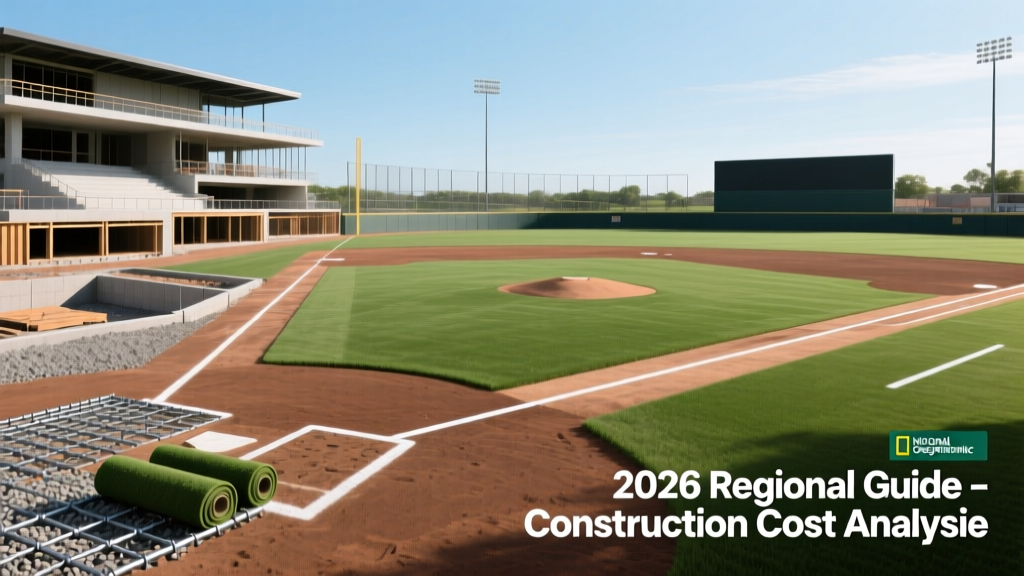
The Baseline: National Average Costs by Field Classification
When stakeholders ask how much would it cost to build a baseball field, the answer hinges entirely on the level of play, dimensions, and subsurface engineering. A basic youth field requires vastly different earthmoving and material specifications than a collegiate diamond. In 2026, inflation in specialized sports aggregates and skilled grading labor has shifted the baseline costs upward, making precise early-stage estimating critical for municipal parks departments and private sports complexes.
| Field Classification | Typical Dimensions (Foul Pole to CF) | Estimated Base Cost (2026) | Cost Per Square Foot (Avg) |
|---|---|---|---|
| Youth / Little League | 200 ft - 225 ft | $180,000 - $320,000 | $2.50 - $4.00 |
| High School / Legion | 300 ft - 330 ft | $550,000 - $950,000 | $4.50 - $7.50 |
| Collegiate / Pro-Am | 330 ft - 400 ft | $1.4M - $3.2M+ | $9.00 - $15.00+ |
These baseline figures assume a greenfield site with moderate soil stability. They encompass rough grading, subsurface drainage, infield soil installation, natural grass sodding, and standard chain-link fencing. They do not include grandstands, permanent dugouts, or high-mast LED lighting, which can easily add $250,000 to $600,000 to the final ledger.
Regional Price Variance Matrix: Where Your Dollar Goes Furthest
Construction costs are not uniform across the United States. Regional variations in labor rates, material availability, and environmental mandates drastically alter the final price tag. According to data trends tracked by the American Sports Builders Association (ASBA), regional multipliers must be applied to baseline estimates to achieve accurate budget forecasting.
The Frost-Line Factor (Northeast & Upper Midwest)
Cost Multiplier: +15% to +25%
In regions with deep frost lines (48 to 60 inches), the earthwork required for light pole footings, dugout foundations, and backstop anchors is significantly more expensive. Excavating below the frost line to pour concrete piers prevents frost heave, which can tilt a 60-foot light pole by several degrees over a single winter. Furthermore, subsurface drainage trenches must be dug deeper to prevent freezing and pipe rupture, adding $20,000 to $35,000 in heavy equipment and concrete costs alone compared to southern builds.
Soil Amendment and Irrigation (The South)
Cost Multiplier: -5% to +10%
While labor rates in the South are generally lower, the native soil profile often presents hidden costs. Heavy red clay soils prevalent in states like Georgia and Alabama possess terrible percolation rates. To support a high-traffic baseball outfield, contractors must either excavate and remove the native clay or aggressively amend it with thousands of tons of coarse sand. Additionally, the reliance on warm-season grasses like Tifway 419 Bermuda requires robust, multi-zone smart irrigation systems to survive the intense summer heat, pushing water infrastructure costs higher than in temperate zones.
Water Scarcity and Synthetic Mandates (The West)
Cost Multiplier: +20% to +40%
In California, Nevada, and Arizona, municipal water restrictions are increasingly dictating sports field design. Many new municipal builds are abandoning natural grass entirely in favor of synthetic turf systems (such as AstroTurf Diamond Series or FieldTurf) to comply with drought ordinances. While a synthetic infield/outfield combination eliminates irrigation and mowing costs, the upfront capital expenditure for the shock pad, crumb rubber or organic infill, and specialized seaming labor adds $8 to $13 per square foot to the initial build.
Material Specifications: What You Are Actually Paying For
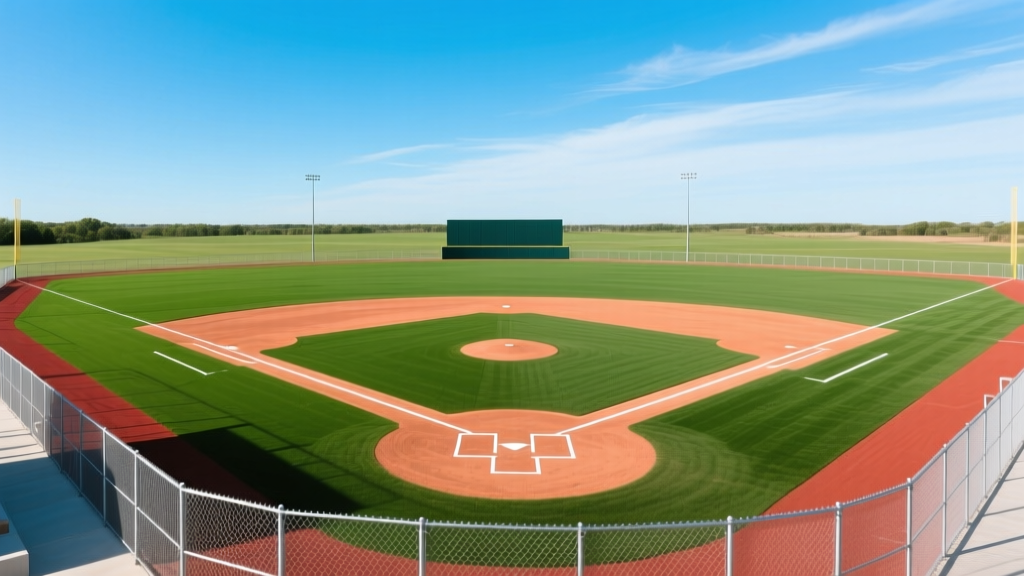
To understand where the budget goes, you must look at the specialized materials required for a regulation diamond. General landscaping materials will fail under the sheer shear-force of metal cleats and the impact of 90-mph ground balls. The Sports Field Management Association (SFMA) emphasizes that skimping on infield mix is the most common cause of premature field failure.
- Infield Mix (The Dirt): A high school infield requires a precise blend of 60% sand, 25% silt, and 15% clay. Premium engineered soils like DuraEdge ProSlide or Beam Clay cost between $75 and $95 per ton delivered. A standard high school infield requires roughly 120 to 150 tons of this mix, totaling $10,000 to $14,000 just for the top 3 inches of the skin.
- Infield Top-Dressing: To prevent the clay from sticking to cleats and to manage moisture, the infield must be top-dressed with calcined clay (e.g., Turface Pro League). This adds $3,500 to $5,000 to the material budget.
- Outfield Turfgrass: For natural grass, big-roll Kentucky Bluegrass or Bermuda sod is preferred over seed to ensure immediate playability and erosion control. Big-roll sod installation, including laser-grading the root zone, runs $1.50 to $2.75 per square foot. According to NC State University TurfFiles, establishing a proper sand-based root zone beneath the sod is critical for preventing soil compaction in high-traffic outfield areas.
- Fencing and Windbreaks: Heavy-duty 10-gauge chain link fencing with a 2-inch mesh costs $30 to $45 per linear foot installed. Adding vinyl windbreaks, which are essential for player visibility and wind mitigation, adds $5 to $8 per linear foot.
Hidden Site Preparation Costs That Derail Budgets
The most frequent point of budget failure in baseball field construction occurs before a single blade of grass is laid. Subsurface drainage and laser-grading are invisible once the project is complete, but they dictate the field's lifespan.
"A baseball field is essentially a massive, highly engineered sponge. If the sub-grade is not laser-graded to a 0.5% to 1.0% slope, and if the herringbone drainage grid is compromised by heavy equipment during sodding, the field will hold water and become unplayable for days after a moderate rain event."
Expect to allocate 15% to 20% of your total budget strictly to site preparation. This includes geotechnical soil testing ($3,000 - $5,000), rough cut-and-fill earthmoving, and the installation of a 4-inch perforated PVC drainage network wrapped in non-woven geotextile fabric. The drainage aggregate must be washed pea gravel; using unwashed gravel will introduce fines that clog the PVC pipes within three years.
Actionable Framework: Estimating Your Local Build
To move from a rough conceptual idea to a hard number for your specific municipality or private facility, follow this four-step estimation framework:
- Define the Envelope and Level of Play: Lock in your fence distances. A 315-foot foul pole and 390-foot centerfield dictates the total square footage of your outfield and the length of your fencing. Calculate the total acreage required (a regulation HS field needs roughly 3 to 4 acres including foul territory and runoff).
- Commission a Geotech Report Early: Before finalizing your budget, spend the $4,000 on a soil boring report. If your site sits on expansive clay or peat, your earthwork and soil amendment costs will double. Knowing this upfront prevents catastrophic change orders mid-build.
- Apply the Regional Multiplier: Take your national baseline cost per square foot and apply the regional variance. If you are building in the Northeast, add 20% to your earthwork and concrete line items to account for deep frost-line excavation.
- Separate the 'Play' from the 'Stay': Segment your bids. The 'Play' (grading, drainage, dirt, turf, fence) is mandatory. The 'Stay' (dugouts, bleachers, LED lighting, concession stands) can be phased. In 2026, with supply chain lead times on structural steel and LED arrays stretching up to 24 weeks, phasing the amenities allows you to open the field for play while the grandstands are completed in the off-season.
Building a baseball field is a complex exercise in agronomy, civil engineering, and heavy construction. By understanding the regional forces that drive material and labor costs, project managers can build resilient budgets that deliver safe, high-performance diamonds capable of withstanding decades of play.
Written by
Priya KapoorPriya Kapoor is a real estate market analyst and construction economics researcher with expertise in housing affordability, development feasibility, and infrastructure investment. She holds a Master of Regional Planning from Cornell University and previously worked as a senior analyst at CBRE's Investment Properties group, where she modeled returns for $4B in mixed-use development pipelines. Priya now runs an independent research practice advising developers, municipalities, and REITs on construction cost forecasting and market timing. She publishes the quarterly "BuildMat Market Pulse" report tracking material price indices across 12 commodity categories. Based in Austin, TX, Priya serves on the board of Habitat for Humanity Austin and is a marathon runner.
More from Priya Kapoor
View all
Construction Cost
Cost to Build a 1600 Sq Ft Home in 2026: Full Breakdown
Accurate 2026 cost to build a 1600 sq ft home—material, labor, and regional pricing breakdowns included. Plan your budget with real-time estimates.
Aug 11, 2026

Wood & Lumber
Name the Types of Wood for Pressure Treatment and Preservation
Learn how to name the types of wood best suited for pressure treatment. Compare species treatability, chemical retention levels, and 2026 preservation costs.
Aug 4, 2026

Stone & Masonry
Stone Veneer Suppliers Lindenhurst: 2026 Cost Analysis
Analyze 2026 stone veneer costs in Lindenhurst, NY. Compare local supplier pricing, delivery fees, and Suffolk County installation labor rates.
Aug 4, 2026