How Much Does It Cost to Build a Park? Size & Feature Guide
Compare the cost to build a park by acreage and type. Detailed 2026 pricing for playground surfacing, hardscaping, and site prep.

The True Cost to Build a Park: Beyond Grass and Benches
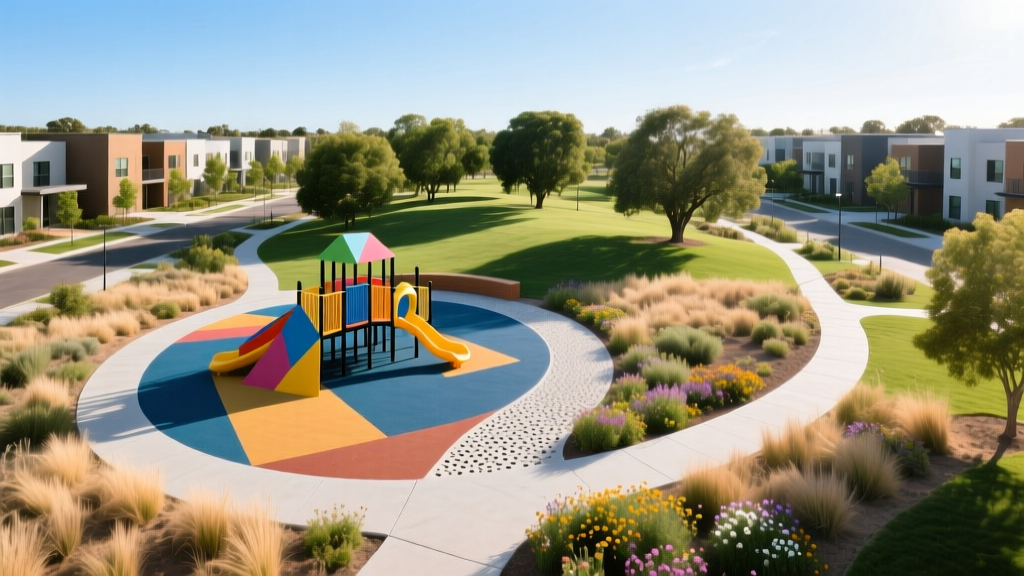
When municipal planners, private developers, or HOA boards ask how much does it cost to build a park, the answer depends entirely on the scale, topography, and programmed features of the site. A basic 5-acre neighborhood green space with a single playground and walking loop operates on a completely different financial tier than a 50-acre community hub featuring sports complexes, stormwater bioswales, and amphitheaters. In 2026, material volatility and stringent environmental compliance standards have shifted baseline budgets upward. On average, park development costs range from $50,000 for a micro-pocket park to over $15 million for large-scale regional facilities. Understanding where your capital is actually going requires breaking down the project into hard costs (materials, labor, equipment) and soft costs (design, engineering, permitting).
- Pocket Park (0.5 - 2 acres): $50,000 – $180,000
- Neighborhood Park (5 - 15 acres): $300,000 – $1.2 Million
- Community Park (20 - 50 acres): $2 Million – $7.5 Million
- Regional Park (100+ acres): $12 Million – $35 Million+
Cost Comparison Matrix: Park Scale and Feature Density
The per-acre cost of park development is rarely linear. Smaller parks often have a higher cost-per-acre ratio because fixed soft costs (like environmental impact studies and landscape architecture fees) are amortized over fewer acres. Conversely, large regional parks benefit from economies of scale in earthmoving but incur massive infrastructure costs for utility routing and parking structures.
| Park Type | Typical Acreage | Avg. Cost Per Acre | Total Estimated Range | Primary Cost Drivers |
|---|---|---|---|---|
| Pocket / Mini | 0.5 - 2 | $90,000 - $150,000 | $50K - $180K | Hardscaping, modular play structures, site fencing |
| Neighborhood | 5 - 15 | $60,000 - $90,000 | $300K - $1.2M | Pathways, basic irrigation, small parking lot, lighting |
| Community | 20 - 50 | $80,000 - $150,000 | $2M - $7.5M | Sports courts, restrooms, complex grading, stormwater mgmt |
| Regional | 100+ | $100,000 - $250,000 | $12M - $35M+ | Major utility extensions, paved roads, large-scale earthwork |
Hardscaping and Playground Surfacing: Material Deep Dive
Surface materials dictate a massive portion of the hard budget, particularly in high-traffic zones. Selecting the wrong material for the local climate or maintenance capacity is the most common reason parks fall into disrepair within five years of opening. According to the American Society of Landscape Architects, sustainable material selection must balance initial capital expenditure with lifecycle maintenance costs.
Playground Safety Surfacing
Playground surfacing must meet ASTM F1292 standards for impact attenuation. The choice here drastically alters the budget:
- Poured-in-Place (PIP) Rubber: Costs between $14 and $19 per square foot. It offers superior ADA accessibility and a 10-to-15-year lifespan but requires a highly compacted aggregate base and professional installation.
- Engineered Wood Fiber (EWF): The budget option at $2.00 to $3.50 per square foot. While cheap upfront, EWF requires annual top-offs and frequent raking to maintain ADA compliance and impact ratings, driving up long-term O&M budgets.
- Synthetic Turf with Pad: Ranges from $11 to $16 per square foot. Excellent for multi-use play areas, though it retains heat in southern climates and requires periodic infill redistribution.
Pathways and Trails
For pedestrian circulation, standard asphalt costs $5 to $8 per square foot but is prone to root heaving if tree protection zones aren't respected. Pervious concrete, which aligns with modern stormwater management goals outlined by the Environmental Protection Agency, costs $9 to $14 per square foot. It requires a deep, clean-washed aggregate base (often 12 to 18 inches) to function as a water retention bed, adding to excavation costs.
Site Preparation: The Hidden Budget Killer
Before a single bench is bolted down, the site must be prepped. Earthwork and site preparation typically consume 20% to 35% of the total hard costs. If the land was previously used for agriculture or light industry, soil remediation will inflate this number exponentially.
If geotechnical borings reveal expansive clay soils (common in the American South and Midwest), standard compaction will fail. You must budget for soil stabilization using lime or Portland cement mixing, or install deep geogrid reinforcement beneath all hardscapes. Failing to address this during the estimating phase routinely results in change orders that blow past the contingency budget.
Grading and drainage are non-negotiable. Modern parks are increasingly designed as green infrastructure. Incorporating bioswales and rain gardens costs roughly $35 to $65 per linear foot, but this offsets the need for expensive underground concrete storm drain networks. Data from the Trust for Public Land highlights that municipalities are increasingly mandating on-site water retention, making surface-level green infrastructure a mandatory line item rather than an aesthetic upgrade.
Soft Costs: Design, Engineering, and Permitting
Soft costs are frequently underestimated by first-time developers. Expect to allocate 15% to 25% of your total hard construction costs to soft expenses. This includes:
- Landscape Architecture & Civil Engineering: 8% to 12% of construction costs. This covers master planning, grading plans, and construction documents.
- Geotechnical and Environmental Surveys: $8,000 to $25,000 for soil borings, Phase I Environmental Site Assessments (ESA), and arborist reports.
- Permitting and Impact Fees: Highly variable by jurisdiction. Some municipalities waive impact fees for public parks, while private HOA parks may be subject to standard commercial utility tap fees, which can exceed $40,000 for water and sewer connections.
Decision Framework: Maximizing Budget on a Tight Timeline
When capital is constrained but community demand is high, utilize a phased construction strategy. This framework allows you to open the park faster while deferring high-cost amenities to future fiscal years.
Phase 1: Core Infrastructure (Months 1-6)
Focus the initial budget on permanent, difficult-to-retrofit elements. Complete all major grading, install underground utilities, irrigation mainlines, and pour the primary concrete pathways. Establish the tree canopy by planting large-caliber shade trees early, as they take decades to mature. Install basic EWF playground surfacing and a modular play structure.
Phase 2: Programming and Hardscaping (Months 12-18)
Once the site has settled and initial funding is replenished or grant money is secured, add the high-cost amenities. Upgrade the EWF to PIP rubber, construct the sports courts (which require precise laser-grading that is easily ruined by early construction traffic), and build permanent masonry restroom facilities.
Phase 3: Aesthetic and Secondary Amenities (Months 24+)
Defer secondary features like amphitheaters, decorative water features, and high-end site furnishings (smart benches with solar charging) until the park's usage patterns are established. This prevents spending capital on amenities that the specific neighborhood demographic may not actually utilize.
Written by
James ThorntonJames Thornton is a construction industry veteran with 25 years of hands-on experience in wood framing, lumber grading, and residential building codes. He started as a framing carpenter in rural Oregon, earned his ICC Residential Building Inspector certification, and eventually became a senior plan reviewer for the City of Portland Bureau of Development Services. James holds a B.S. in Wood Science & Technology from Oregon State University and is a certified lumber grader through the West Coast Lumber Inspection Bureau (WCLIB). He has inspected over 3,000 residential construction sites and authored the city's internal guide on advanced framing techniques (2x6 at 24" O.C.). James lives in Bend, OR, where he builds custom timber-frame cabins and competes in lumberjack sports.
More from James Thornton
View all
Insulation
Best Home Insulation Materials: Complete 2026 Guide
Compare top home insulation materials for 2026. Find R-values, installed costs per square foot, and best uses for fiberglass, spray foam, and mineral wool.
Aug 4, 2026

Sustainable Building
Certify Your Green Building Material for LEED and WELL
Step-by-step guide to certifying a green building material for LEED v5 and WELL v2. Master EPDs, HPDs, and VOC limits for 2026 project specifications.
Aug 4, 2026

Stone & Masonry
Veneer Stacked Stone Panels: Interior Design & Style Showcase
Discover how veneer stacked stone panels transform interiors. Explore modern design profiles, material pairings, and technical installation specs.
Aug 4, 2026