Cost to Build a Solar Farm in 2026: Complete MW Pricing Guide
Discover the true cost to build a solar farm in 2026. Detailed per-megawatt pricing, land needs, hardware costs, and ROI timelines for utility-scale projects.
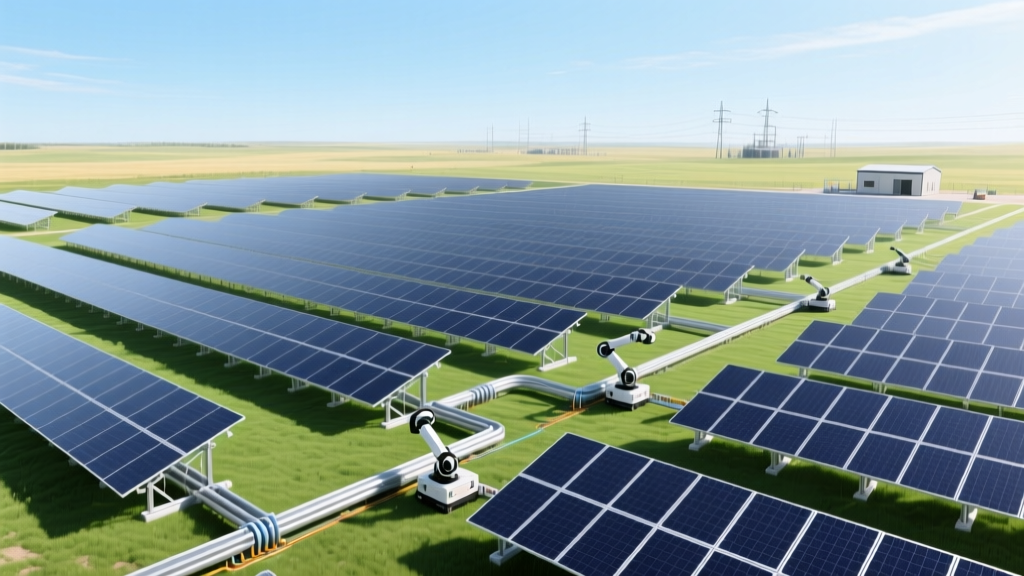
2026 Utility-Scale Solar Baseline Metrics
- Average CapEx: $1.15 to $1.45 per Watt DC ($1.15M - $1.45M per MW)
- Land Requirement: 4.5 to 5.5 usable acres per MW DC
- Annual OpEx: $16,000 to $22,000 per MW/year
- Typical Interconnection Queue Wait: 36 to 60 months
Capital Expenditure (CapEx) Breakdown per Megawatt
The cost to build a solar farm at the utility scale (typically defined as 5 MW to 200+ MW) is primarily measured in dollars per Watt DC. According to the NREL Annual Technology Baseline, baseline capital costs have stabilized following early-2020s supply chain shocks, though domestic manufacturing premiums and prevailing wage requirements under the Inflation Reduction Act (IRA) have shifted the cost structure. For a standard 50 MW project utilizing single-axis trackers and bifacial modules, expect total CapEx to range between $1.15 and $1.45 per Watt DC.
| Component Category | Cost per Watt DC | % of Total CapEx | Key 2026 Market Notes |
|---|---|---|---|
| PV Modules (Bifacial TOPCon) | $0.28 - $0.36 | 28% | Domestic content commands a $0.04-$0.07/W premium but unlocks 10% IRA adder. |
| Inverters (Central or String) | $0.05 - $0.08 | 6% | 1500V central inverters (e.g., SMA, Sungrow) remain standard for >20 MW sites. |
| Racking & Tracking Systems | $0.14 - $0.19 | 14% | Single-axis trackers (e.g., Nextracker NX Horizon) dominate utility-scale builds. |
| Balance of System (BOS) | $0.22 - $0.30 | 22% | Includes cabling, combiner boxes, transformers, and switchgear. |
| Installation Labor & Civil | $0.25 - $0.35 | 24% | Prevailing wage requirements increase labor costs by 12-18% in many regions. |
| Soft Costs & Permitting | $0.10 - $0.17 | 6% | Legal, engineering, interconnection studies, and land lease upfronts. |
Fixed-Tilt vs. Single-Axis Tracking Systems
Choosing between fixed-tilt racking and single-axis trackers is the most consequential hardware decision impacting both the initial cost to build a solar farm and its long-term Levelized Cost of Energy (LCOE). Lazard's LCOE+ analysis consistently demonstrates that the yield generation of trackers outweighs their mechanical maintenance costs in most US latitudes.
Fixed-Tilt Racking
- CapEx Delta: Baseline (Saves ~$0.12/W vs trackers)
- Capacity Factor: 18% - 22%
- Maintenance: Near zero moving parts
- Land Use: Requires wider row spacing to prevent winter solstice shading
- Best For: High-wind zones, brownfields with strict penetration limits, or extreme northern latitudes where tracker ROI diminishes.
Single-Axis Trackers
- CapEx Delta: Adds $0.12 - $0.16/W to hardware/labor
- Capacity Factor: 24% - 29%
- Maintenance: Requires motor, gearbox, and sensor upkeep
- Land Use: Denser packing; terrain-following algorithms allow deployment on 3-5 degree slopes
- Best For: Standard utility-scale greenfield sites where maximizing AC output per acre is critical for PPA viability.
Land Acquisition, Leasing, and Civil Engineering
A standard rule of thumb for utility-scale solar is that 1 MW DC requires approximately 4.5 to 5.5 acres of contiguous, usable land. However, the raw acreage is only a fraction of the site preparation budget. Civil engineering and site prep typically consume $0.08 to $0.14 per Watt.
Critical Site Prep Cost Drivers
- Geotechnical Testing: Ramming tests and soil resistivity testing cost $15,000 to $30,000 per site but dictate whether you use standard driven H-piles or require helical piers (which can triple racking foundation costs in rocky or liquefiable soils).
- Grading and Earthwork: While modern trackers tolerate slopes up to 5 degrees, excessive cut-and-fill grading to flatten a site can add $20,000+ per acre. Minimizing earthwork by adapting the array layout to natural topography is a primary cost-saving strategy.
- Access Roads and Fencing: Building all-weather access roads for construction and O&M vehicles, alongside 7-foot agricultural fencing with wildlife barriers, typically runs $45,000 to $70,000 per MW.
Grid Interconnection: The Hidden Budget Killer
The most volatile variable in the cost to build a solar farm is grid interconnection. According to SEIA Market Insight reports, interconnection queue backlogs and sudden network upgrade assessments have derailed countless projects. You must budget for both the soft costs of the queue process and the hard costs of grid upgrades.
Interconnection Queue Realities
Do not sign a land lease without a preliminary fatal flaw interconnection analysis. In congested ISO regions like PJM or CAISO, network upgrade costs assigned to your project can suddenly exceed $100,000 per MW, instantly destroying project economics. Budget $75,000 to $150,000 just for the engineering studies required to move through the queue before a single panel is ordered.
Hard interconnection costs include the construction of the substation, high-voltage switchgear, and the transmission tap. A 50 MVA substation transformer alone can cost between $800,000 and $1.2 million, with lead times stretching 60 to 90 weeks. Always secure transformer reservations early in the development phase.
Operational Expenditure (OpEx) and Maintenance
Once commissioned, utility-scale solar farms are relatively passive assets, but they are not maintenance-free. Accurate financial modeling requires an OpEx budget of $16,000 to $22,000 per MW per year. This covers:
- Vegetation Management: Mowing, grazing (agrivoltaics), or targeted herbicide application to prevent shading. Budget $3,500 per MW annually.
- Module Washing: In arid, high-soiling regions (e.g., West Texas, Central Valley CA), robotic or manual washing 1-2 times a year is required to maintain performance ratios. Budget $2,500 per MW.
- Inverter and Tracker O&M: Preventative maintenance on central inverter cooling systems and tracker slew drives. Budget $5,000 per MW.
- Land Lease Payments: Typically structured as $800 to $1,500 per acre annually, escalating at 1.5% to 2.5% per year over the 25-year PPA term.
- Insurance and Asset Management: Property, casualty, and business interruption insurance, plus third-party performance monitoring.
Federal Incentives and the IRA Impact
The Inflation Reduction Act fundamentally altered the financial modeling of solar farm construction. The base Investment Tax Credit (ITC) remains at 30% of eligible CapEx, but the true cost reduction comes from stacking bonus adders. To maximize ROI, developers must engineer their supply chain and site selection to trigger these specific multipliers:
- Domestic Content Adder (+10%): Requires 100% of steel/iron to be US-melted and a specific percentage of manufactured components (like modules and inverters) to be domestically produced. This often justifies paying a premium for US-made modules.
- Energy Community Adder (+10%): Available if the project is located in a census tract with historical employment tied to fossil fuel extraction or generation, or where a coal mine/power plant has recently closed.
- Low-Income Community Adder (+10% to +20%): Highly competitive allocation process for projects directly benefiting tribal lands or low-income residential areas.
When fully stacked, a project can achieve a 60% ITC, effectively reducing the net cost to build a solar farm by more than half and compressing payback periods to under 5 years under favorable Power Purchase Agreements (PPAs).
Frequently Asked Questions
What is the minimum viable size for a utility-scale solar farm?
While definitions vary by utility, projects under 5 MW are generally classified as community or distributed generation. True utility-scale projects typically start at 10 MW to 20 MW, as the fixed soft costs of high-voltage interconnection and substation construction are amortized more effectively over larger capacities.
How long does it take to build a solar farm once permits are secured?
Physical construction (EPC phase) for a 50 MW site takes 6 to 9 months. However, the total development timeline—from land acquisition and interconnection queue entry to final Commercial Operation Date (COD)—routinely spans 3 to 5 years due to regulatory and grid study bottlenecks.
Do solar farms require battery storage to be profitable?
No, standalone solar remains highly profitable under daytime-peaking PPAs. However, adding a Battery Energy Storage System (BESS) increases CapEx by $250,000 to $350,000 per MWh of storage. Developers increasingly co-locate BESS to capture capacity market payments and shift solar generation to evening peak pricing windows.
Written by
David NakamuraDavid Nakamura is a licensed architect (AIA) and construction technology writer focused on sustainable building methods, mass timber engineering, and high-performance building envelopes. He holds a Master of Architecture from the University of Washington and is a certified Passive House Consultant (CPHC). David spent eight years at the Seattle firm Mithun, where he led the design of three LEED Platinum projects, before founding his own practice specializing in net-zero residential design. He serves on the editorial advisory board of GreenBuilder Magazine and has authored peer-reviewed papers on cross-laminated timber (CLT) connections for the Journal of Structural Engineering. In his spare time, David teaches woodworking at Pratt Fine Arts Center and kayaks the Puget Sound.
More from David Nakamura
View all
Construction Cost
Labor Cost to Build a Deck Per Sq Ft: 2026 Installation Guide
Discover the exact labor cost to build a deck per sq ft in 2026. This installation guide breaks down contractor rates, complexity factors, and hidden fees.
Aug 4, 2026

Construction Cost
How Much Does It Cost to Build a 3 Bedroom House? Financing Guide
Learn exactly how much it costs to build a 3 bedroom house and explore 2026 financing options, construction loan types, and budget frameworks for your build.
Aug 4, 2026

Construction Cost
Cost to Build a Tennis Court: 2026 Guide
How much does it cost to build a tennis court in 2026? Breakdowns for asphalt, concrete, and synthetic surfaces plus fencing and lighting.
Jul 30, 2026