Mastering Your Building Materials List Cost for Accurate Project Budgets
Learn how to accurately calculate your building materials list cost using the 3-tier takeoff framework, precise waste factors, and 2026 pricing data.
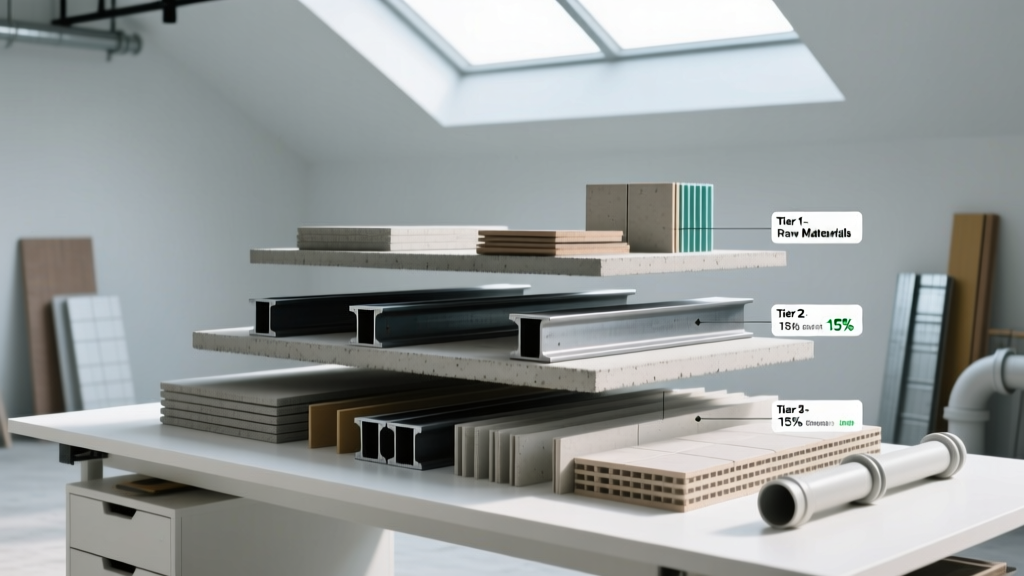
The Hidden Reality of Material Takeoffs
Calculating an accurate building materials list cost is the single most critical variable in pre-construction budget planning. A flawed takeoff does not merely result in a minor accounting discrepancy; it triggers cascading project delays, emergency freight charges, and compromised structural integrity when builders substitute inferior products to stay within a depleted budget. According to data tracked by the Bureau of Labor Statistics Producer Price Index, construction material inputs experience distinct volatility cycles, meaning a budget estimated in Q1 can easily be invalidated by Q3 if procurement strategies are not locked in.
Most amateur estimators and even some seasoned contractors calculate their building materials list cost by measuring square footage and multiplying by a generic unit price. This linear approach ignores the physical realities of construction: off-cuts, kerf loss, damaged deliveries, and the vast ecosystem of invisible consumables required to assemble primary components. To build a resilient budget, estimators must abandon single-tier pricing models and adopt a comprehensive, multi-tiered material auditing framework.
Applying a flat 15% waste factor across an entire building materials list cost is a mathematical error. While 15% might be accurate for complex roof framing with multiple valleys and hips, applying that same multiplier to interior drywall or concrete slab pours will artificially inflate your budget by thousands of dollars, potentially causing you to lose competitive bids or over-allocate capital that could be used for higher-grade finishes.
The 3-Tier Framework for Calculating Building Materials List Cost
To achieve precision, break your material takeoff into three distinct tiers. This prevents the common error of hyper-focusing on expensive structural elements while entirely forgetting the fasteners and adhesives required to install them.
Tier 1: Primary Structural and Envelope Materials
Tier 1 encompasses the high-volume, high-cost elements that define the physical footprint of the structure. These are the materials most commonly tracked in standard estimating software. When pricing Tier 1 materials for your building materials list cost, you must account for specific grades and regional availability.
- Dimensional Lumber: For standard SPF (Spruce-Pine-Fir) #2 framing, budget between $4.25 and $5.10 per linear foot for 2x4s, and $7.80 to $9.50 for 2x6s. Engineered lumber, such as 11-7/8" TJI I-joists, averages $6.50 to $8.20 per linear foot.
- Ready-Mix Concrete: Base pricing for standard 3,000 PSI mix ranges from $145 to $165 per cubic yard. However, your building materials list cost must include pump truck fees ($800 to $1,200 per day) and fiber-mesh or rebar reinforcement additives, which add $15 to $25 per yard.
- Structural Steel: Wide-flange beams (W-shapes) are priced per ton, currently fluctuating between $1,100 and $1,400 per ton depending on the National Association of Home Builders market indices, excluding fabrication and galvanization costs.
Tier 2: Secondary and Finishing Materials
Tier 2 includes the materials that enclose, insulate, and finish the structure. The primary budgeting failure here is ignoring the transition materials—the components that bridge different systems.
- Drywall and Sheathing: Standard 1/2" drywall sheets (4x8) cost $12 to $15, while 5/8" Type X fire-rated panels cost $18 to $22. OSB structural sheathing (7/16") averages $38 to $48 per sheet. Your takeoff must calculate the exact number of sheets required, dividing total square footage by 32 (the square footage of a 4x8 sheet) and adding a precise 7% to 10% waste factor for cuts.
- Insulation: R-38 unfaced fiberglass batts for 2x6 cathedral ceilings cost approximately $1.40 to $1.80 per square foot. Closed-cell spray foam, applied at a 2-inch depth for R-14, costs $1.20 to $1.50 per board foot, requiring specialized subcontractor pricing rather than off-the-shelf material costs.
Tier 3: The "Invisible" Consumables
Tier 3 is where budgets silently collapse. These are the low-unit-cost items required in massive quantities. Failing to itemize Tier 3 consumables typically results in a 6% to 9% budget shortfall during the framing and finishing phases.
- Fasteners and Hardware: A standard 2,000 sq. ft. wood-framed home requires roughly 16,000 to 22,000 framing nails (approx. 45 boxes of 16d sinkers). Budget $45 to $60 per box. Furthermore, modern building codes mandate engineered tie-downs. A single Simpson Strong-Tie H2.5A hurricane tie costs $1.15, but a house may require 400 of them, plus the specific 10d x 1.5" structural nails required to install them.
- Adhesives and Sealants: Subfloor installation requires polyurethane construction adhesive (e.g., Loctite PL Premium) applied to every joist. Budget one 28oz tube per 100 linear feet of joist. At $9.50 per tube, a 2,000 sq. ft. home requires roughly 35 tubes ($332) just for the subfloor.
- Housewrap and Flashing: Tyvek HomeWrap costs $0.55 to $0.75 per square foot. Your building materials list cost must also include 6-inch cap nails (one per every 12 inches of overlap) and specialized 3" butyl flashing tape for window and door rough openings, which costs $1.80 per linear foot.

Material Waste Factors and Consumable Multipliers
Use the following matrix to adjust your raw square-foot The percentages below represent industry-standard waste factors based on complexity and material fragility.
| Material Category | Standard Layout Waste | Complex Layout Waste | Hidden Consumable Multiplier |
|---|---|---|---|
| Dimensional Lumber (Framing) | 10% | 15% - 18% | +$0.12 per linear foot (nails/brackets) |
| OSB / Plywood Sheathing | 7% | 12% | +H-clips (1 per 4ft seam) |
| Asphalt Architectural Shingles | 10% | 15% (valleys/hips) | +Ice & Water shield, drip edge, coil nails |
| Interior Drywall | 5% - 7% | 10% (curved walls/many openings) | +1.5 gal joint compound & 500ft tape per 10 sheets |
| Concrete Flatwork | 3% - 5% | 8% (complex forms/slopes) | +Vapor barrier, wire mesh, form stakes |
Regional Price Volatility and Procurement Strategy
The final step in solidifying your building materials list cost is adjusting for regional logistics and procurement timing. Materials do not cost the same in a metropolitan hub as they do in a rural county, and the distance from a distribution center heavily impacts freight surcharges.
"When planning a rural build, estimators frequently overlook the 'last-mile' delivery premium. Lumber yards may offer competitive unit prices for engineered trusses, but if the site is outside their standard 50-mile delivery radius, flatbed freight surcharges and the requirement for a specialized boom truck for offloading can add $1,500 to $3,000 in pure logistics costs to the final invoice."
To mitigate these risks, implement a phased procurement strategy. Lock in pricing for Tier 1 structural materials (lumber packages, trusses, steel) via a written quote with a 60-day or 90-day price guarantee from your supplier. Do not purchase Tier 2 and Tier 3 materials until the structure is dried in, as storing drywall, insulation, and adhesives on an active, unsecured job site leads to high rates of moisture damage and theft, forcing duplicate purchases that destroy your budget.
Actionable Checklist for Finalizing Your Budget
Before submitting your final budget or signing a construction loan agreement, run your building materials list cost through this verification protocol:
- Verify Code Minimums: Ensure your insulation R-values, drywall fire ratings (e.g., 5/8" Type X in garages), and structural tie-downs match the specific amendments of your local municipal building code, not just general national standards.
- Audit the Fastener Schedule: Cross-reference your structural engineering plans with your hardware list. If the plans call for SDS heavy-duty structural screws instead of standard galvanized nails for sheer walls, update your Tier 3 costs immediately (SDS screws cost 4x more than nails).
- Factor in Sales Tax and Pallet Deposits: Commercial material suppliers often charge pallet deposits ($15 to $25 per pallet for lumber and brick) which are refundable but require upfront cash flow. Furthermore, ensure local state and municipal sales taxes (often 6% to 9%) are applied to the subtotal, not just the unit prices.
- Include Offloading Labor: If the supplier's delivery policy is "curbside drop only," your budget must include the hourly cost for a 3-person labor crew and a forklift rental to move 15,000 lbs of materials into the structure before they are exposed to weather.
Written by
James ThorntonJames Thornton is a construction industry veteran with 25 years of hands-on experience in wood framing, lumber grading, and residential building codes. He started as a framing carpenter in rural Oregon, earned his ICC Residential Building Inspector certification, and eventually became a senior plan reviewer for the City of Portland Bureau of Development Services. James holds a B.S. in Wood Science & Technology from Oregon State University and is a certified lumber grader through the West Coast Lumber Inspection Bureau (WCLIB). He has inspected over 3,000 residential construction sites and authored the city's internal guide on advanced framing techniques (2x6 at 24" O.C.). James lives in Bend, OR, where he builds custom timber-frame cabins and competes in lumberjack sports.
More from James Thornton
View all
Insulation
Best Home Insulation Materials: Complete 2026 Guide
Compare top home insulation materials for 2026. Find R-values, installed costs per square foot, and best uses for fiberglass, spray foam, and mineral wool.
Aug 4, 2026

Sustainable Building
Certify Your Green Building Material for LEED and WELL
Step-by-step guide to certifying a green building material for LEED v5 and WELL v2. Master EPDs, HPDs, and VOC limits for 2026 project specifications.
Aug 4, 2026

Stone & Masonry
Veneer Stacked Stone Panels: Interior Design & Style Showcase
Discover how veneer stacked stone panels transform interiors. Explore modern design profiles, material pairings, and technical installation specs.
Aug 4, 2026