How to Estimate the Cost to Build a Retaining Wall on a Budget
Accurately estimate the cost to build a retaining wall. Compare material prices, labor rates, and hidden drainage expenses for smart budget planning.

Most homeowners budget only for the visible face of a retaining wall, leading to severe cost overruns when excavation, drainage, and structural reinforcement are factored in. Proper budget planning requires calculating the cost to build a retaining wall based on volumetric displacement and soil mechanics, not just the square footage of the façade. A wall that appears to be 80 square feet on the surface often requires moving three times that volume in earth and aggregate behind the blocks.
Material Cost Matrix: Façade vs. Structural Reality
When evaluating materials, you must account for the accompanying base and backfill requirements. According to the National Concrete Masonry Association (NCMA), segmental retaining wall (SRW) blocks are the industry standard for residential DIY and mid-tier professional builds due to their flexibility and engineered pinning systems.
| Material Type | Material Cost (Per Sq. Ft.) | Required Base & Backfill | Lifespan |
|---|---|---|---|
| Segmental Concrete (e.g., Allan Block Classic) | $6.00 - $12.00 | Compacted 3/4" base, washed clear stone backfill | 75+ Years |
| Poured Concrete (Formed & Poured) | $25.00 - $45.00 | Deep frost-footing, heavy rebar, French drain | 50+ Years |
| Treated Timber (6x6 Landscape Ties) | $10.00 - $18.00 | Gravel base, deadman anchors, drain tile | 15-20 Years |
| Natural Boulders (Limestone/Granite) | $15.00 - $30.00 | Heavy machinery excavation, filter fabric, gravel | 100+ Years |
The Hidden Budget Killers: Excavation and Drainage
The most common reason retaining walls fail—and subsequently require expensive rebuilding—is hydrostatic pressure. When water saturates the soil behind a wall, the lateral pressure increases exponentially. To prevent bulging or catastrophic collapse, you must budget for premium drainage materials.
The 3/4-Inch Washed Clear Stone Rule
Never use standard 'crusher run' or gravel with fine dust (fines) for your drainage column or base trench. Fines wash into the block cores and clog the drainage paths over time. You must purchase 3/4-inch washed clear stone. While standard gravel costs around $25 per ton, washed clear stone typically costs $45 to $65 per ton. For a standard wall, you need roughly 1 ton of clear stone for every 10 square feet of wall face to fill the 12-inch drainage column directly behind the blocks.
Base Trench Depth Calculations
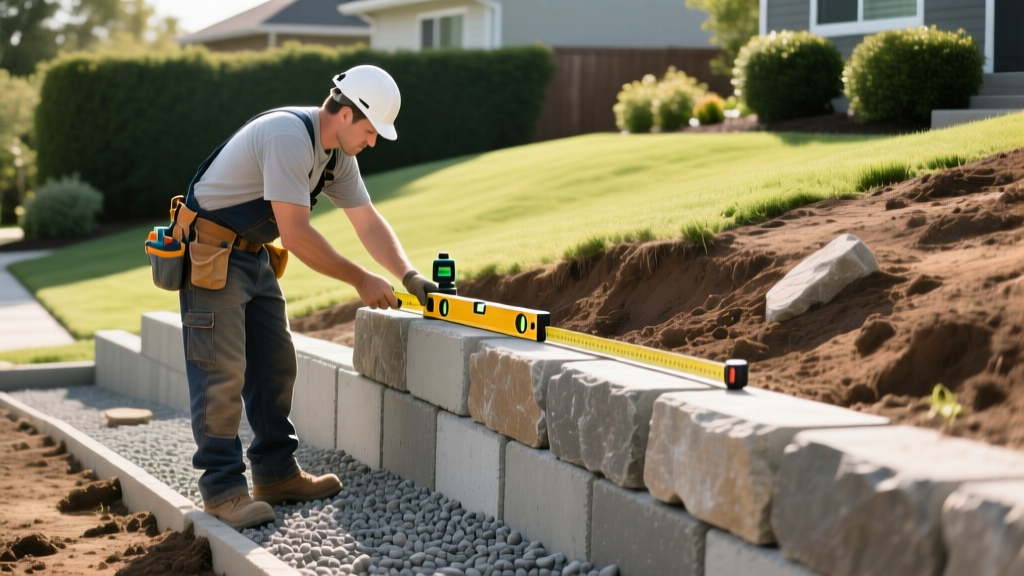
Your base trench dictates the structural integrity of the entire project. The NCMA mandates a base trench depth of 1 inch of buried block for every 8 inches of exposed wall height, plus a minimum of 6 inches of compacted base stone. If you are building a 4-foot (48-inch) wall, you must bury at least 6 inches of the first course. This means excavating a trench 12 to 14 inches deep and 18 inches wide, significantly increasing your soil removal and base stone costs.
Geogrid Reinforcement for Walls Over 3 Feet
For any segmental wall exceeding 3 feet in height, or any wall supporting a surcharge load (like a patio or driveway), mechanical soil reinforcement is non-negotiable. Geogrid is a synthetic mesh material (brands like Tensar or Mirafi are industry standards) that layers into the block courses and extends back into the compacted soil, tying the wall face to the earth mass.
- Material Cost: $1.50 to $3.50 per square foot of geogrid coverage.
- Placement Rule: Typically installed every 2 to 3 courses (12 to 18 inches vertically).
- Length Rule: The geogrid must extend back into the soil a minimum distance equal to 60% of the wall's height. A 4-foot wall requires geogrid extending at least 2.4 feet back from the block face.
Failing to budget for geogrid on a 4-foot wall will result in a structure that leans outward within 24 months of installation, voiding any manufacturer warranties.
Labor vs. DIY: Where to Spend and Where to Save
Industry data from Bob Vila's landscaping cost guides indicates that professional installation labor generally ranges from $30 to $60 per square foot of wall face, depending on regional rates and site accessibility. However, labor is only one side of the equation.
When to DIY: Walls under 3 feet high, built with segmental blocks, on well-draining sandy or loamy soils, with no heavy structures above the wall.
When to Hire a Pro: Walls over 3 feet, sites with heavy expansive clay soils, locations requiring the removal of massive tree root systems, or projects involving concrete cutting and poured footings.
Step-by-Step Budget Calculation Formula
To accurately forecast your expenses, break the project down into linear and volumetric measurements rather than just looking at the face of the wall. Use this framework for your budget planning.
Real-World Example: 80 Sq. Ft. Allan Block Wall (20 ft Long x 4 ft High)
Here is an exact material and equipment breakdown for a standard 4-foot high segmental wall using mid-tier concrete blocks.
- Wall Blocks: 80 sq. ft. / 0.89 sq. ft. per block = 90 blocks. At $7.50 each = $675.00
- Capstones: 20 linear ft. / 1.5 ft per cap = 14 caps. At $12.00 each = $168.00
- Base Trench Stone: 20 ft x 1.5 ft wide x 0.5 ft deep = 15 cu. ft. (approx. 1.5 tons of crushed gravel) = $60.00
- Drainage Column (Washed Clear Stone): 20 ft x 1 ft wide x 4 ft high = 80 cu. ft. (approx. 4 tons) = $220.00
- Perforated Drain Pipe: 25 ft roll of 4-inch corrugated pipe + filter sock = $45.00
- Geogrid Reinforcement: 20 ft x 2.5 ft deep (2 layers) = 100 sq. ft. roll = $180.00
- Backfill Soil & Topsoil: 3 cubic yards to fill behind the drainage stone = $120.00
- Equipment & Consumables: Plate compactor rental (2 days), landscape fabric, masonry adhesive for caps = $280.00
Total Estimated DIY Material Cost: $1,748.00 (Approx. $21.85 per sq. ft. of wall face).
Total Estimated Professional Cost: Add $3,200 to $4,000 for labor, site grading, and heavy machinery, bringing the total installed cost to roughly $62 to $71 per square foot.
By calculating the cost to build a retaining wall through the lens of soil displacement, drainage volume, and structural reinforcement, you eliminate the surprise expenses that derail landscaping budgets. Always secure your local grading and retaining wall permits before breaking ground, and ensure your base trench is excavated to undisturbed, load-bearing soil.
Written by
Sarah WhitfieldSarah Whitfield is a chartered quantity surveyor (MRICS) and construction cost analyst with 15 years of experience in material pricing, procurement strategy, and project budgeting. She earned her degree in Construction Management from the University of Reading (UK) and has worked on projects ranging from $2M custom homes to $180M mixed-use developments across North America and Europe. Sarah currently leads cost estimating for BuildMat Insight, maintaining a proprietary database of 4,000+ material price points updated quarterly. She is a frequent contributor to RSMeans cost data panels and has presented at the International Cost Engineering Council (ICEC) congress. Based in Denver, CO, Sarah is an avid trail runner and volunteer mentor for Women in Construction.
More from Sarah Whitfield
View all
Wood & Lumber
What Are the Different Types of Wood? A Builder's Guide
Compare structural softwoods, finish hardwoods, and engineered lumber. Analyze Janka ratings, MOE values, and 2026 pricing for construction.
Aug 4, 2026

Walls & Panels
Steel Framing vs Wood Framing: Corrosion and Moisture Defense
Compare steel framing vs wood framing for moisture resistance. Learn about galvanized coatings, condensation risks, and corrosion protection strategies.
Jul 21, 2026

Stone & Masonry
How to Cut Stone Veneer: Wet Saw vs Grinder Comparison
Compare the best tools for cutting stone veneer. We review wet saws, angle grinders, and chop saws to help you achieve clean, chip-free cuts.
Jul 21, 2026