True Cost to Build a Koi Pond: Size & Scope Calculator
Calculate the true cost to build a koi pond based on size, depth, and filtration scope. Get 2026 pricing for EPDM, concrete, and biofilters.
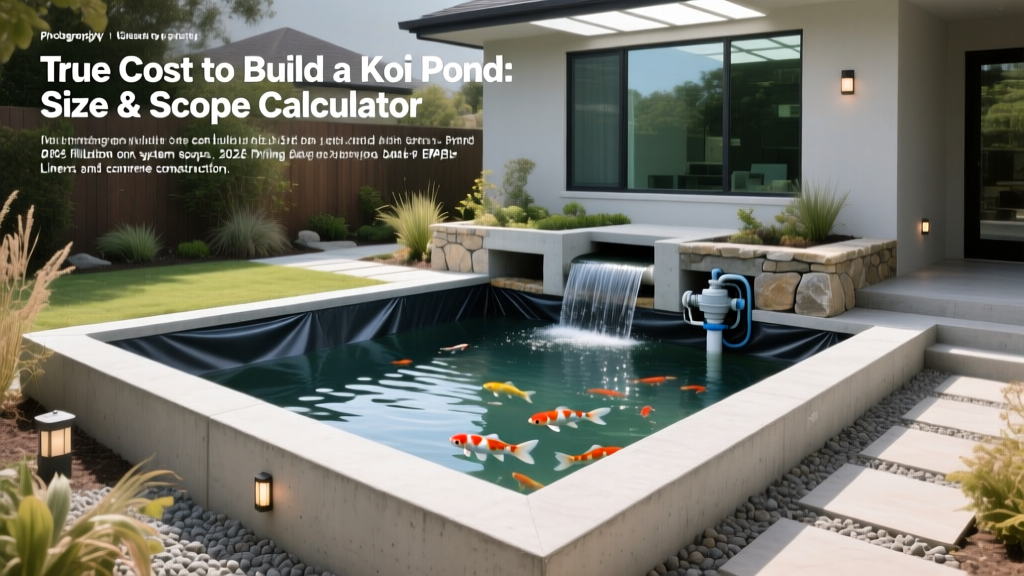
The Koi Pond Premium: Why Size and Scope Dictate Price
Calculating the cost to build a koi pond requires a fundamental shift in perspective: a koi pond is not a water garden. While water gardens prioritize aquatic plants and shallow shelves, a dedicated koi habitat is essentially a life-support system for massive, high-waste fish. The cost scales non-linearly with volume because filtration, aeration, and predator protection demand specialized engineering. According to guidelines from the Associated Koi Clubs of America (AKCA), a proper koi pond requires a minimum depth of 3 to 4 feet, sheer vertical walls to deter wading predators, and advanced biological filtration. This guide breaks down the exact size and scope multipliers that dictate your final construction budget in 2026.
Phase 1: Excavation and Shell Construction
The physical footprint of your pond sets the baseline for excavation, soil removal, and shell materials. Koi ponds require deeper excavation than standard landscape features. A 1,500-gallon pond requires roughly 200 cubic feet of water volume. At a standard 4-foot depth, that translates to 50 square feet of surface area, plus an additional 20% for filter chambers and plumbing trenches.
Material Matrix: EPDM Liner vs. Gunite
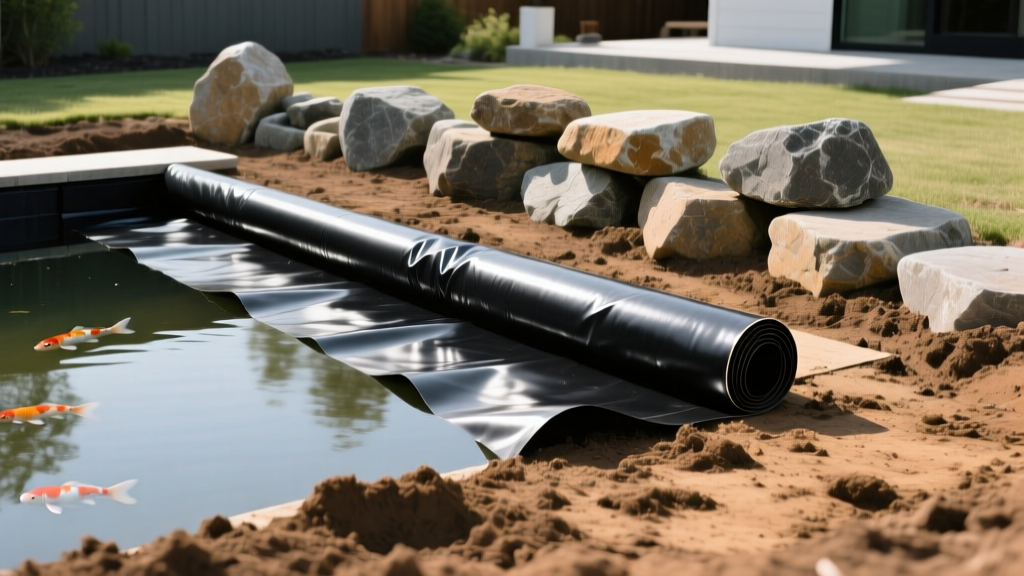
Your choice of shell material represents the first major cost divergence. While 45-mil EPDM rubber is the industry standard for flexible liners, high-end custom builds often utilize steel-reinforced gunite (shotcrete).
| Shell Material | Cost per Sq. Ft. (Installed) | Lifespan | Best Use Case |
|---|---|---|---|
| 45-Mil EPDM Liner | $3.50 - $6.00 | 20-25 Years | Standard residential builds, organic shapes |
| Reinforced RPE (Reinforced Polyethylene) | $4.00 - $7.50 | 30+ Years | High puncture resistance, rocky soils |
| Steel-Reinforced Gunite | $18.00 - $28.00 | 50+ Years | Massive commercial ponds, precise geometric shapes |
Phase 2: The Life Support System (Filtration & Flow)
The most common budgeting error is underestimating the filtration scope. A standard submersible pump and waterfall filter box (adequate for a 500-gallon water garden) will fail catastrophically in a koi pond. Koi produce massive bioloads, requiring gravity-fed filtration systems that process the entire pond volume every 1 to 2 hours.
The Gravity-Fed Filtration Sequence
Professional koi pond builders utilize a specific hydraulic sequence to ensure mechanical and biological waste is removed before it breaks down into toxic ammonia. According to veterinary and design resources on Koivet, maintaining pristine water quality is the single most critical factor in preventing koi ulcer disease and parasitic outbreaks.
- Bottom Drains: A 4-inch anti-vortex bottom drain is plumbed via 4-inch PVC Schedule 40 pipe directly to the filter room. (Cost: $150-$250 per drain, plus $15/linear foot for trenching and pipe).
- Settlement Chamber / Sieve Filter: Captures heavy solids and fish waste mechanically. (Cost: $800 for basic settlement; $2,500+ for a stainless steel rotary drum filter).
- Moving Bed Biofilm Reactor (MBBR): A dedicated chamber filled with K1 or Hel-X bio-media, heavily aerated to cultivate nitrifying bacteria. K1 media provides roughly 900 square meters of protected surface area per cubic foot. (Cost: $1,200 - $3,000 depending on chamber size).
- External Pump & UV Sterilizer: An external centrifugal pump (e.g., Sequence or Oase) pushes water through a high-output UV sterilizer (e.g., Emperor Aquatics) to kill suspended algae and pathogens before returning it to the pond. (Cost: $1,500 - $3,500 combined).
Size & Scope Calculator: Cost Tiers by Volume
Use the matrix below to estimate your total project cost based on the target volume. These ranges assume professional installation, proper excavation, and koi-specific life support systems.
| Pond Tier | Volume (Gallons) | Approx. Dimensions (L x W x D) | Estimated Total Cost (2026) |
|---|---|---|---|
| Entry-Level Koi | 800 - 1,200 | 8' x 10' x 4' | $12,000 - $18,000 |
| Standard Hobbyist | 1,500 - 2,500 | 10' x 14' x 4.5' | $22,000 - $38,000 |
| Advanced / Show Koi | 3,000 - 5,000 | 12' x 20' x 5' | $45,000 - $75,000 |
| Estate / Commercial | 6,000 - 10,000+ | Custom / Gunite Shell | $90,000 - $150,000+ |
Hidden Scope Creep: Aeration, Heating, and Automation
When running your size and scope calculations, contractors often omit the auxiliary systems required to keep high-value koi alive through extreme seasonal shifts. Industry publications like Pond Trade Magazine frequently highlight that auxiliary life-support failures are the leading cause of winter and summer fish kills.
- Dedicated Aeration Systems ($600 - $1,500): Koi require highly oxygenated water, especially in summer when water holds less dissolved oxygen. A dedicated linear piston air compressor (e.g., Medo or Secoh) running multiple diffuser rings on the pond floor is mandatory, separate from the biofilter aeration.
- Pond De-Icers and Heating ($800 - $4,500): In freezing climates, a gas-fired pool heater adapted for ponds or high-wattage inline electric heaters keep the water above 40°F, preventing the pond from freezing solid and allowing toxic gases to escape.
- Auto-Fill Valves and Overflow ($300 - $600): Evaporation can drop water levels by inches per week in summer. A mechanical auto-fill valve connected to your irrigation line, paired with a screened overflow drain, prevents chlorine spikes and catastrophic drain-downs.
- Filter Room Construction ($2,500 - $8,000): Gravity-fed filters must be situated below the pond's water level. This requires excavating a separate, vaulted, and weatherproof filter room or burying large concrete vaults to house the settlement and bio-chambers.
Expert Sizing Framework: Calculating Your Exact Footprint
To finalize your scope, apply the 10-Gallon Per Inch Rule as an absolute maximum stocking density, but aim for the 25-Gallon Per Inch Rule for optimal water quality and fish growth. If you intend to keep fifteen 24-inch koi, you are housing 360 inches of fish. At 25 gallons per inch, your minimum target volume is 9,000 gallons.
Once your target volume is set, calculate your required biofilter media. A general professional benchmark is 1/2 cubic foot of K1 bio-media per 100 gallons of pond volume, assuming a standard stocking density. For a 3,000-gallon pond, you will need a bio-chamber capable of holding at least 15 cubic feet of media, plus the 40% air-space required for the media to boil and tumble. This dictates the physical size of your filter room excavation, which directly impacts your final labor and concrete costs.
Frequently Asked Questions
Can I convert an existing water garden into a koi pond?
Converting a shallow water garden (typically 18-24 inches deep) into a koi pond requires complete demolition and re-excavation. You must achieve a minimum 3.5-foot depth, remove all plant shelves, and install 4-inch bottom drain plumbing. The cost to retrofit usually equals 80% of building a new pond from scratch.
How much does it cost to maintain a koi pond annually?
Annual maintenance costs scale with the size of the system. Expect to spend $800 to $1,500 per year on electricity (running external pumps and aeration 24/7), $200 to $400 on high-protein koi food, $150 on replacement UV bulbs, and occasional water treatments. Professional seasonal cleanings and filter media washes can add $1,200 to $2,500 annually.
Does adding a bog filter reduce the cost of mechanical filtration?
While an upflow wetland (bog) filter provides excellent biological filtration and nitrate reduction, it does not replace the need for a mechanical settlement chamber or sieve filter. If heavy solid waste enters a bog filter, it will clog the gravel matrix within a single season, creating anaerobic dead zones and hydrogen sulfide gas. You must still budget for primary mechanical filtration upstream of the bog.
Written by
Priya KapoorPriya Kapoor is a real estate market analyst and construction economics researcher with expertise in housing affordability, development feasibility, and infrastructure investment. She holds a Master of Regional Planning from Cornell University and previously worked as a senior analyst at CBRE's Investment Properties group, where she modeled returns for $4B in mixed-use development pipelines. Priya now runs an independent research practice advising developers, municipalities, and REITs on construction cost forecasting and market timing. She publishes the quarterly "BuildMat Market Pulse" report tracking material price indices across 12 commodity categories. Based in Austin, TX, Priya serves on the board of Habitat for Humanity Austin and is a marathon runner.
More from Priya Kapoor
View all
Construction Cost
Cost to Build a 1600 Sq Ft Home in 2026: Full Breakdown
Accurate 2026 cost to build a 1600 sq ft home—material, labor, and regional pricing breakdowns included. Plan your budget with real-time estimates.
Aug 11, 2026

Wood & Lumber
Name the Types of Wood for Pressure Treatment and Preservation
Learn how to name the types of wood best suited for pressure treatment. Compare species treatability, chemical retention levels, and 2026 preservation costs.
Aug 4, 2026

Stone & Masonry
Stone Veneer Suppliers Lindenhurst: 2026 Cost Analysis
Analyze 2026 stone veneer costs in Lindenhurst, NY. Compare local supplier pricing, delivery fees, and Suffolk County installation labor rates.
Aug 4, 2026