Cost to Paint Interior Commercial Building: Size & Scope Calculator
Calculate the cost to paint an interior commercial building. Learn scope variables, square footage multipliers, and commercial coating prices.

The Paintable Square Footage (PSF) Formula
Estimating the cost to paint an interior commercial building requires abandoning residential metrics. In commercial spaces, floor area rarely correlates directly with paintable surface area due to varying ceiling heights, partition densities, and structural columns. Professional estimators use Paintable Square Footage (PSF) to generate accurate material and labor bids.
To calculate PSF, you must segment the building by use-case and apply specific multipliers to the gross floor area:
- Open-Plan Offices & Retail: Multiply floor area by 1.5 for wall space, then add the exact ceiling square footage. (Formula: Floor Area × 1.5 + Ceiling Area)
- Partitioned Offices & Clinics: Multiply floor area by 3.0 to account for interior demising walls, corridor partitions, and individual office enclosures, then add ceiling area. (Formula: Floor Area × 3.0 + Ceiling Area)
- Warehouses & High-Bay Facilities: Calculate the exact exterior perimeter, multiply by the interior wall height (often 24 to 32 feet), and add the ceiling/deck area. Subtract 5% for overhead doors and dock cutouts.
Once you have the total PSF, divide by the spread rate of your chosen coating (typically 350 to 400 square feet per gallon for commercial acrylics) to determine base material volume. Always add a 10% waste factor for airless spraying and surface texture absorption.
2026 Commercial Painting Cost Matrix
The baseline cost to paint an interior commercial building ranges from $1.75 to $4.50 per PSF. However, this spread is heavily dictated by the scope of surface preparation and the operational status of the facility. The matrix below breaks down current market rates for fully insured, licensed commercial contractors.
| Scope Category | Cost per PSF | Surface Prep Required | Typical Coating System |
|---|---|---|---|
| New Construction (Unoccupied) | $1.75 - $2.25 | Level 4/5 drywall prep, dust removal | PVA Primer + 2 coats flat/matte acrylic |
| Standard Office Repaint | $2.50 - $3.25 | TSP washing, minor drywall patching, masking | 1 coat transition primer + 2 coats eggshell |
| Retail/Restaurant Refresh | $3.50 - $4.50 | Heavy degreasing, sanding, mill glaze removal | High-build primer + 2 coats scuff-resistant satin |
| Warehouse/Industrial High-Bay | $2.80 - $4.00 | Power washing, efflorescence treatment | Direct-to-Metal (DTM) acrylic or epoxy mastic |
Scope Multipliers: Logistics & Access Equipment
The base PSF rate assumes standard 8-to-10-foot ceilings and daytime work hours. Commercial projects frequently trigger logistical multipliers that can inflate the final cost to paint an interior commercial building by 30% to 60%.
Access Equipment & High-Ceiling Premiums
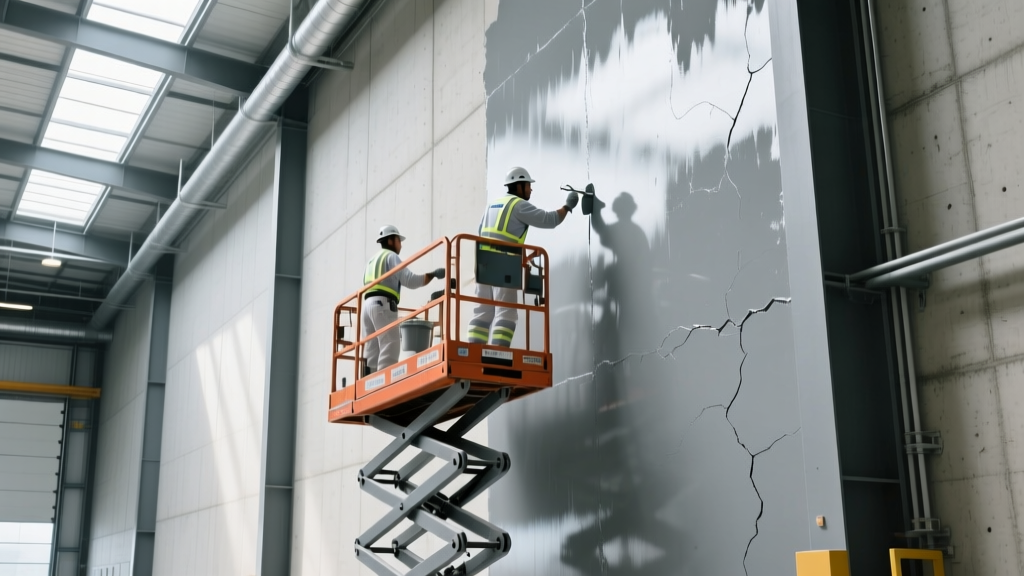
Painting above 12 feet requires mechanical access. While ladders suffice for minor touch-ups, commercial codes and efficiency demands require scissor or boom lifts. Renting a standard 19-foot electric scissor lift (such as the Genie GS-1930) costs approximately $250 to $350 per day, excluding delivery fees. For spaces exceeding 20 feet or requiring horizontal reach over fixed machinery, articulated boom lifts (e.g., JLG 450AJ) are necessary, pushing daily rental rates past $600. Labor productivity drops by roughly 25% when operators must constantly reposition heavy machinery, which must be factored into the hourly burden rate.
Off-Hours and Occupied Space Premiums
Active commercial environments—such as hospitals, data centers, and 24-hour retail—cannot be painted during standard business hours. Night and weekend shifts typically incur a 1.2x to 1.5x labor premium. Furthermore, occupied spaces require daily mobilization and demobilization: painters must lay down heavy-duty floor protection (like Ram Board), mask off sensitive IT equipment, and completely clear the workspace by 6:00 AM. This setup/teardown cycle adds 1.5 to 2 hours of non-painting labor per shift.
Commercial Coating Specifications & Material Costs
Commercial specifications prioritize scrubability, hide (opacity), and low odor over aesthetic depth. Architectural coatings used in commercial spaces must comply with strict EPA VOC regulations to maintain indoor air quality, especially in HVAC-recirculated environments.
Industry-Standard Product Lines
Estimators should base material costs on commercial-tier product lines, which offer higher volume solids and better spatter resistance for airless application:
- Sherwin-Williams ProMar 200 Zero VOC: The industry workhorse for drywall. Costs approximately $55 to $65 per gallon (wholesale). It provides excellent touch-up capabilities, which is critical for high-traffic corridors.
- Benjamin Moore Ultra Spec 500: Priced around $60 to $75 per gallon. Known for its exceptional leveling and spatter resistance, making it ideal for large, well-lit open office ceilings where roller marks are highly visible.
- PPG Speedhide Interior Latex: A budget-friendly option ($40 to $50 per gallon) often specified for back-of-house areas, storage rooms, and utility corridors where premium scrub resistance is unnecessary.
Dry Film Thickness (DFT) Compliance
Commercial specifications often mandate a specific Dry Film Thickness to ensure warranty compliance. For example, applying a coating at 4.0 wet mils typically yields 1.6 dry mils. If a facility manager specifies a 2.0 dry mil finish for high-abuse areas (like hospital corridors), the estimator must reduce the assumed spread rate from 400 sq ft/gal to roughly 320 sq ft/gal, directly increasing material costs by 25%.
Surface Preparation: The Hidden Cost Driver
According to the Painting and Decorating Contractors of America (PDCA), surface preparation accounts for up to 65% of total project labor. In commercial renovations, the existing substrate dictates the prep scope:
- Level 4 vs. Level 5 Drywall: If the existing walls are Level 4 (standard tape and joint compound) and you are painting with a semi-gloss or using dark colors, the joint lines will photograph. The scope must include a skim coat (Level 5 upgrade) or a high-build drywall primer to bridge the texture differential.
- Mill Glaze on Trim: Commercial MDF and pre-primed trim often suffer from mill glaze, a burnished surface that repels paint. The scope must include liquid sanding (deglossing) or mechanical scuff-sanding to ensure adhesion, preventing peeling in high-touch areas like handrails and door frames.
- Acoustic Ceiling Tiles: Never paint standard mineral fiber acoustic tiles; it destroys their Noise Reduction Coefficient (NRC). If a client wants a monolithic black or white ceiling in a modern office, the scope must include replacing standard tiles with factory-finished acoustic tiles or installing a drywall ceiling grid.
Step-by-Step Scope Calculator Workflow
To build a comprehensive, defensible estimate for a commercial interior painting project, follow this sequential workflow:
Step 2: Calculate PSF and Deduct Openings. Apply the multipliers outlined above. Subtract 100% of the area for large overhead doors, but only subtract 50% for standard commercial doors and windows, as the framing and returns still require cutting-in and painting.
Step 3: Audit Access & Logistics. Identify ceiling heights over 12 feet. Check loading dock availability for material staging. Verify if OSHA scaffolding and lift regulations require specific fall protection gear for the crew.
Step 4: Apply Labor Production Rates. A skilled commercial painter using an airless sprayer can cover 1,500 to 2,000 sq ft of open wall per 8-hour day (including back-rolling). Cut-in and trim work average 150 to 200 linear feet per day.
Step 5: Factor in General Conditions. Add 10-15% for project management, daily site cleanup, floor protection materials (Ram Board, plastic sheeting), and final disposal of commercial waste.
Frequently Asked Questions
How does HVAC operation affect commercial painting costs?
Active HVAC systems can blow dust and debris onto wet paint, causing inclusions and finish defects. Furthermore, negative air pressure in commercial buildings can pull unfiltered air into the workspace. Estimators must include the cost of temporarily shutting down HVAC zones, sealing supply/return vents with magnetic covers, and deploying HEPA air scrubbers to maintain a clean painting environment.
Can we use residential paint to lower commercial painting costs?
Using residential paint in a commercial setting is a critical failure point. Residential paints lack the high-volume solids required to withstand commercial cleaning chemicals, scuffing from carts, and frequent touch-ups. Warranties are immediately voided if non-specified coatings are used, and the facility will likely require a full repaint within 18 to 24 months due to burnishing and stain penetration.
What is the cost impact of choosing dark or saturated colors?
Deep, saturated colors (like navy blues or charcoal grays) require a tinted primer base and often three to four topcoats to achieve uniform hide and color consistency, compared to the standard two coats for light neutrals. This increases both material costs by 50% and labor time by 30%, significantly raising the overall cost to paint the interior commercial building.
Written by
Priya KapoorPriya Kapoor is a real estate market analyst and construction economics researcher with expertise in housing affordability, development feasibility, and infrastructure investment. She holds a Master of Regional Planning from Cornell University and previously worked as a senior analyst at CBRE's Investment Properties group, where she modeled returns for $4B in mixed-use development pipelines. Priya now runs an independent research practice advising developers, municipalities, and REITs on construction cost forecasting and market timing. She publishes the quarterly "BuildMat Market Pulse" report tracking material price indices across 12 commodity categories. Based in Austin, TX, Priya serves on the board of Habitat for Humanity Austin and is a marathon runner.
More from Priya Kapoor
View all
Construction Cost
Cost to Build a 1600 Sq Ft Home in 2026: Full Breakdown
Accurate 2026 cost to build a 1600 sq ft home—material, labor, and regional pricing breakdowns included. Plan your budget with real-time estimates.
Aug 11, 2026

Wood & Lumber
Name the Types of Wood for Pressure Treatment and Preservation
Learn how to name the types of wood best suited for pressure treatment. Compare species treatability, chemical retention levels, and 2026 preservation costs.
Aug 4, 2026

Stone & Masonry
Stone Veneer Suppliers Lindenhurst: 2026 Cost Analysis
Analyze 2026 stone veneer costs in Lindenhurst, NY. Compare local supplier pricing, delivery fees, and Suffolk County installation labor rates.
Aug 4, 2026