Cost to Build a Commercial Kitchen: 2026 Budget Planner
Discover the true cost to build a commercial kitchen in 2026. Detailed budget breakdowns for equipment, HVAC, plumbing, and finishes per square foot.

The 2026 Baseline: Cost Per Square Foot
Estimating the cost to build a commercial kitchen requires moving beyond generic square-footage averages. In 2026, the national average for a fully built-out, code-compliant commercial kitchen ranges from $250 to $450 per square foot. A standard 1,000-square-foot prep and cooking facility will cost between $250,000 and $450,000. This variance is driven by the complexity of the menu, the condition of the existing shell, and local mechanical codes. Unlike front-of-house construction, kitchen builds are heavily weighted toward mechanical, electrical, and plumbing (MEP) infrastructure, which accounts for nearly 40% of the total capital expenditure.
Quick 2026 Cost Ranges
- Ghost Kitchen / Prep Only: $150 - $220 per sq. ft.
- Standard Full-Service Restaurant: $250 - $350 per sq. ft.
- High-Volume / Institutional (Hospitals, Hotels): $380 - $500+ per sq. ft.
Mechanical, Electrical, and Plumbing (MEP) Rough-Ins
The most frequent point of budget failure in kitchen construction is underestimating MEP rough-ins. You are not just powering appliances; you are engineering an industrial environment that manages extreme heat, grease-laden air, and massive water volume.
Exhaust Hoods and Make-Up Air (MUA)
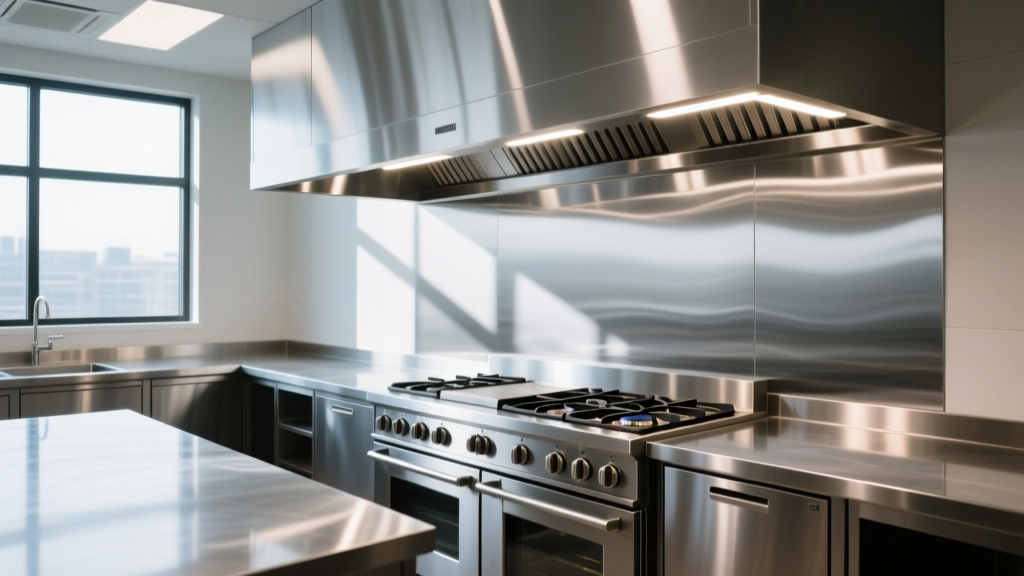
Ventilation is the single most expensive line item in kitchen construction. Type 1 hoods, required for grease and smoke-producing appliances (fryers, ranges, charbroilers), cost between $1,200 and $1,600 per linear foot, fully installed with ductwork. However, exhausting 2,500 to 4,000 CFM of air creates severe negative pressure inside the building. To prevent doors from locking shut and gas appliances from backdrafting, you must install a Make-Up Air (MUA) unit. A commercial MUA system with tempered heating capabilities adds $18,000 to $30,000 to the budget. Never attempt to bypass MUA requirements; local fire marshals and building inspectors will fail the inspection immediately.
Plumbing, Trench Drains, and Grease Interceptors
Commercial kitchens require specialized drainage. Standard floor drains are insufficient for the volume of water generated during washdowns. Trench drains are mandatory in dish pits and hot lines. When budgeting, allocate $150 to $250 per linear foot for trench drains, ensuring the concrete subfloor is pitched at exactly 1/4 inch per foot toward the drain channel. Furthermore, municipal codes mandate commercial grease interceptors to prevent FOG (Fats, Oils, and Grease) from entering the sewer system. A high-capacity exterior grease interceptor (such as the Zurn Z1185 series) or a large interior hydromechanical unit will cost between $4,500 and $9,000 installed, including the necessary core drilling and concrete trenching.
Heavy Equipment and Hot Line Capital Expenses
Equipment costs scale rapidly based on whether you purchase standard atmospheric ranges or high-efficiency combi-ovens. All commercial food equipment must meet ANSI/NSF Standard 2 for cleanability and material safety. Purchasing non-NSF certified equipment to save money will result in immediate health department violations.
| Equipment Category | Industry Standard Model Example | 2026 Estimated Cost | Infrastructure Requirement |
|---|---|---|---|
| Combi-Oven | Rational iCombi Pro 10-Half | $24,000 - $28,000 | 3-Phase 208V, Water Filtration, Floor Drain |
| High-Temp Dishmachine | Hobart AM15 Door-Type | $9,500 - $12,500 | Dedicated 60A Breaker, Hot Water Line, Vent Hood |
| Reach-In Refrigeration | Traulsen G-Series 2-Door | $7,000 - $9,500 each | Standard 115V, 4" Rear Clearance for Condenser |
| Heavy Duty Range | Vulcan VCCB36 Charbroiler | $5,500 - $7,500 | 1" Black Iron Gas Line, Type 1 Hood |
Code-Compliant Finishes and Surfaces
The FDA Food Code mandates that all surfaces in a commercial food establishment must be smooth, durable, non-absorbent, and easily cleanable. Drywall and standard residential paints are strictly prohibited in food prep and wash areas.
Flooring Systems
Slip resistance and chemical durability dictate kitchen flooring. Quarry tile remains the gold standard for high-heat hot lines, costing $14 to $20 per square foot installed, including the epoxy grout required to prevent grease penetration. For prep areas and dish pits, poured polyurethane or epoxy terrazzo systems ($10 to $16 per square foot) provide a seamless, cove-base transition to the walls, eliminating 90-degree corners where bacteria harbor. Ensure your flooring contractor installs an integral cove base that extends at least 4 inches up the wall.
Wall and Ceiling Systems
Fiberglass Reinforced Plastic (FRP) panels are the most cost-effective wall finish for commercial kitchens, running $4 to $7 per square foot installed over a moisture-resistant drywall or cement board substrate. For areas directly behind the hot line where heat and grease impact is highest, upgrade to stainless steel wainscoting or ceramic tile. Ceilings in food prep areas must be washable; avoid acoustic drop tiles entirely, opting instead for sealed drywall or specialized washable ceiling grids.
Warning: Hidden Budget Killers
1. Electrical Panel Upgrades: Most existing retail shells only have 200-amp single-phase service. A commercial kitchen often requires a 400-amp to 800-amp 3-phase upgrade. Budget $25,000 to $60,000 for utility transformer upgrades and new switchgear.
2. Gas Line Sizing: Running a new 2-inch black iron gas main from the meter to the kitchen hot line can add $10,000+ if the existing meter cannot support the BTU load of modern high-output ranges.
3. Hood Fire Suppression: Ansul or Kidde wet-chemical fire suppression systems integrated into the exhaust hood are mandatory. Expect $4,000 to $8,000 for installation and municipal fire marshal sign-off.
The 40/25/20/15 Budget Allocation Framework
To maintain financial control during the build-out, structure your capital stack using this industry-validated allocation framework. This prevents over-investing in aesthetic front-of-house elements at the expense of critical back-of-house infrastructure.
- 40% - Equipment & Fixtures: Ovens, refrigeration, prep tables, dishwashing, and smallwares. This is the revenue-generating engine of the business.
- 25% - MEP & Infrastructure: HVAC, Type 1/Type 2 hoods, MUA units, plumbing rough-ins, grease traps, and electrical panel upgrades.
- 20% - Construction & Finishes: Framing, quarry tile, FRP walls, trench drains, and lighting.
- 15% - Soft Costs & Contingency: Architectural drawings, MEP engineering stamps, health department plan reviews, building permits, and a minimum 5% contingency fund for unforeseen structural issues.
According to industry data analyzed by Toast's restaurant planning resources, kitchens that under-allocate funds to MEP infrastructure frequently face change orders that delay opening by 4 to 8 weeks. By securing your mechanical engineering and equipment cut-sheets before signing a lease, you lock in the true cost to build a commercial kitchen and protect your pre-opening capital runway.
Written by
Marcus ChenMarcus Chen is a licensed structural engineer (PE) and building materials analyst with over 12 years of experience across residential, commercial, and industrial construction. He holds a Master of Science in Civil Engineering from UC Berkeley and spent six years at Thornton Tomasetti before transitioning to independent consulting and technical writing. Marcus specializes in material selection for seismic-prone regions, concrete reinforcement strategies, and lifecycle cost analysis. His work has been cited by the American Concrete Institute (ACI) and the Structural Engineers Association of California (SEAOC). When he is not on a job site or at his desk, you will find him hiking the Sierra Nevada or restoring a 1920s craftsman bungalow in Oakland, CA.
More from Marcus Chen
View all
Construction Cost
How Much Did the Eiffel Tower Cost to Build?
How much did the Eiffel Tower cost to build in 1889? We adjust for inflation and compare its budget to modern skyscraper construction.
Aug 4, 2026

Fire Resistance
What Is a Fire Resistant Material? Testing & Certification Guide
Discover what is a fire resistant material through ASTM and UL testing. Learn how fire ratings, certifications, and assemblies work in construction.
Aug 4, 2026

Construction Cost
How Much Did the Burj Khalifa Cost to Build?
How much did the Burj Khalifa cost to build? We break down the $1.5B project and extract 5 money-saving strategies for your next build.
Jul 30, 2026