Cost to Build a Professional Website for Construction Firms
Discover the true cost to build a professional website for your construction firm. Learn money-saving strategies to maximize your digital ROI in 2026.
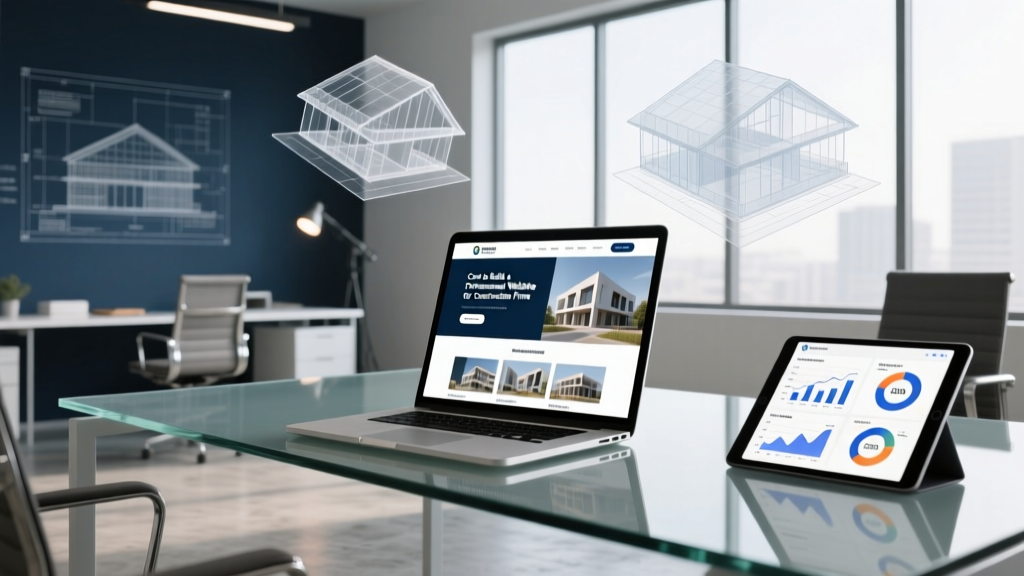
The Digital Foundation: Why Construction Firms Need Accurate Web Estimates
For contractors and builders, estimating a physical structure requires precise takeoffs, material pricing, and labor calculations. Yet, when it comes to establishing a digital presence, many construction firm owners treat the process as an afterthought, leading to blown budgets and subpar results. Understanding the true cost to build a professional website is just as critical as estimating the materials for a commercial build. Your website is your 24/7 digital showroom, qualifying leads and showcasing your portfolio while you are out on the job site.
In 2026, the digital landscape for construction marketing is highly competitive. Homeowners and commercial developers expect seamless mobile experiences, fast-loading project galleries, and instant quote request capabilities. By applying construction estimating principles—breaking down 'materials' (software and hosting) and 'labor' (design and development)—you can accurately budget for your digital infrastructure and implement strategic money-saving tactics without sacrificing quality.
Breaking Down the Cost to Build a Professional Website
Just as a pole barn and a custom luxury home have vastly different price tags, website costs vary wildly based on the build method. According to Forbes Advisor, small business website costs can range from a few hundred dollars to tens of thousands, depending on complexity and customization. Below is a 2026 pricing matrix tailored specifically for construction and contracting businesses.
| Build Method | Estimated Upfront Cost | Annual Maintenance | Best For |
|---|---|---|---|
| DIY Website Builder (Wix, Squarespace) | $500 - $1,500 | $300 - $500/yr | Sole proprietors, handymen, startups under $250k revenue |
| Freelance WordPress/Webflow Developer | $3,500 - $8,500 | $800 - $1,500/yr | Established remodelers, roofers, and specialty contractors ($1M-$5M revenue) |
| Specialized Construction Marketing Agency | $12,000 - $25,000+ | $3,000 - $6,000/yr | Large GCs, multi-state commercial builders, design-build firms |
Material Costs: The Digital Tech Stack
In web development, your 'materials' are the software licenses, hosting environments, and domain registrations. Skimping here is the equivalent of using substandard lumber; it will inevitably lead to structural failure, security breaches, or poor performance.
- Domain Name: $15 to $25 per year via registrars like Cloudflare or Namecheap. Avoid overpaying for privacy protection; it should be included for free.
- Managed Hosting: $25 to $45 per month. For a construction firm, site speed directly impacts local SEO rankings. Utilize managed WordPress hosting like Kinsta or WP Engine, or a high-performance cloud setup via Cloudways. Avoid $3/month shared hosting plans, which throttle bandwidth when high-resolution project images are loaded.
- Premium Theme & Page Builder: $59 to $99 annually. Tools like GeneratePress paired with Elementor Pro or Bricks Builder provide the structural flexibility needed for custom portfolio layouts without the bloat of multipurpose themes.
- Lead Capture & CRM Integration: $100 to $300 annually. Plugins like WPForms Pro or Gravity Forms are essential for building complex, multi-step 'Request a Quote' funnels that integrate directly with construction CRMs like Jobber or Houzz Pro.
Labor Costs: Design, Development, and Copywriting
Labor typically accounts for 60% to 80% of your total digital build cost. A specialized web developer familiar with the construction industry will charge between $85 and $150 per hour in 2026. However, the most frequently overlooked labor cost is copywriting. As highlighted by the U.S. Small Business Administration, clear digital messaging is vital for converting local traffic into contracted work. Professional B2B/B2C copywriters charge $0.20 to $0.40 per word. A standard 15-page contractor website requires roughly 5,000 words, adding $1,000 to $2,000 to your labor estimate.
4 Money-Saving Strategies for Your Digital Build
You do not need to compromise on quality to keep your web development budget in check. By applying value-engineering principles to your digital build, you can significantly reduce costs.
Scope creep destroys web budgets just as it destroys renovation budgets. Before writing a single line of code, finalize a rigid sitemap and wireframe document. Any additions requested after development begins (like adding a client portal or a complex material calculator) should be treated as formal change orders with predefined hourly rates.
1. Templatize the Framing, Customize the Finishes
Do not pay a developer to code a custom layout from scratch. Instead, purchase a premium, industry-specific template (the 'framing') and hire a developer strictly to customize the branding, colors, and typography (the 'finishes'). This approach can reduce development labor hours by up to 40%, saving you $2,000 to $4,000 on a mid-sized build.
2. In-House the 'Paint and Trim' (Content Creation)
Agency photography and videography packages often add $2,500 to $5,000 to your invoice. Modern smartphones, such as the iPhone 15 Pro or Samsung Galaxy S24 Ultra, shoot in high enough resolution and dynamic range for web use. Spend a day walking your active job sites and completed projects, capturing wide-angle structural shots and close-up finish work. Use free tools like Canva to crop and color-correct. Writing the initial draft of your service pages yourself, then paying an editor to polish them, can halve your copywriting costs.
3. Implement Modular Portfolio Galleries
Construction firms often want to showcase 50+ projects. Building custom, unique page layouts for every single project is a massive waste of development hours. Instead, pay your developer to build one highly optimized 'Project Case Study' template. Use a custom post type in WordPress to dynamically populate the gallery. You can then add new projects in-house via the CMS without paying hourly developer rates for every new job you complete.
4. Phase Your SEO 'Insulation'
A beautiful website without local SEO is like a custom home without insulation—it looks great but fails to perform. However, you do not need to optimize for every service and city on day one. Phase your SEO strategy. Launch with your core services and primary service area. Allocate a monthly budget of $300 to $500 to systematically build out location-specific landing pages (e.g., 'Custom Deck Builder in [Suburb Name]') over the first 12 months.
Ongoing Maintenance: The 'Property Tax' of Your Website
Just as a physical building requires HVAC maintenance and roof inspections, a professional website requires ongoing technical upkeep. According to HubSpot's website cost analysis, ongoing maintenance is a mandatory operational expense. Budget for the following annual costs:
- Security & Backups: $100 - $200/year (e.g., Wordfence Premium, BlogVault).
- Plugin & Core Updates: $50 - $100/month if hiring a maintenance agency, or 2 hours of your own time monthly.
- Accessibility Compliance: $490/year for tools like accessiBe or UserWay to ensure ADA compliance, protecting your firm from digital liability lawsuits.
Decision Framework: Which Build Path Fits Your Business?
Use this matrix to determine the most cost-effective route for your specific contracting business based on your current annual gross revenue and lead generation needs.
| Annual Revenue | Primary Lead Source | Recommended Build Path | Budget Allocation |
|---|---|---|---|
| Under $500k | Word of Mouth / Referrals | DIY Builder (Squarespace) | Under $1,500 |
| $500k - $2M | Local SEO / Home Advisor | Freelance WordPress Expert | $4,000 - $7,000 |
| $2M - $10M | Inbound Marketing / Bidding | Boutique Construction Agency | $10,000 - $18,000 |
| $10M+ | Enterprise RFPs / Brand Authority | Custom Enterprise Development | $25,000+ |
By treating your digital presence with the same rigorous estimating and value-engineering mindset you apply to your physical builds, you can control the cost to build a professional website while creating a powerful asset that consistently bids and wins work on your behalf.
Written by
Priya KapoorPriya Kapoor is a real estate market analyst and construction economics researcher with expertise in housing affordability, development feasibility, and infrastructure investment. She holds a Master of Regional Planning from Cornell University and previously worked as a senior analyst at CBRE's Investment Properties group, where she modeled returns for $4B in mixed-use development pipelines. Priya now runs an independent research practice advising developers, municipalities, and REITs on construction cost forecasting and market timing. She publishes the quarterly "BuildMat Market Pulse" report tracking material price indices across 12 commodity categories. Based in Austin, TX, Priya serves on the board of Habitat for Humanity Austin and is a marathon runner.
More from Priya Kapoor
View all
Construction Cost
Cost to Build a 1600 Sq Ft Home in 2026: Full Breakdown
Accurate 2026 cost to build a 1600 sq ft home—material, labor, and regional pricing breakdowns included. Plan your budget with real-time estimates.
Aug 11, 2026

Wood & Lumber
Name the Types of Wood for Pressure Treatment and Preservation
Learn how to name the types of wood best suited for pressure treatment. Compare species treatability, chemical retention levels, and 2026 preservation costs.
Aug 4, 2026

Stone & Masonry
Stone Veneer Suppliers Lindenhurst: 2026 Cost Analysis
Analyze 2026 stone veneer costs in Lindenhurst, NY. Compare local supplier pricing, delivery fees, and Suffolk County installation labor rates.
Aug 4, 2026