How Much Did It Cost to Build the Panama Canal? Financing Breakdown
Explore how much it cost to build the Panama Canal. We break down the $375M historical budget, inflation adjustments, and mega-project financing lessons.

The Ultimate Mega-Project: Deconstructing the Panama Canal's Price Tag
When analyzing historical infrastructure, the question of how much did it cost to build the Panama Canal remains a masterclass in civil engineering finance, risk management, and sovereign appropriations. For modern construction estimators and project financiers, the Canal is not merely a historical artifact; it is the foundational case study for mega-project cost overruns, contingency planning, and inflation-adjusted capital expenditure.
The direct answer requires splitting the project into its two distinct phases: the failed French attempt (1881–1889) and the successful United States execution (1904–1914). The U.S. ultimately completed the 50-mile waterway for approximately $375 million in 1914 dollars. However, translating that figure into modern purchasing power requires a nuanced understanding of construction cost indices versus standard consumer inflation.
The French Financial Collapse (1881–1889)
Before the U.S. involvement, Ferdinand de Lesseps, the diplomat behind the Suez Canal, led the French effort. The French company raised approximately 1.4 billion francs (roughly $287 million USD at the time) through public lotteries and bond issues.
The French attempt failed catastrophically due to severe estimating errors. De Lesseps insisted on a sea-level canal, entirely misjudging the hydrological volatility of the Chagres River and the sheer volume of the continental divide at Culebra. Furthermore, the French budget allocated virtually zero capital for disease mitigation. Yellow fever and malaria decimated the workforce, leading to a mortality rate that paralyzed labor productivity. By 1889, the company declared bankruptcy, wiping out the investments of over 800,000 French citizens. For modern estimators, the French failure underscores the fatal flaw of applying historical cost-per-yard metrics from one geographic environment (the sandy, arid Suez) to a radically different one (the tropical, mountainous jungles of Panama).
The U.S. Execution: A $375 Million Masterclass in Appropriations
The United States took over the project in 1904, fundamentally altering the engineering approach and the financial structure. Authorized by the Spooner Act of 1902, the U.S. Congress appropriated funds directly from the Treasury, backed by the full faith and credit of the U.S. government, insulating the project from the private market panics that doomed the French.
According to the U.S. Department of State Office of the Historian, the financial acquisition and construction budget was meticulously tracked by the Isthmian Canal Commission. Below is the generalized line-item breakdown of the $375 million total expenditure.
| Budget Category | 1914 Cost (USD) | Modern Estimating Equivalent |
|---|---|---|
| Purchase of French Assets | $40,000,000 | Site Acquisition & Brownfield Remediation |
| Payment to Panama (Treaty) | $10,000,000 | Land Rights, Easements & Sovereign Fees |
| Construction & Engineering | $297,000,000 | Hard Costs (Earthwork, Concrete, Locks) |
| Sanitation & Healthcare | $20,000,000 | Site Safety, Environmental & Health Mitigation |
| Administration & Zone Gov. | $8,000,000 | Project Management, Overhead & Logistics |
| Total Estimated Cost | ~$375,000,000 | Total Capital Expenditure (CapEx) |
The Shift to a Lock-Based System
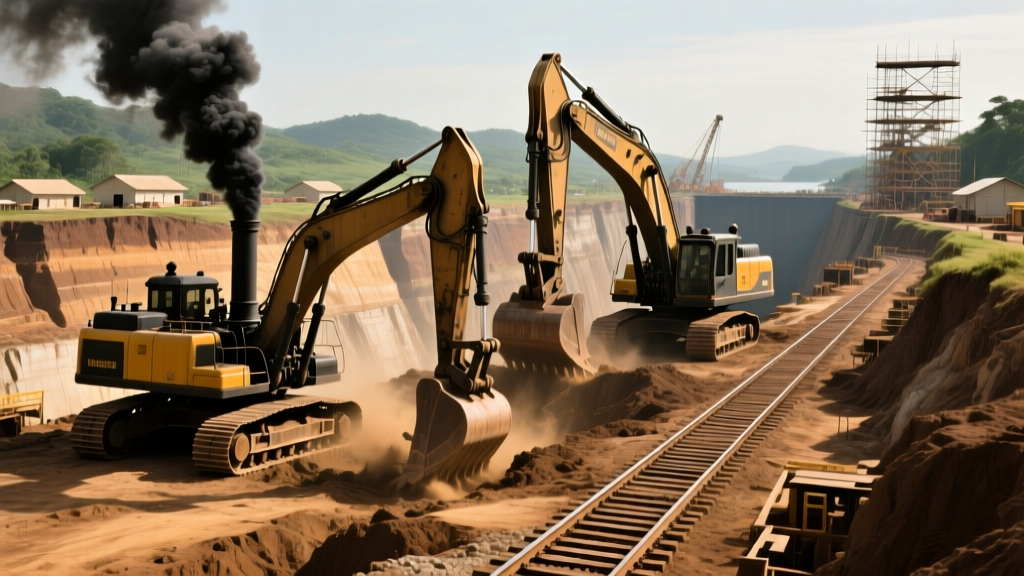
Chief Engineer John Frank Stevens made the critical pivot from a sea-level canal to a lock-and-lake system. This required the construction of the Gatun Dam, which at the time was the largest earth dam in the world, and the pouring of roughly 4.5 million cubic yards of concrete for the lock chambers. This design choice reduced the total excavation volume by tens of millions of cubic yards, saving an estimated $100 million in 1904 dollars and shaving years off the schedule.
Adjusting for Inflation: What Would It Cost Today?
To understand the true scale of the $375 million price tag, estimators must adjust for over a century of inflation. Using the Bureau of Labor Statistics CPI Inflation Calculator, $375 million in 1914 equates to roughly $11.8 billion in 2026 dollars.
However, standard CPI measures consumer goods (food, apparel, housing). Heavy civil construction scales differently due to the mechanization of earthmoving. In 1904, excavation relied on steam shovels and manual labor; today, GPS-guided autonomous haul trucks and massive cutter suction dredges drastically reduce the cost-per-cubic-yard of earthwork. Therefore, while the raw inflation-adjusted number is $11.8 billion, the functional replacement cost using modern construction cost indices (CCI) and modern equipment productivity rates would likely sit closer to $7 billion to $9 billion today.
Modern Mega-Project Comparison: The 2016 Expansion
To contextualize the original build, we can compare it to the Panama Canal Expansion Project (the Third Set of Locks), completed in 2016. As detailed by the Encyclopedia Britannica and the Panama Canal Authority, the expansion cost approximately $5.25 billion.
| Metric | Original Canal (1914) | Expansion Project (2016) |
|---|---|---|
| Total Nominal Cost | $375 Million | $5.25 Billion |
| Primary Financing | U.S. Treasury Appropriations | Multilateral Bank Loans & Toll Revenue Bonds |
| Major Cost Driver | Virgin Earthwork & Disease Mitigation | Specialized Steel, Concrete & Lock Gates |
| Concrete Volume | ~4.5 Million Cubic Yards | ~5 Million Cubic Meters |
The expansion was financed not by sovereign taxation, but by the Canal's own balance sheet, utilizing $2.3 billion from the Panama Canal Authority's internal cash flow and $2.9 billion in loans from multilateral development banks. This demonstrates the ultimate ROI of the original $375 million investment: the asset generated sufficient free cash flow a century later to self-fund a $5 billion modernization without requiring a Panamanian sovereign bailout.
Risk Mitigation and the "Sanitation Premium"
One of the most vital lessons for modern construction estimators is how the U.S. handled the "Sanitation Premium." Dr. William Gorgas, the chief sanitary officer, demanded $20 million to eradicate mosquito breeding grounds through swamp draining, oiling of waterways, and building screened housing.
Initially, military and engineering brass viewed this as bloated overhead. However, Gorgas's budget was essentially an aggressive risk mitigation contingency. By spending 5% of the total budget on healthcare and sanitation, the U.S. prevented the labor shortages and work stoppages that bankrupted the French. In modern estimating terms, this validates the practice of front-loading health, safety, and environmental (HSE) budgets in high-risk geographic zones, treating them as critical-path hard costs rather than disposable soft costs.
Key Takeaways for Modern Construction Estimators
- Geographic Cost Indices Matter: Never apply a cost-per-unit metric from a previous project without adjusting for local hydrology, geology, and climate. The French bankruptcy was fundamentally an estimating failure regarding the Chagres River's flood plains.
- Design Value Engineering Saves CapEx: The pivot from a sea-level canal to a lock-and-lake system required more complex mechanical engineering but drastically reduced the volume of civil earthwork, proving that cross-discipline value engineering is the most powerful cost-control tool available.
- Finance HSE as Risk Mitigation: Allocate specific, ring-fenced budgets for site-specific environmental and health risks. A 5% premium on sanitation and safety can prevent 100% schedule failure in hostile environments.
- Sovereign vs. Revenue Financing: Mega-projects often require the low cost of capital provided by sovereign debt (U.S. Treasury in 1904) to absorb initial construction risk, allowing the asset to later leverage higher-cost revenue bonds (ACP in 2016) for expansions.
Written by
Marcus ChenMarcus Chen is a licensed structural engineer (PE) and building materials analyst with over 12 years of experience across residential, commercial, and industrial construction. He holds a Master of Science in Civil Engineering from UC Berkeley and spent six years at Thornton Tomasetti before transitioning to independent consulting and technical writing. Marcus specializes in material selection for seismic-prone regions, concrete reinforcement strategies, and lifecycle cost analysis. His work has been cited by the American Concrete Institute (ACI) and the Structural Engineers Association of California (SEAOC). When he is not on a job site or at his desk, you will find him hiking the Sierra Nevada or restoring a 1920s craftsman bungalow in Oakland, CA.
More from Marcus Chen
View all
Construction Cost
How Much Did the Eiffel Tower Cost to Build?
How much did the Eiffel Tower cost to build in 1889? We adjust for inflation and compare its budget to modern skyscraper construction.
Aug 4, 2026

Fire Resistance
What Is a Fire Resistant Material? Testing & Certification Guide
Discover what is a fire resistant material through ASTM and UL testing. Learn how fire ratings, certifications, and assemblies work in construction.
Aug 4, 2026

Construction Cost
How Much Did the Burj Khalifa Cost to Build?
How much did the Burj Khalifa cost to build? We break down the $1.5B project and extract 5 money-saving strategies for your next build.
Jul 30, 2026