Cost to Build a Small Cabin: Complete Pricing Guide
Discover the true cost to build a small cabin. Explore detailed pricing for A-frames, log kits, prefab, site prep, and off-grid utilities.
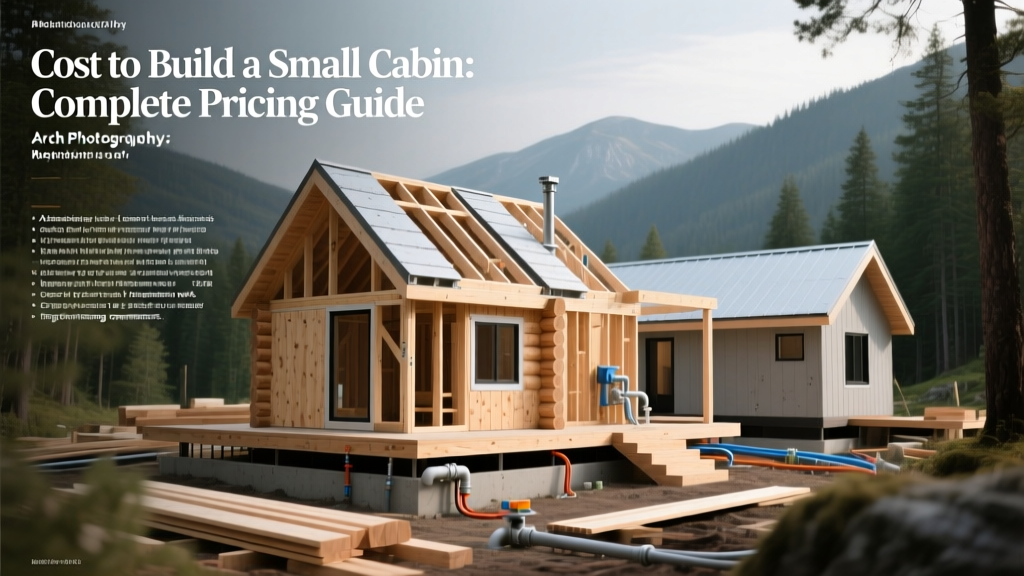
The Economics of Small Cabin Construction
Building a small cabin—typically defined as a structure between 200 and 800 square feet—requires navigating highly variable site conditions, material choices, and utility infrastructure. Unlike suburban tract housing, cabin construction costs are heavily skewed by topography, access limitations, and off-grid requirements. According to data from the National Association of Home Builders (NAHB), custom and remote builds carry a 15% to 30% premium over standard residential construction due to mobilization fees and supply chain friction. In 2026, the average cost to build a small cabin ranges from $125 to $350 per square foot, translating to $50,000 for a basic DIY A-frame shell up to $280,000 for a fully finished, turnkey timber-frame retreat.
Cost Matrix by Cabin Architecture
The architectural style and structural system you select dictate your material-to-labor ratio. Prefabricated and kit options shift costs toward materials and away from on-site carpentry, which is crucial when building in remote areas where skilled labor is scarce or commands high travel premiums.
| Cabin Type | Material Cost / Sq Ft | Total Build Cost / Sq Ft | Best Use Case |
|---|---|---|---|
| A-Frame Kit | $45 - $85 | $110 - $180 | DIY builders, steep snow-load regions |
| Prefabricated Modular | $100 - $160 | $180 - $260 | Fast deployment, restricted build seasons |
| Structural Insulated Panels (SIPs) | $75 - $120 | $200 - $290 | Extreme climates, high energy efficiency |
| Full Scribe Log | $150 - $250 | $300 - $450+ | Legacy builds, high aesthetic budget |
| Stick-Built (Standard Wood Frame) | $60 - $95 | $160 - $250 | Custom layouts, accessible sites |
Site Preparation and Foundation Economics
Remote cabin sites rarely arrive build-ready. Site preparation often consumes 10% to 20% of the total budget, a reality that catches many first-time builders off guard. Before a single piece of lumber is laid, you must address access, clearing, and soil stability.
Clearing, Grading, and Access
Clearing heavily wooded land costs between $1,500 and $3,500 per acre, but if you need to cut a dedicated access road for heavy equipment (like concrete pump trucks or delivery semis), expect to pay $15 to $35 per linear foot for gravel road installation. If your site requires blasting through bedrock to install utilities or level a pad, excavators charge $150 to $300 per hour, and dynamite blasting can add $5,000 to $15,000 to your site prep budget.
Foundation Selection for Variable Terrain
- Helical Piers ($200 - $350 per pier): Ideal for rocky, sloped, or ecologically sensitive sites. A 600-square-foot cabin typically requires 9 to 12 piers. Total installed cost: $3,500 - $6,000. They require no curing time and can be loaded immediately.
- Frost-Protected Shallow Foundation (FPSF) ($8 - $14 per sq ft): Uses rigid foam insulation to trap geothermal heat, preventing frost heave without digging below the frost line. Total cost for 600 sq ft: $4,800 - $8,400.
- Monolithic Slab ($6 - $12 per sq ft): Only viable on flat, well-draining sites with minimal frost heave risk. Requires extensive forming and rebar reinforcement. Total cost: $3,600 - $7,200.
Framing and Enclosure: Securing the Shell
The enclosure phase—framing, sheathing, roofing, and windows—represents the largest single line item in cabin construction. In 2026, material volatility has stabilized, but high-performance building envelopes command a premium that pays dividends in off-grid heating and cooling loads.
Roofing Material Breakdown
Cabin roofs must withstand harsh elements while minimizing maintenance. 26-gauge corrugated metal roofing remains the industry standard for remote cabins, costing $4.50 to $7.50 per square foot installed. It sheds snow efficiently and resists ember intrusion in wildfire zones. For areas with strict Wildland-Urban Interface (WUI) codes, you must pair the metal roofing with a Class A fire-rated underlayment (such as FireBlocker), adding $0.75 to $1.25 per square foot. Avoid architectural asphalt shingles on remote cabins; they cost $5.00 to $8.00 per square foot but are prone to wind uplift and require replacement every 15-20 years, making the long-term lifecycle cost significantly higher.
Off-Grid vs. On-Grid Utility Infrastructure
Connecting to municipal utilities can cost $20,000 to $50,000 if the main lines are more than a few hundred feet away. Consequently, many cabin owners opt for decentralized, off-grid systems. The Environmental Protection Agency (EPA) notes that alternative wastewater systems are increasingly common in rural developments, but they require precise soil percolation testing.
Water and Wastewater
Drilling a residential water well costs $30 to $65 per foot. A 200-foot well with a submersible pump, pressure tank, and trenching will cost between $8,000 and $14,000. If bedrock prevents drilling or water tables are too low, a 2,500-gallon buried polyethylene cistern (delivered by water truck) costs $4,500 to $7,000 installed.
For wastewater, a conventional gravity-fed septic system costs $10,000 to $18,000. If your soil fails a perc test, an engineered aerobic treatment unit (ATU) or mound system will push costs to $20,000 - $35,000. For ultra-small cabins (under 400 sq ft) used seasonally, high-end composting toilets (like the Sun-Mar Excel) cost $1,800 to $2,500 and bypass septic requirements entirely, provided local codes allow greywater leaching fields for sink and shower runoff.
Power Generation: Solar and Storage
According to the U.S. Department of Energy, residential solar efficiency and battery storage capabilities have expanded dramatically. A robust off-grid system for a small cabin running a mini-split HVAC, LED lighting, a refrigerator, and a water pump requires a 5kW to 7kW solar array paired with Lithium Iron Phosphate (LiFePO4) battery storage.
- Solar Array (5kW - 7kW): $12,000 - $18,000 (using modern bifacial panels that capture ground-reflected light, ideal for snowy environments).
- LiFePO4 Battery Bank (15kWh - 30kWh): $8,000 - $16,000. Brands like EG4 or SOK offer server-rack batteries that are significantly cheaper than integrated units like the Tesla Powerwall, while offering deeper cycle life and modular scalability.
- Hybrid Inverter & Balance of System: $3,500 - $6,000.
Never size an off-grid solar system based on peak summer production. Always calculate your battery autonomy based on the lowest solar insolation hours of your specific location in December, and ensure you have a backup propane generator (e.g., Honda EU7000is) for multi-day winter storm events.
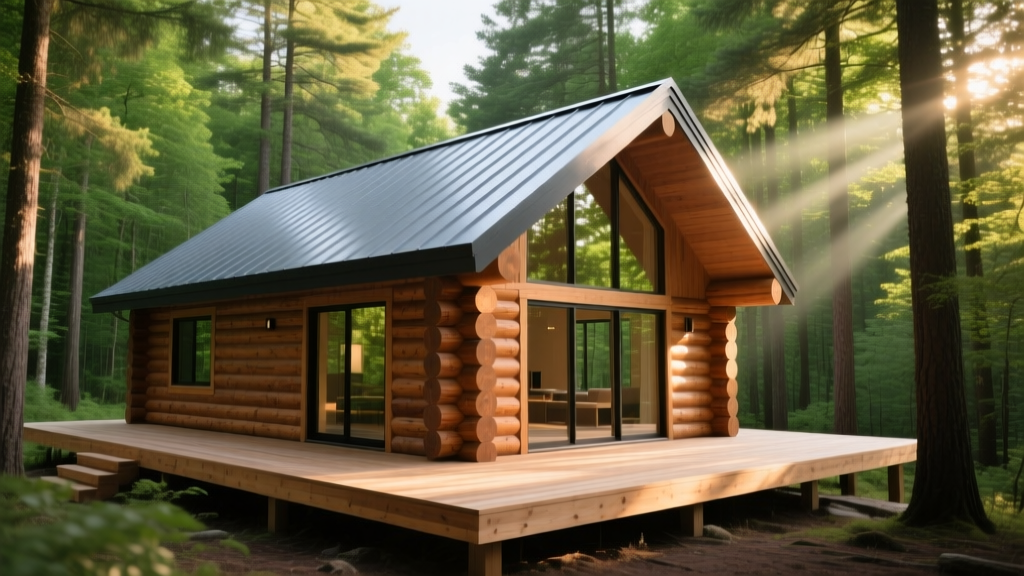
Hidden Variables and Edge Cases
Budget overruns in cabin construction rarely happen because lumber prices spiked; they happen because of logistical and regulatory edge cases.
Material suppliers typically quote delivery based on standard semi-truck access. If your cabin site requires a smaller flatbed, a crane to offload trusses, or manual labor to carry materials 200 yards up a muddy trail, expect 'last mile' surcharges of $2,000 to $8,000. Always verify the exact turning radius and bridge weight limits on your access road before ordering engineered lumber or roof trusses.
Additionally, permitting in rural or unincorporated counties can be deceptively complex. While the permit fees themselves might only be $500 to $1,500, counties increasingly require engineered site plans, environmental impact reviews for tree clearing, and specialized fire-mitigation inspections, which can add $3,000 to $6,000 in soft engineering costs.
Actionable Decision Framework
Use this matrix to align your cabin build strategy with your specific site constraints and budget:
- If your site is heavily sloped and inaccessible: Choose a helical pier foundation and a SIPs or Prefab modular shell. Do not attempt stick-building or pouring concrete, as the mobilization of pumps and scaffolding will destroy your budget.
- If you are building in a high wildfire zone (WUI): Prioritize a standing-seam metal roof, fiber-cement siding (like James Hardie), and tempered glass windows. Budget an extra 12% for non-combustible exterior materials.
- If you plan to use the cabin only 20-30 days a year: Skip the well and septic. Install a buried cistern, a composting toilet, and a simple greywater trench. Reallocate the $25,000 saved toward a premium wood-burning stove and high-R-value insulation for winter comfort.
- If you are financing the build: Lenders require permanent foundations (slab, crawlspace, or full basement) and grid-tied utilities to classify the structure as real property rather than an RV or personal property. If you need a construction loan, off-grid systems and pier foundations may complicate your appraisal.
Written by
Elena RodriguezElena Rodriguez is a civil engineer and technical writer specializing in concrete technology, masonry systems, and ASTM/ACI compliance. She earned her B.S. in Civil Engineering from Texas A&M University and spent a decade at a materials testing laboratory, performing over 2,000 concrete compressive strength tests and masonry prism evaluations. Elena is an ACI-certified Field Testing Technician (Grade I) and a member of ASTM Committee C12 on Natural Building Stone. She currently consults on forensic engineering cases involving concrete failures and moisture intrusion. Based in San Antonio, TX, Elena is a proud member of the Society of Women Engineers (SWE) and coaches her daughter's FIRST Robotics team.
More from Elena Rodriguez
View all
Walls & Panels
Cost Analysis: Light Gauge Steel Framing Advantages and Disadvantages
Evaluate light gauge steel framing advantages and disadvantages through a strict cost analysis lens, comparing material, labor, and lifecycle expenses.
Aug 4, 2026

Walls & Panels
Gypsum Board Types: Exact Specifications, Thickness & Dimensions
Compare standard, Type X, and moisture-resistant gypsum board types. Get exact specifications, thicknesses, dimensions, and ASTM standards for your project.
Aug 4, 2026

Fire Resistance
Best Fire-Resistant Outdoor Decking Materials: 2026 Buyer Guide
Discover the best fire-resistant outdoor decking materials for 2026. Compare Class A PVC, aluminum, and hardwood options for WUI compliance and safety.
Aug 4, 2026