Average Cost to Build a Website: 2025 vs 2026 Contractor Budgets
Discover the average cost to build a website (2025/2026 data). Budget planning for contractors needing project galleries, CRM, and material calculators.

The True Average Cost to Build a Website: 2025 Baseline vs. 2026 Projections
When evaluating digital infrastructure for construction firms, general market data falls short. While analysts tracking the average cost to build a website 2025 benchmarks report a median spend of $3,000 to $10,000 for standard service businesses, contractors, builders, and material suppliers operate in a high-stakes, visually demanding environment. A digital presence for a general contractor or building material distributor is not merely a digital brochure; it is a lead-qualification engine, a secure client portal, and a technical resource hub.
According to Forbes Advisor, custom website development for specialized industries routinely pushes past the $15,000 mark due to complex backend integrations. For 2026, we project a 12% to 18% increase in development costs driven by the demand for AI-driven material estimators, 3D virtual tour integrations, and stringent ADA compliance requirements for commercial bidders.
| Website Tier | Target Construction Audience | 2025 Baseline Cost | 2026 Projected Cost | Core Capabilities |
|---|---|---|---|---|
| Tier 1: Brochure | Independent Handymen, Single-Truck Operators | $2,500 - $5,000 | $3,000 - $5,500 | Service lists, basic contact forms, static project photos. |
| Tier 2: Mid-Market | Custom Home Builders, Remodelers, Specialty Subs | $8,000 - $18,000 | $9,500 - $21,000 | CRM integration, Houzz/Buildertrend API, dynamic portfolios, SEO architecture. |
| Tier 3: Enterprise | Commercial GCs, Material Manufacturers, Developers | $25,000 - $60,000+ | $30,000 - $75,000+ | RFP portals, BIM model viewers, multi-language, WCAG 2.2 compliance, custom calculators. |
Construction-Specific Integrations That Impact Your Budget
The primary reason contractor websites exceed standard small business budgets is the necessity for industry-specific software integrations. Off-the-shelf themes cannot handle the technical weight of construction operations. When planning your budget, you must allocate capital for the following specialized modules:
1. Project Management & Client Portal APIs
Modern clients expect transparency. Integrating your website with platforms like Buildertrend, CoConstruct, or Procore allows homeowners and commercial stakeholders to log in and view daily logs, change orders, and schedule updates. Developing a secure, white-labeled client portal bridge on your main domain typically costs between $2,500 and $6,000 in custom API development, excluding the SaaS subscription fees of the underlying software.
2. Material Takeoff and Estimation Calculators
For building material suppliers and roofing contractors, interactive calculators are high-conversion assets. A basic square-footage multiplier widget costs under $500 to implement. However, a dynamic calculator that pulls real-time pricing from your ERP (like Epicor or SAP), accounts for regional waste factors, and generates a downloadable PDF cut-list requires custom JavaScript and backend logic, pushing the cost to $4,000 - $8,500.
3. 3D Virtual Tours and Drone Progression Timelines
Embedding Matterport 3D scans or creating interactive, phase-by-phase drone progression timelines requires specialized hosting and frontend rendering. As noted in the JBKnowledge ConTech Report, visualization tech is a top investment for modern contractors. Budget an additional $1,500 to $3,000 for the frontend development required to embed these heavy assets without destroying your site's Core Web Vitals and page load speeds.
If you are a commercial contractor bidding on municipal, state, or federal projects, your digital presence must meet WCAG 2.2 AA standards. Automated accessibility scanners are insufficient. Manual remediation of a 50-page contractor website to ensure screen-reader compatibility for architectural PDFs and high-contrast navigation typically costs $3,500 to $7,000. Failing to budget for this can result in disqualified bids or digital accessibility lawsuits.
Budget Planning Matrix: Platform Selection for Builders
Choosing the right Content Management System (CMS) dictates your long-term maintenance costs. Here is how the top platforms compare for construction businesses:
- WordPress (Custom Theme): The industry standard. Excellent for SEO and integrating with niche construction plugins. Initial Cost: $8,000 - $20,000. Maintenance: High (requires monthly security patching due to plugin vulnerabilities).
- Webflow: Superior for high-end custom home builders who prioritize award-winning, visually stunning design and flawless animations. Initial Cost: $12,000 - $25,000. Maintenance: Low (hosting and security are managed).
- Headless CMS (Next.js / Sanity): Required for enterprise material suppliers needing blazing-fast load times across global markets and complex ERP integrations. Initial Cost: $35,000+. Maintenance: Requires a dedicated developer or agency retainer.
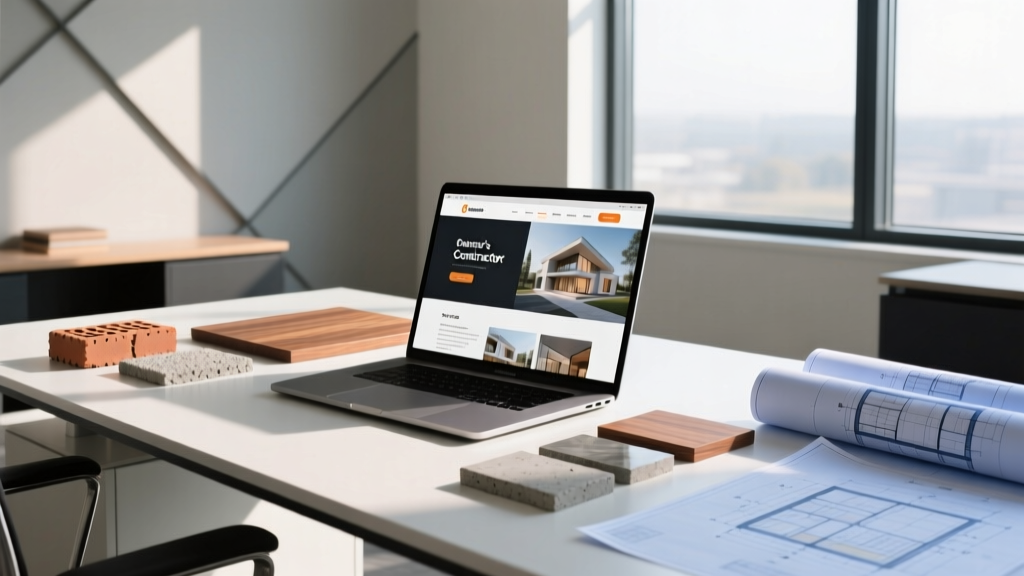
Hidden Infrastructure Costs for High-Volume Imagery
Construction portfolios are inherently image-heavy. A single custom home project can generate hundreds of high-resolution architectural photos, drone orthomosaics, and 4K video walkthroughs. Clutch.co industry data frequently highlights hosting and media optimization as the most common hidden costs in web development.
Do not rely on standard shared hosting. You must budget for:
- Content Delivery Network (CDN): Services like Cloudflare or AWS CloudFront to serve massive image files from edge servers closest to the user. ($20 - $100/month)
- Automated Image Optimization: API services like Cloudinary that automatically convert uploaded 20MB RAW site photos into next-gen WebP formats, preserving visual fidelity while maintaining sub-2-second load times. ($89 - $224/month)
- Video Hosting: Never host 4K drone videos directly on your web server. Budget for enterprise Vimeo or Wistia accounts to embed video without crashing your bandwidth limits. ($60 - $150/month)
Strategic Budget Allocation Framework
If you are a mid-sized residential contractor with a $20,000 digital budget for 2026, avoid the common mistake of spending 80% on frontend design. Allocate your capital based on revenue-generating utility:
| Budget Category | Allocation (%) | Dollar Amount | Strategic Focus |
|---|---|---|---|
| UX/UI Design & Frontend | 35% | $7,000 | Mobile-first design for architects and homeowners browsing on-site. |
| Backend & CRM Integration | 30% | $6,000 | Automated lead routing to HubSpot/Salesforce, RFP submission gating. |
| Technical SEO & Local Map | 20% | $4,000 | Service-area schema markup, location-specific landing pages. |
| Media Optimization & CDN | 10% | $2,000 | First-year enterprise image hosting and video embedding setup. |
| Contingency / ADA Audit | 5% | $1,000 | Buffer for third-party accessibility audits or API changes. |
Final Considerations for Construction Firms
Estimating the cost of a website in the construction sector requires looking beyond the initial build. The most successful contractors view their website as a piece of heavy machinery: it requires regular maintenance, fuel (content/SEO), and occasional upgrades to remain competitive. By understanding the true average cost to build a website in 2025 and projecting into 2026, you can secure the necessary capital to build a digital asset that not only showcases your craftsmanship but actively automates your lead qualification and client management pipelines.
Written by
Priya KapoorPriya Kapoor is a real estate market analyst and construction economics researcher with expertise in housing affordability, development feasibility, and infrastructure investment. She holds a Master of Regional Planning from Cornell University and previously worked as a senior analyst at CBRE's Investment Properties group, where she modeled returns for $4B in mixed-use development pipelines. Priya now runs an independent research practice advising developers, municipalities, and REITs on construction cost forecasting and market timing. She publishes the quarterly "BuildMat Market Pulse" report tracking material price indices across 12 commodity categories. Based in Austin, TX, Priya serves on the board of Habitat for Humanity Austin and is a marathon runner.
More from Priya Kapoor
View all
Construction Cost
Cost to Build a 1600 Sq Ft Home in 2026: Full Breakdown
Accurate 2026 cost to build a 1600 sq ft home—material, labor, and regional pricing breakdowns included. Plan your budget with real-time estimates.
Aug 11, 2026

Wood & Lumber
Name the Types of Wood for Pressure Treatment and Preservation
Learn how to name the types of wood best suited for pressure treatment. Compare species treatability, chemical retention levels, and 2026 preservation costs.
Aug 4, 2026

Stone & Masonry
Stone Veneer Suppliers Lindenhurst: 2026 Cost Analysis
Analyze 2026 stone veneer costs in Lindenhurst, NY. Compare local supplier pricing, delivery fees, and Suffolk County installation labor rates.
Aug 4, 2026