Analyzing the Regional Cost to Build iPhone Assembly Plants
Discover the 2026 regional construction costs to build iPhone assembly plants, comparing cleanroom, MEP, and structural expenses across global hubs.

Beyond the Bill of Materials: The CapEx of Smartphone Manufacturing
When industry analysts evaluate the cost to build iPhone devices, they typically focus on the $400 to $500 Bill of Materials (BOM) for internal components. However, from a construction estimating perspective, the true capital expenditure (CapEx) lies in the specialized mega-factories required to assemble them. Building a modern smartphone assembly plant is not a standard industrial warehouse project; it is a highly complex integration of cleanroom technology, heavy utility infrastructure, and extreme vibration control. As global supply chains decentralize in 2026, understanding the regional price variances for these specialized facilities is critical for developers, general contractors, and corporate real estate teams.
Structural Engineering and Vibration Isolation
The foundation of any electronics assembly plant is dictated by the sensitivity of Surface Mount Technology (SMT) lines and automated optical inspection (AOI) equipment. Standard concrete slabs are insufficient. Facilities must be constructed to meet VC-F or VC-G vibration criteria curves, requiring 400mm to 600mm thick reinforced concrete waffle slabs or isolated pedestal foundations. In seismically active regions like parts of California or Japan, this structural requirement can increase the concrete and rebar package costs by 22% to 35% compared to standard tilt-up industrial warehouses. Furthermore, the facility must support immense dead loads from rooftop Make-Up Air Units (MAUs) and exhaust scrubbers, necessitating heavy steel structural grids with moment frames capable of supporting 150+ pounds per square foot of roof-mounted MEP equipment.
2026 Regional Construction Cost Matrix
The cost to build iPhone assembly infrastructure varies drastically based on local labor rates, material tariffs, and supply chain maturity. The following table outlines the estimated construction costs per square foot for a standard 1,000,000 sq. ft. Tier-1 assembly facility across four key global regions in 2026.
| Region / Hub | Shell & Core ($/sqft) | Cleanroom Fit-Out ($/sqft) | Specialized MEP ($/sqft) | Total Est. Cost (1M sqft) |
|---|---|---|---|---|
| China (Zhengzhou) | $145 | $215 | $185 | $545,000,000 |
| India (Tamil Nadu) | $98 | $195 | $165 | $458,000,000 |
| Vietnam (Bac Giang) | $115 | $205 | $175 | $495,000,000 |
| USA (Texas) | $235 | $290 | $260 | $785,000,000 |
Note: Costs exclude land acquisition, specialized manufacturing tooling, and owner-furnished equipment (OFE). Data reflects Q1 2026 construction indices.
Cleanroom Standards and HVAC Infrastructure
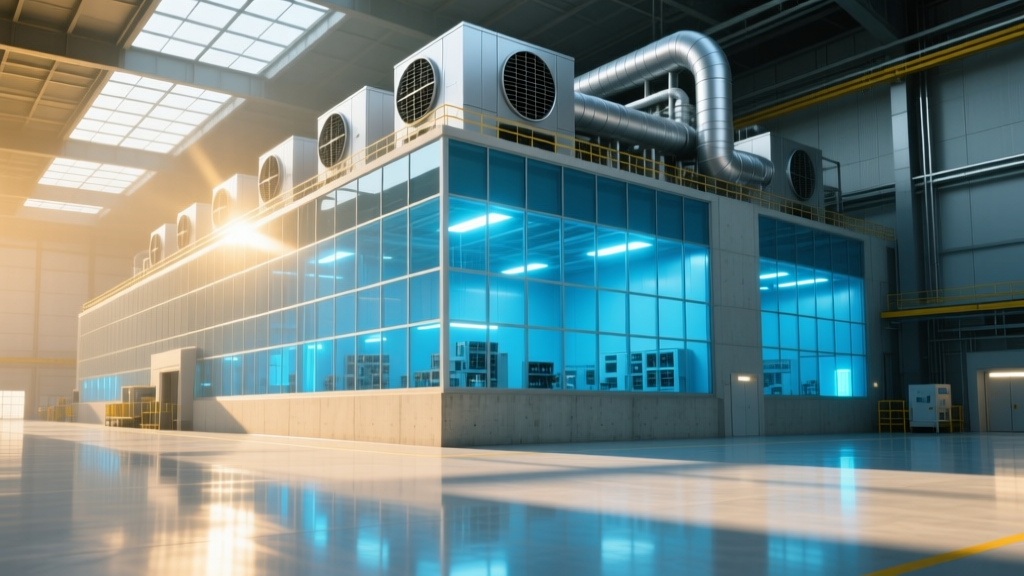
Final assembly and testing zones require strict environmental controls, typically adhering to ISO 14644-1:2015 Cleanroom Standards for ISO Class 7 and Class 8 environments. Constructing these zones requires specialized modular wall systems, such as FM-4910 compliant cleanroom panels that resist combustion and chemical degradation. The HVAC infrastructure for these spaces is the single largest MEP expense. Unlike commercial buildings that recirculate air, electronics cleanrooms require 100% outside air systems to manage volatile organic compounds (VOCs) and particulate matter. A single 1,000,000 sq. ft. facility may require 40 to 60 massive MAUs, each costing upwards of $1.2 million, alongside extensive ductwork fabricated from 304 stainless steel to prevent off-gassing and rust.
Process Cooling Water (PCW) and Compressed Dry Air (CDA)
SMT reflow ovens and laser welding stations generate immense heat, requiring dedicated Process Cooling Water (PCW) loops. To prevent biological growth and mineral leaching that could ruin micro-soldering equipment, PCW piping must be constructed from 316L stainless steel or high-purity PVDF (polyvinylidene fluoride), which costs 40% more per linear foot than standard carbon steel. Similarly, Compressed Dry Air (CDA) systems must maintain a pressure dew point of -40°C to prevent moisture ingress during component placement, requiring desiccant dryers and redundant oil-free centrifugal compressors.
ESD Flooring and Interior Finishes
Electrostatic Discharge (ESD) is the silent killer of microelectronics. Assembly floors must comply with strict ESD Association Standards (ANSI/ESD S20.20). Standard epoxy coatings are insufficient; estimators must price out conductive epoxy terrazzo or specialized ESD vinyl tiling integrated with a copper grounding grid embedded in the subfloor. This grounding grid must tie directly into the facility's isolated technical ground system, separate from the building's standard electrical ground, to prevent transient voltage spikes. The installed cost for a high-performance ESD floor system ranges from $14.50 to $22.00 per square foot, representing a significant premium over standard industrial polished concrete ($4.00 to $6.00 per square foot).
Utility Substations and Site Work
The electrical load of a smartphone mega-factory is staggering, often exceeding 40 Megawatts (MW) for a mid-sized campus. Site work must include the construction of dedicated 115kV or 230kV electrical substations, complete with dual redundant feeds from the municipal grid to ensure 99.999% uptime. In regions with unstable municipal grids, such as parts of Southeast Asia, developers must also factor in the cost of N+1 backup diesel generators or massive lithium-ion Battery Energy Storage Systems (BESS) capable of bridging the gap during power transfers. According to Apple's Supplier Responsibility initiatives, there is also a growing mandate for renewable energy integration, requiring structural reinforcements for expansive rooftop solar arrays and on-site microgrid inverters.
Estimator's Decision Framework: Regional Site Selection
IF speed-to-market and established supply chain ecosystems are the primary drivers:
THEN target the Greater Bay Area (China) or Bac Giang (Vietnam). Despite rising labor costs, the density of tier-2 and tier-3 component suppliers reduces logistical CapEx and accelerates facility commissioning by 3 to 5 months.
IF long-term geopolitical risk mitigation and favorable corporate tax incentives are prioritized:
THEN target Tamil Nadu or Karnataka (India). While specialized cleanroom labor may require expat premiums during the initial commissioning phase, the baseline shell and core construction costs remain 35% lower than Western equivalents.
IF the facility is designated for final assembly of highly classified, proprietary prototypes or localized market fulfillment:
THEN target the US Sunbelt (Texas/North Carolina). Expect a 65% premium on MEP and cleanroom fit-outs due to a scarcity of certified cleanroom pipefitters and stringent local environmental permitting for exhaust scrubbers.
Cost Escalation Factors to Monitor
As we move through 2026, construction estimators must account for specific escalation vectors unique to high-tech manufacturing. First, the global demand for high-purity 316L stainless steel and specialized HEPA filter media continues to outpace supply, leading to 12-18 week lead times for critical MEP components. Second, the integration of AI-driven automated quality control systems requires upgraded server rooms within the assembly plant, necessitating localized liquid-cooling infrastructure and FM-200 or Novec 1230 clean agent fire suppression systems. By accurately modeling these specialized construction requirements, development teams can avoid the severe budget overruns that frequently plague first-generation electronics manufacturing facilities in emerging markets.
Written by
David NakamuraDavid Nakamura is a licensed architect (AIA) and construction technology writer focused on sustainable building methods, mass timber engineering, and high-performance building envelopes. He holds a Master of Architecture from the University of Washington and is a certified Passive House Consultant (CPHC). David spent eight years at the Seattle firm Mithun, where he led the design of three LEED Platinum projects, before founding his own practice specializing in net-zero residential design. He serves on the editorial advisory board of GreenBuilder Magazine and has authored peer-reviewed papers on cross-laminated timber (CLT) connections for the Journal of Structural Engineering. In his spare time, David teaches woodworking at Pratt Fine Arts Center and kayaks the Puget Sound.
More from David Nakamura
View all
Construction Cost
Labor Cost to Build a Deck Per Sq Ft: 2026 Installation Guide
Discover the exact labor cost to build a deck per sq ft in 2026. This installation guide breaks down contractor rates, complexity factors, and hidden fees.
Aug 4, 2026

Construction Cost
How Much Does It Cost to Build a 3 Bedroom House? Financing Guide
Learn exactly how much it costs to build a 3 bedroom house and explore 2026 financing options, construction loan types, and budget frameworks for your build.
Aug 4, 2026

Construction Cost
Cost to Build a Tennis Court: 2026 Guide
How much does it cost to build a tennis court in 2026? Breakdowns for asphalt, concrete, and synthetic surfaces plus fencing and lighting.
Jul 30, 2026