Cost to Build a House Sydney: 2026 Regional Price Breakdown
Discover the true cost to build a house in Sydney for 2026. Expert regional price analysis, site cost variables, and per-sqm budgets across Greater Sydney.

The 2026 Sydney Housing Construction Landscape
Estimating the cost to build a house in Sydney requires navigating a complex matrix of topography, micro-climates, and stringent local council regulations. Unlike flat, uniform regional markets, Greater Sydney presents extreme variables: from the sandstone ridges of the Northern Beaches to the reactive clay soils of the South West. According to recent data from the Australian Bureau of Statistics (ABS), Sydney continues to command the highest median construction costs per square metre in the country, driven by specialized site works and premium material mandates.
2026 Sydney Build Cost Snapshot
- Project Home (Volume Builder): $2,400 – $3,100 per sqm
- Custom Architectural Build: $3,800 – $5,200 per sqm
- Luxury / High-Spec Bespoke: $6,500 – $10,000+ per sqm
- Average Site Cost Premium (Sydney vs. National): +38%
Note: These figures represent the base build contract and exclude land acquisition, stamp duty, and standalone landscaping.
Base Construction Costs Per Square Metre by Build Tier
The Housing Industry Association (HIA) tracks building material and labour indices quarterly. In 2026, trades shortages in specialized sectors (waterproofing, custom joinery, and structural steel) have stabilized but remain at a premium. Below is the current pricing matrix for a standard 250sqm double-storey dwelling in Sydney.
| Build Tier | Cost per sqm (AUD) | Typical Inclusions | Total Est. (250sqm) |
|---|---|---|---|
| Project / Volume | $2,400 - $3,100 | Standard brick veneer, Colorbond roof, basic stone benchtops, standard glazing. | $600,000 - $775,000 |
| Custom Mid-Spec | $3,800 - $5,200 | Hebel/Scyon cladding, double-glazed uPVC, engineered timber floors, custom joinery. | $950,000 - $1,300,000 |
| Luxury Bespoke | $6,500 - $10,000+ | Architectural concrete, structural steel, smart home integration, imported stone, hydronic heating. | $1,625,000 - $2,500,000+ |
Regional Price Variations Across Greater Sydney
A blanket per-square-metre rate is dangerously misleading in Sydney. The Master Builders Association NSW frequently highlights how localized logistics and council overlays drastically alter the final contract sum. Here is how the cost to build a house in Sydney fractures across key regions.
1. Northern Beaches & North Shore
Cost Premium: +15% to +25% above base rates.
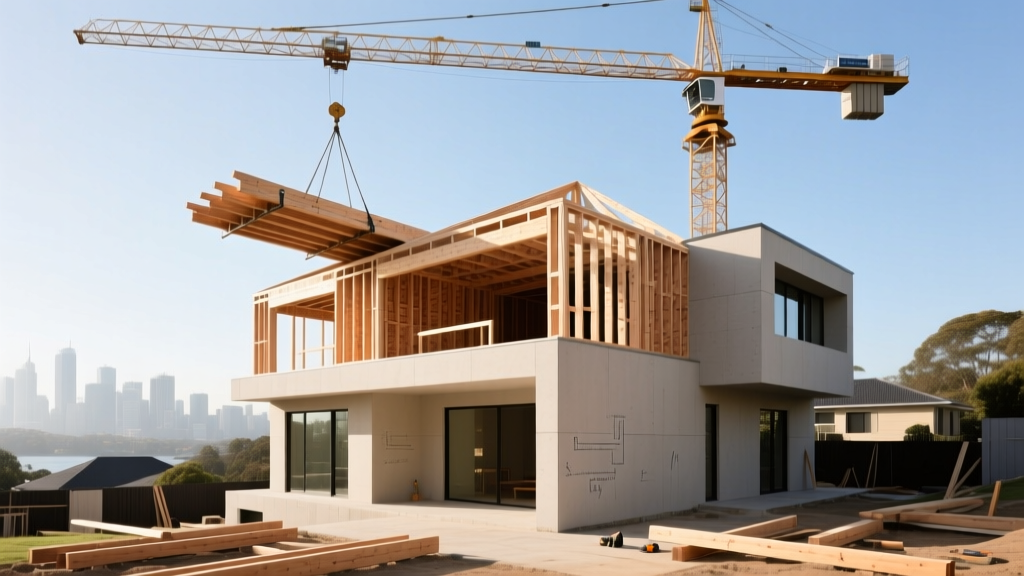
Primary Cost Drivers: Severe slope classifications and Bushfire Attack Level (BAL) ratings. Many blocks in the Forest District and Northern Beaches require BAL-29 or BAL-40 compliance. This mandates the use of toughened glass, non-combustible external cladding (like CSR Hebel PowerPanel), and specialized bushfire shutters. Furthermore, tight, narrow streets often necessitate crane lifts for materials and traffic control permits, adding $15,000–$30,000 to preliminary site costs.
2. Inner West & Eastern Suburbs
Cost Premium: +20% to +40% above base rates.
Primary Cost Drivers: Zero-lot-line building, acoustic attenuation, and heritage constraints. Building a new home or major duplex in areas like Marrickville or Paddington often involves party wall agreements, underpinning adjacent foundations, and strict acoustic treatments (e.g., double-stud walls with Soundstop plasterboard). Access restrictions frequently mean materials must be hand-balled or moved via mini-cranes, severely inflating labour hours.
3. Western Sydney & South West Growth Centres
Cost Premium: Base rate to -5% (Economies of scale).
Primary Cost Drivers: Reactive clay soils. While land access is easier and blocks are generally flat, the soil classification in areas like Marsden Park and Box Hill is frequently Class H1, H2, or E (Highly Reactive). This requires heavily reinforced raft slabs, deep bored piers, and articulated masonry joints, which can add $25,000–$45,000 to the foundation budget compared to a standard Class S (Sand) site.
Hidden Site Costs That Derail Sydney Builds
⚠ Warning: The "Sydney Sandstone" Tax
Sydney is built on the Hawkesbury sandstone shelf. If your geotechnical report identifies shallow bedrock, standard excavation is impossible. You will require specialized rock-breaking equipment (hoe rammers or rock saws). Rock excavation in Sydney currently costs between $180 and $280 per cubic metre, compared to $40–$60 per cubic metre for standard soil. A split-level home requiring 300 cubic metres of rock removal can instantly add $60,000 to your site costs. Always budget a minimum 15% contingency specifically for latent ground conditions.
Drop Edge Beams and Retaining
For sloping blocks, drop edge beams are required to support the slab perimeter. If the fall across the building envelope exceeds 1.5 metres, engineered retaining walls (blockwork or reinforced concrete) are mandatory. A 20-metre long, 1.5-metre high reinforced concrete retaining wall will cost approximately $18,000–$24,000, including drainage and engineering certification.
2026 Material & Labour Cost Matrix
Material selection dictates both the upfront cost and the long-term thermal performance of your Sydney home. Below is a breakdown of premium versus standard material choices prevalent in 2026 custom builds.
- External Cladding: Standard brick veneer ($110–$140/sqm installed) vs. James Hardie Scyon Linea weatherboards ($180–$220/sqm installed). Scyon offers superior coastal durability and modern aesthetic profiles.
- Roofing: Standard Colorbond corrugated ($65–$85/sqm) vs. Colorbond Ultra (Marine grade, $95–$120/sqm). Ultra is mandatory within 100-200m of the surf coast to prevent salt-induced corrosion.
- Glazing: Standard aluminium single-glazed ($350/sqm) vs. Thermally broken uPVC double-glazed ($650–$850/sqm). Given Sydney's intense summer heat, thermally broken frames are now standard in custom builds to meet BASIX (Building Sustainability Index) energy targets without oversizing HVAC systems.
- Flooring: Polished concrete ($90–$130/sqm) vs. Engineered European Oak ($160–$220/sqm). Polished concrete requires early coordination with the slab pourer to ensure a burnished finish, whereas engineered timber can be installed post-lockup.
Strategic Framework: Where to Allocate Your Budget
When managing the cost to build a house in Sydney, capital allocation must prioritize elements that cannot be easily retrofitted. Use this decision matrix to guide your spending.
Invest Heavily (High ROI / Hard to Change)
- Geotechnical site works & foundation engineering
- Thermal envelope (insulation, double-glazing, airtightness)
- Roofing grade (especially in coastal zones)
- Structural steel and load-bearing framing
Cost-Control Areas (Easy to Upgrade Later)
- Landscaping and driveway paving
- Lighting fixtures and smart home accessories
- Appliances and freestanding furniture
- Secondary bathroom tapware and tiles
Frequently Asked Questions
How long does it take to build a house in Sydney in 2026?
A standard volume project home takes 8 to 12 months from slab down to handover. Custom architectural homes typically require 14 to 24 months. However, the pre-construction phase (council DA approval, CDC certification, and engineering) frequently adds an additional 6 to 12 months before ground is even broken.
Are prefab or modular homes cheaper to build in Sydney?
Prefabricated modular homes can reduce on-site labour time by 40%, but the overall cost to build a house in Sydney using modular methods is generally on par with, or slightly higher than, traditional custom builds ($3,500–$4,500/sqm). The primary financial advantage is not raw cost reduction, but the mitigation of weather delays and site access logistics, which are major cost blowout risks in Sydney.
What is the BASIX impact on construction costs?
NSW's BASIX requirements mandate strict thermal and water efficiency. To comply without expensive mechanical heating/cooling systems, builders must invest in higher-spec insulation (e.g., R4.0 ceiling batts instead of R3.0), reflective sarking, and rainwater harvesting tanks. Expect BASIX compliance to add 3% to 5% to the total base build contract.
Written by
Priya KapoorPriya Kapoor is a real estate market analyst and construction economics researcher with expertise in housing affordability, development feasibility, and infrastructure investment. She holds a Master of Regional Planning from Cornell University and previously worked as a senior analyst at CBRE's Investment Properties group, where she modeled returns for $4B in mixed-use development pipelines. Priya now runs an independent research practice advising developers, municipalities, and REITs on construction cost forecasting and market timing. She publishes the quarterly "BuildMat Market Pulse" report tracking material price indices across 12 commodity categories. Based in Austin, TX, Priya serves on the board of Habitat for Humanity Austin and is a marathon runner.
More from Priya Kapoor
View all
Construction Cost
Cost to Build a 1600 Sq Ft Home in 2026: Full Breakdown
Accurate 2026 cost to build a 1600 sq ft home—material, labor, and regional pricing breakdowns included. Plan your budget with real-time estimates.
Aug 11, 2026

Wood & Lumber
Name the Types of Wood for Pressure Treatment and Preservation
Learn how to name the types of wood best suited for pressure treatment. Compare species treatability, chemical retention levels, and 2026 preservation costs.
Aug 4, 2026

Stone & Masonry
Stone Veneer Suppliers Lindenhurst: 2026 Cost Analysis
Analyze 2026 stone veneer costs in Lindenhurst, NY. Compare local supplier pricing, delivery fees, and Suffolk County installation labor rates.
Aug 4, 2026