Larry's Building Materials Costa Mesa: Cost-Saving Sourcing Guide
Discover actionable money-saving strategies for sourcing lumber and supplies at Larry's Building Materials in Costa Mesa to reduce Orange County project costs.

The Economics of Local Sourcing in Orange County
Building in Orange County means navigating premium labor rates, stringent coastal commission regulations, and high logistics costs. When estimating construction costs for residential or light commercial projects in Costa Mesa, Newport Beach, or Irvine, material sourcing dictates your margin. While national big-box retailers offer convenience, independent hubs like Larry's Building Materials in Costa Mesa provide structural pricing advantages that directly impact the bottom line. Understanding how to leverage a local yard requires moving beyond simple price-checking and adopting a tactical procurement strategy tailored to the 2026 supply chain landscape.
Big Box vs. Independent Yard: A 2026 Price Matrix
To understand the true cost difference, we must compare standardized retail pricing against negotiated local yard pricing. The following matrix highlights estimated costs for core structural and finishing materials commonly sourced in Southern California. Note that local yard prices reflect standard pro-account discounts, excluding seasonal volume rebates.
| Material Specification | Big Box Retail Avg (SoCal) | Local Yard Pro Price (Costa Mesa) | Margin Impact |
|---|---|---|---|
| 2x4x8 SPF #2 & Btr (Dimensional) | $4.85 / ea | $3.95 / ea | 18.5% Savings |
| 3/4" CDX Plywood (4x8 Sheathing) | $62.00 / sheet | $54.50 / sheet | 12.1% Savings |
| 1x6 PVC Trimboard (12' White) | $38.50 / ea | $35.00 / ea | 9.1% Savings |
| Simpson Strong-Tie LUS26 Joist Hanger | $1.45 / ea | $1.10 / ea (Bulk Bin) | 24.1% Savings |
| Trex Transcend Composite Decking (16') | $98.00 / board | $92.00 / board | 6.1% Savings |
While the per-unit savings on composite decking or PVC trim might appear marginal, the cumulative savings on structural framing packages (lumber and sheathing) for a standard 2,500 sq. ft. custom home can easily exceed $4,500. For contractors managing multiple builds across the 405 and 55 corridors, this margin is the difference between profitability and breaking even.
4 Tactical Money-Saving Strategies at Local Yards
Securing a pro account is merely the baseline. To maximize your budget when sourcing from Larry's Building Materials Costa Mesa, implement these specific procurement tactics:
1. The 'Cull' and 'Off-Cut' Bin Negotiation
Standard SPF #2 & Btr grading allows for significant wane, knots, and minor bowing. Big box stores discard heavily warped boards or sell them at a slight markdown. Independent yards often accumulate 'cull' lumber that is structurally compromised for long spans but perfectly viable for blocking, bracing, and temporary formwork. Negotiate a flat rate for cull carts—often dropping the cost from $4.50 per 2x4 to $1.25. For a mid-sized remodel requiring extensive fire-blocking and structural sheathing clips, this eliminates the need to cut into premium straight-grade stock.
2. Mill-Direct Ordering for High-Volume Trims
If your project specifies extensive exterior millwork, such as clear cedar siding or specialized AZEK beadboard, do not buy from the yard's retail shelves. Work with the local yard's purchasing agent to set up a mill-direct order. By committing to a full unit (typically 400-600 pieces), the yard bypasses their standard wholesale markup, passing a 15% to 22% discount directly to you. The trade-off is a 3-to-4 week lead time, which requires precise scheduling but drastically reduces material overhead.
3. Strategic Fastener and Hardware Consolidation
Contractors often bleed money buying Simpson Strong-Tie connectors and Grip-Rite fasteners in small, retail-boxed quantities. Local yards stock bulk bins and full-carton quantities. Purchasing a 50-lb box of 3" galvanized ring-shank nails instead of ten 5-lb retail boxes reduces fastener costs by up to 35%. Furthermore, buying structural screws (like GRK RSS) in bulk contractor packs rather than retail blister packs yields similar savings.
4. Q4 Composite and Hardscape Clearouts
Local yards in coastal regions experience a sharp drop in outdoor living construction from November through January. During this window, yards need to clear floor space for spring framing lumber. Approach the yard manager in late Q4 to negotiate aggressive discounts on leftover composite decking bundles, pavers, and retaining wall blocks. It is common to secure 20% to 30% off retail for taking entire, mixed-dye-lot pallets, provided you can store them on your own job site or warehouse.
Navigating Delivery Fees and Routing in SoCal
Delivery logistics in Orange County can erode material savings if not managed correctly. Transporting heavy materials from inland distributors to coastal sites involves navigating PCH traffic, tight residential streets, and strict municipal noise ordinances.
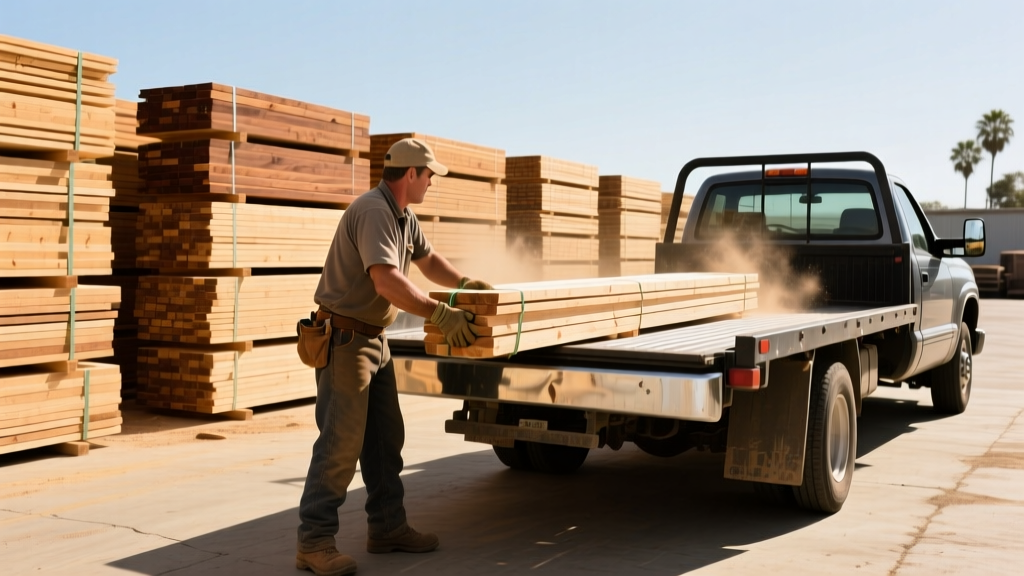
'The secret to local yard delivery isn't just the drop fee; it's the truck type. Requesting a flatbed with a forklift drop (moffett) is cheaper than a boom truck, but requires a clear, paved staging area on-site. If you're building in the tight lots of the Balboa Peninsula, you must spec a smaller rig and expect a premium routing surcharge.'
— Senior Estimator, Orange County Custom Homes
To minimize delivery costs, consolidate your framing, sheathing, and structural hardware into a single primary drop. Subsequent 'will-call' pickups for forgotten items in a company truck cost you labor hours (valued at $65-$90/hr in SoCal) and fuel. A standard flatbed delivery from a Costa Mesa yard to Newport Beach typically ranges from $125 to $175, whereas emergency same-day boom truck deliveries can exceed $350. Plan your material takeoffs with a 5% overage on sheathing and framing to eliminate mid-week emergency deliveries.
Managing Volatility and Locking in Pricing
Lumber markets remain susceptible to geopolitical shifts, mill closures, and seasonal demand spikes. According to the FRED BLS Producer Price Index for Lumber, softwood pricing can swing 15% to 20% within a single quarter. The NAHB Building Materials Prices Index further corroborates the ongoing volatility in engineered wood and structural components.
When estimating a project that won't break ground for 60 to 90 days, utilize a 'Price Hold' agreement. Independent yards like Larry's are often willing to lock in current pricing for up to 30 days on committed framing packages, provided you put down a 10% deposit. This shields your estimated budget from sudden market spikes. For engineered wood products, always verify that the materials meet current local structural codes by referencing the APA Engineered Wood Association specifications, ensuring your cost estimates don't require expensive mid-build change orders due to code compliance failures.
Material-Specific Sourcing Rules
Not every material should be sourced locally. Use this decision matrix to determine where to allocate your procurement budget:
- Dimensional Lumber & Sheathing: Buy local. The weight and volume make shipping costs prohibitive from online suppliers, and local yards allow for hand-picking straight studs for visible framing or trim backing.
- Structural Steel & Beams: Buy local. LVL (Laminated Veneer Lumber) and steel I-beams require specialized transport and precise cutting. Local yards offer on-site cutting and boom-truck delivery directly to the foundation.
- Specialty Finish Hardware: Buy direct/online. High-end architectural door hinges, smart-lock preps, and specialty tile setting compounds are often marked up 30% or more at local yards. Source these from specialized online distributors.
- Insulation & Drywall: Buy local, but bid it out. Insulation and drywall are high-volume, low-margin commodities. Local yards will often match or beat specialized drywall suppliers if you bundle the delivery with your structural framing package.
By treating Larry's Building Materials Costa Mesa not just as a retail store, but as a strategic logistics partner, estimators and builders can systematically shave thousands of dollars off their project overheads. The key lies in leveraging pro-account autonomy, optimizing delivery routing, and understanding the granular pricing differences between commodity structural materials and specialty finishes.
Written by
David NakamuraDavid Nakamura is a licensed architect (AIA) and construction technology writer focused on sustainable building methods, mass timber engineering, and high-performance building envelopes. He holds a Master of Architecture from the University of Washington and is a certified Passive House Consultant (CPHC). David spent eight years at the Seattle firm Mithun, where he led the design of three LEED Platinum projects, before founding his own practice specializing in net-zero residential design. He serves on the editorial advisory board of GreenBuilder Magazine and has authored peer-reviewed papers on cross-laminated timber (CLT) connections for the Journal of Structural Engineering. In his spare time, David teaches woodworking at Pratt Fine Arts Center and kayaks the Puget Sound.
More from David Nakamura
View all
Construction Cost
Labor Cost to Build a Deck Per Sq Ft: 2026 Installation Guide
Discover the exact labor cost to build a deck per sq ft in 2026. This installation guide breaks down contractor rates, complexity factors, and hidden fees.
Aug 4, 2026

Construction Cost
How Much Does It Cost to Build a 3 Bedroom House? Financing Guide
Learn exactly how much it costs to build a 3 bedroom house and explore 2026 financing options, construction loan types, and budget frameworks for your build.
Aug 4, 2026

Construction Cost
Cost to Build a Tennis Court: 2026 Guide
How much does it cost to build a tennis court in 2026? Breakdowns for asphalt, concrete, and synthetic surfaces plus fencing and lighting.
Jul 30, 2026