2026 Cost to Build a Pool: Concrete vs. Fiberglass vs. Vinyl
Compare the 2026 cost to build a pool across concrete, fiberglass, and vinyl. Get exact pricing, installation timelines, and long-term maintenance data.

The True Cost to Build a Pool: Beyond the Base Quote
2026 National Average Baseline
Calculating the exact cost to build a pool requires moving past advertised starting prices. In 2026, a fully equipped, turnkey inground pool averages between $65,000 and $115,000, heavily dictated by shell material, site accessibility, and regional labor rates. The lowest entry point for a basic 14x28 vinyl liner pool is roughly $48,000, while custom shotcrete designs with integrated spas and automation routinely exceed $150,000.
Homeowners often receive base quotes that exclude critical structural upgrades, permitting, and long-term maintenance realities. According to industry data compiled by Angi, excavation, soil hauling, and utility rerouting alone can add 15% to 22% to the initial contract price. This guide breaks down the structural economics of the three primary pool types—shotcrete, fiberglass, and vinyl—providing the material specifications and hidden cost multipliers you need to evaluate contractor bids accurately.
Material Matrix: Shotcrete vs. Fiberglass vs. Vinyl
| Shell Material | 2026 Turnkey Cost Range | Install Timeline | Shell Lifespan | Design Flexibility |
|---|---|---|---|---|
| Shotcrete (Concrete) | $75,000 – $150,000+ | 3 – 6 Months | 50+ Years | Unlimited (Custom) |
| Fiberglass | $55,000 – $95,000 | 3 – 6 Weeks | 25 – 30 Years | Limited (Pre-molded) |
| Vinyl Liner | $48,000 – $75,000 | 4 – 8 Weeks | 7 – 12 Years (Liner) | Moderate (Panel-based) |
Deep Dive: Shotcrete Pool Economics
Shotcrete (wet-mix) and gunite (dry-mix) are pneumatically applied concrete mixtures sprayed over a steel rebar grid. For structural integrity, the Pool & Hot Tub Alliance (PHTA) and ACI 318 standards mandate a minimum compressive strength of 3,500 PSI and a shell thickness of 8 to 12 inches. A standard #3 and #4 rebar grid spaced at 10 inches on center is the baseline for preventing structural cracking in expansive clay soils.
Interior Finish Upgrades: Marcite vs. Pebble
The base cost of a shotcrete pool typically includes standard white marcite (plaster). While marcite is the cheapest option, it is highly porous, prone to calcium scaling, and requires acid washing every 3 to 5 years. It typically lasts 7 to 10 years before needing a full drain-and-replaster.
- Standard White Marcite: Included in base price (Lifespan: 7-10 years).
- Quartz Aggregate (e.g., Diamond Brite): Adds $4,500 – $6,500. Denser and more stain-resistant (Lifespan: 12-15 years).
- Pebble Finishes (e.g., PebbleTec): Adds $8,000 – $14,000. The premium standard for 2026, offering a 20+ year lifespan and superior chemical resistance.
Deep Dive: Fiberglass Pool Economics
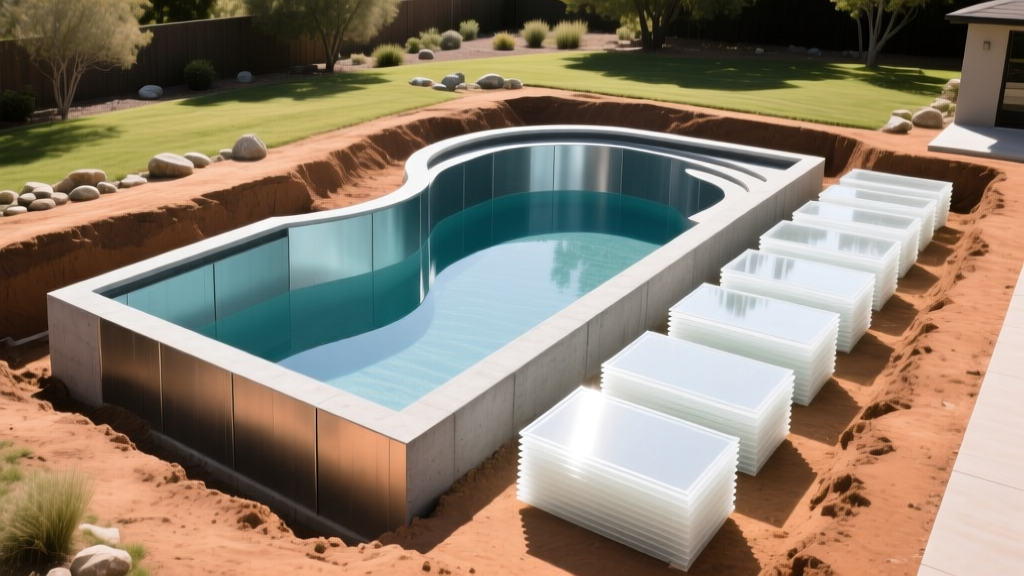
Fiberglass pools are manufactured off-site in a single, seamless mold and lowered into the excavation via crane. The shell consists of chopped fiberglass strands, woven roving, and vinyl ester resin, topped with an ISO/NPG gelcoat layer that is typically 18 to 22 mils thick. Because the gelcoat is non-porous, fiberglass requires significantly fewer algaecides and less acid balancing than concrete.
The Crane Access & Backfill Hidden Costs
The base price of a fiberglass shell rarely includes the logistical realities of delivery and installation. If your property lacks a minimum 12-foot wide, unobstructed path for a semi-truck and 100-ton crane, you will incur mobilization fees for specialized equipment.
- Standard Crane Lift (Accessible): $1,500 – $2,500.
- Extended Reach / Spider Crane (Limited Access): $4,000 – $7,500+.
- Helicopter Lift (Extreme Inaccessibility): $15,000+ (Rare, but required for steep cliffside or dense urban lots).
Furthermore, proper backfilling is non-negotiable. Fiberglass shells must be backfilled with clean, washed 3/8-inch gravel (chip stone), never sand or native dirt. Gravel locks together and drains instantly, preventing hydrostatic pressure buildup that can cause the pool shell to "pop" out of the ground during heavy rains if the water table rises.
Deep Dive: Vinyl Liner Pool Economics
Vinyl liner pools utilize a custom-cut sheet of PVC suspended over a structural framework of galvanized steel, aluminum, or structural polymer panels. While they offer the lowest initial cost to build a pool, they carry the highest long-term maintenance liabilities.
Liner Thickness and Track Systems
When reviewing bids, scrutinize the liner thickness specified. Liners are measured in mils (1 mil = 1/1000th of an inch).
- 20-Mil Liner: The budget standard. Prone to tearing from dog claws, sharp toys, or shifting coping. Lasts 5-7 years.
- 28-Mil to 30-Mil Liner: The recommended standard for 2026. Often features a reinforced woven polyester backing. Costs $1,200 – $1,800 more upfront but extends lifespan to 9-12 years.
The track system (the coping receiver that holds the liner bead) must be heavy-duty aluminum or structural polymer. Avoid contractors using thin-gauge steel tracks, which will rust and deform within a decade, requiring a $3,000+ track replacement before a new liner can be installed.
Site Preparation: The Silent Budget Killers
Excavation estimates assume "standard soil" (loam or light clay). When contractors hit bedrock or a high water table, change orders escalate rapidly.
| Site Condition | Required Mitigation | Estimated Cost Adder |
|---|---|---|
| Solid Bedrock / Ledge | Hydraulic hammer excavation or blasting | $4,500 – $12,000 |
| High Water Table | Wellpoint dewatering system during build | $2,500 – $6,000 |
| Expansive Clay Soil | Over-excavation and engineered gravel base | $2,000 – $4,500 |
| Utility Rerouting | Moving main sewer/gas lines | $3,000 – $8,000 |
Always require a geotechnical soil test or a "rock clause" cap in your contract. A rock clause limits your financial exposure to bedrock removal, capping the contractor's hourly rate for hydraulic hammering at a pre-agreed maximum.
Long-Term Cost of Ownership (10-Year Projection)
The initial construction cost is only half the financial equation. The U.S. Department of Energy notes that pool equipment is a major residential energy draw, but modern variable-speed pumps drastically alter the 10-year ledger.
| 10-Year Cost Category | Shotcrete | Fiberglass | Vinyl Liner |
|---|---|---|---|
| Initial Construction | $95,000 | $70,000 | $55,000 |
| Interior Replacement (Yr 7-10) | $0 (Pebble lasts 20+ yrs) | $0 | $5,500 (28-mil liner) |
| Chemicals & Algaecides (10 Yrs) | $4,500 | $2,200 | $3,800 |
| Energy (Variable Speed Pump) | $3,500 | $3,500 | $3,500 |
| Total 10-Year Cost | $103,000 | $75,700 | $67,800 |
While vinyl remains the cheapest over a decade, fiberglass offers the highest return on investment regarding time spent on maintenance and chemical balancing. Shotcrete commands a premium but is the only option that adds proportional appraisal value to luxury real estate.
Expert Decision Framework
Use this matrix to align your budget and lifestyle with the correct shell material:
- Choose Vinyl If: Your absolute maximum budget is $65,000, you plan to move within 10 years, and you want a custom shape without the shotcrete premium.
- Choose Fiberglass If: Your budget is $70,000–$90,000, you have excellent crane access, you despise weekly pool brushing, and you want the lowest chemical footprint.
- Choose Shotcrete If: Your budget exceeds $95,000, you require a highly custom geometric shape, negative edge, or integrated tanning ledges, and you want a permanent structural asset that increases property value.
Written by
James ThorntonJames Thornton is a construction industry veteran with 25 years of hands-on experience in wood framing, lumber grading, and residential building codes. He started as a framing carpenter in rural Oregon, earned his ICC Residential Building Inspector certification, and eventually became a senior plan reviewer for the City of Portland Bureau of Development Services. James holds a B.S. in Wood Science & Technology from Oregon State University and is a certified lumber grader through the West Coast Lumber Inspection Bureau (WCLIB). He has inspected over 3,000 residential construction sites and authored the city's internal guide on advanced framing techniques (2x6 at 24" O.C.). James lives in Bend, OR, where he builds custom timber-frame cabins and competes in lumberjack sports.
More from James Thornton
View all
Insulation
Best Home Insulation Materials: Complete 2026 Guide
Compare top home insulation materials for 2026. Find R-values, installed costs per square foot, and best uses for fiberglass, spray foam, and mineral wool.
Aug 4, 2026

Sustainable Building
Certify Your Green Building Material for LEED and WELL
Step-by-step guide to certifying a green building material for LEED v5 and WELL v2. Master EPDs, HPDs, and VOC limits for 2026 project specifications.
Aug 4, 2026

Stone & Masonry
Veneer Stacked Stone Panels: Interior Design & Style Showcase
Discover how veneer stacked stone panels transform interiors. Explore modern design profiles, material pairings, and technical installation specs.
Aug 4, 2026