How Much Would It Cost to Build a Wind Turbine: DIY Savings
Discover exactly how much it costs to build a wind turbine. Explore DIY money-saving strategies, component sourcing, and hidden budget traps.

The Real Answer: How Much Would It Cost to Build a Wind Turbine?
When property owners ask how much would it cost to build a wind turbine, the answer depends entirely on the system's capacity, your willingness to sweat, and your proximity to the grid. A professionally installed, grid-tied 10kW system can easily exceed $65,000, while a resourceful DIYer can build a functional 1kW off-grid micro-turbine for under $1,200. The sweet spot for most rural homesteads is a 3kW to 5kW system, which balances material costs with meaningful energy offsets.
Quick Cost Snapshot (2026 Estimates)
- 1kW DIY Off-Grid: $800 – $1,500 (Direct drive, carved wood blades, DIY pipe tower)
- 3kW Hybrid Kit: $6,500 – $9,000 (Pre-manufactured alternator, extruded blades, guyed lattice)
- 5kW Pro-Installed Grid-Tied: $20,000 – $32,000 (Includes trenching, SMA inverter, permitting)
- 10kW Commercial-Grade: $45,000 – $75,000 (Hydraulic tilt-up tower, 3-phase grid integration)
According to the U.S. Department of Energy, small wind turbines typically cost between $3,000 and $8,000 per kilowatt of capacity when professionally installed. However, by leveraging money-saving strategies and avoiding common procurement mistakes, you can slash these baseline figures by 40% to 60%.
Grid-Tied vs. Off-Grid: The Biggest Cost Multiplier
The single most expensive decision in your build is whether you will store energy in batteries or push it to the utility grid. Grid-tied systems require a specialized grid-interactive inverter (like the SMA Sunny Boy or Fronius Primo) and rigorous utility interconnection studies, which can add $2,500 to $5,000 in soft costs and hardware. However, you avoid the massive capital expenditure of battery banks.
Off-grid systems bypass utility red tape but demand robust energy storage. In 2026, Lithium Iron Phosphate (LiFePO4) server-rack batteries have become the standard, offering 6,000+ cycle lives. A 15kWh LiFePO4 bank (such as the SOK or EG4 48V models) will cost roughly $4,500 to $6,000. If you attempt to save money by using refurbished lead-acid forklift batteries, you will inevitably spend more on maintenance, ventilation infrastructure, and premature replacements within 36 months.
| System Type | Primary Hardware Cost | Hidden / Soft Costs | Maintenance Profile |
|---|---|---|---|
| Grid-Tied | $1,800 - $3,500 (Inverter) | $1,500+ (Utility studies, permits) | Low (No batteries) |
| Off-Grid | $4,500 - $8,000 (Batteries + Charge Controller) | $500 (Dump loads, battery enclosures) | High (Cell balancing, thermal management) |
| Hybrid | $6,000 - $10,000 (Bi-directional inverter + small bank) | $2,000 (Transfer switches, critical loads panel) | Medium |
Money-Saving Strategy 1: Sourcing Refurbished & Surplus Components
The turbine nacelle (the housing containing the generator) is the heart of the system. Commercial alternators from brands like Bergey or Jacobs are incredibly durable but carry premium price tags. To save money, experienced DIY builders source surplus Permanent Magnet Alternators (PMAs) from industrial liquidations or specialized wind-energy forums.
When selecting a surplus PMA, prioritize low RPM (Revolutions Per Minute) cut-in speeds. A PMA that requires 400 RPM to begin charging is useless in areas with average wind speeds of 8 mph. Look for models with a cut-in speed below 150 RPM. Furthermore, avoid automotive alternators; they require an external power source to energize the electromagnet and suffer from poor efficiency at low RPMs. A true PMA generates power the moment it spins.
The Blade Dilemma: Wood vs. PVC vs. Composite
Do not use PVC pipe for turbine blades. It is a dangerous, albeit common, beginner mistake. PVC becomes brittle in UV light and cold temperatures, leading to catastrophic blade failure at high RPMs, which can destroy your alternator and tower. Instead, carve your own blades from Sitka Spruce, Douglas Fir, or Western Red Cedar. Hand-carving a set of three 7-foot wooden blades takes roughly 15 hours of labor but saves $800 to $1,200 compared to buying factory-molded fiberglass or carbon fiber composites. Seal the wood with a high-quality marine-grade epoxy and UV-resistant polyurethane to ensure a 10-year lifespan.
Money-Saving Strategy 2: DIY Tower Construction
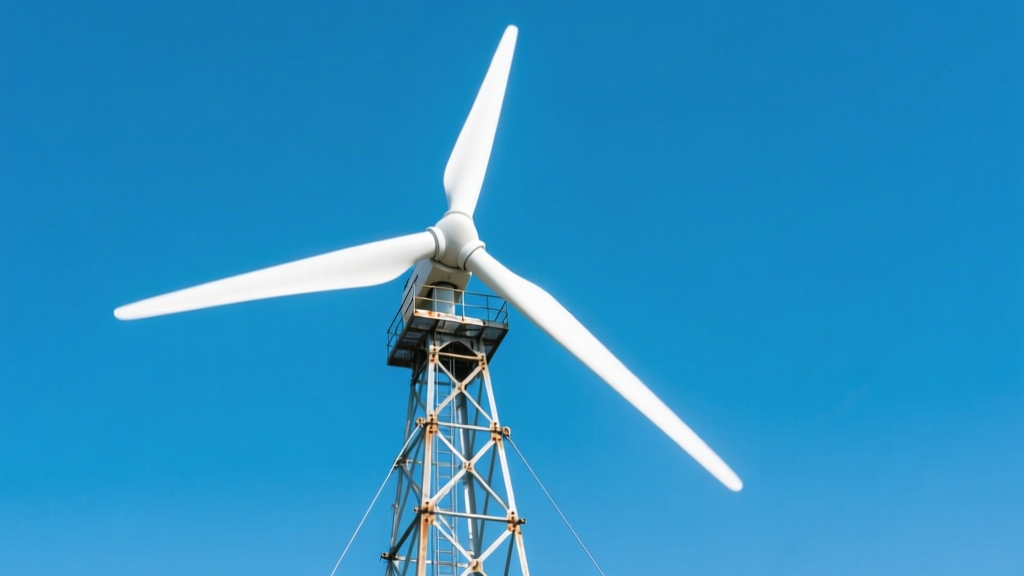
Towers and their foundations often account for 30% to 50% of the total project cost. The two most viable options for budget-conscious builders are the guyed pipe tower and the freestanding lattice tower.
- Guyed Pipe Tower (Cheapest): Constructed from 20-foot sections of 3-inch or 4-inch Schedule 40 galvanized steel pipe, joined by heavy-duty slip joints and stabilized by 3/16-inch aircraft cable guy wires. A 60-foot guyed pipe tower can be built for under $1,200 in materials. The drawback is the large footprint required for the guy wire anchors (a 60-foot tower needs a 90-foot radius clear of obstacles).
- Tilt-Up Hinge Mechanism: By installing a heavy-duty steel hinge at the base of a guyed tower and using a winch or a tractor, you can raise and lower the turbine for maintenance without hiring a crane. This single design choice saves thousands in long-term servicing costs.
- Freestanding Lattice (Most Expensive): Requires massive concrete foundations and heavy steel sections. While it saves yard space, it is rarely justifiable for a budget DIY build unless local zoning strictly prohibits guy wires.
Navigating Permits and Interconnection Fees
Zoning laws and HOA restrictions can kill a wind project before it begins. Many rural counties have blanket height restrictions of 35 feet, which is entirely inadequate for a wind turbine (the blades must clear local tree lines and ground turbulence by at least 30 feet, usually requiring an 80-foot to 100-foot tower).
To save money on legal and permitting fees, apply for a 'conditional use permit' or a 'variance' based on renewable energy generation. Before spending a dime on engineering stamps, consult the DSIRE database (Database of State Incentives for Renewables & Efficiency) to identify local grants, property tax exemptions, and net-metering laws that can offset your initial capital outlay. Some states offer aggressive rebates that cover up to 40% of small wind installation costs, effectively making the DIY labor entirely profitable.
Hidden Costs That Destroy Turbine Budgets
When calculating how much it costs to build a wind turbine, novices frequently overlook the balance-of-system (BOS) components and environmental protections. Failing to budget for these will result in stranded projects or burnt-out electronics.
⚠️ Critical Edge Cases & Failure Modes
- Dump Loads: In off-grid or hybrid systems, when your batteries reach 100% capacity and the wind is still blowing, the turbine has nowhere to send the energy. Without an automated dump load (a bank of heavy-duty resistors that convert excess electricity into heat), the turbine will overspeed and literally tear itself apart. Budget $300 to $600 for a MidNite Solar charge controller with integrated diversion load capabilities.
- Slip Rings vs. Twisted Cable: Cheaper DIY designs use slip rings to prevent the tower cable from twisting as the turbine yaws. Slip rings degrade, cause voltage drops, and spark. Spend the extra $150 on high-quality, heavy-gauge tinned marine wire and install a mechanical cable-limit switch to prevent over-twisting.
- Lightning Protection: A 60-foot steel tower is a lightning rod. You must install a dedicated copper grounding rod tied directly to the tower base, separate from your home's electrical ground, to prevent a strike from frying your inverter and home appliances.
ROI and Payback Period: When Does It Actually Save Money?
The financial viability of a DIY wind turbine hinges on your local wind resource and utility rates. According to data from the National Renewable Energy Laboratory (NREL), a turbine requires an average annual wind speed of at least 10 mph (measured at hub height) to be economically viable.
If you spend $8,000 building a 3kW off-grid system that generates 4,500 kWh annually, and your local utility charges $0.18 per kWh, your turbine offsets $810 per year. That yields a raw payback period of roughly 9.8 years. However, if you utilize federal tax credits, state rebates, and avoid utility connection fees for a remote off-grid cabin (which can exceed $20,000 for trenching and pole installation), the system pays for itself immediately. Ultimately, the cheapest turbine is the one built with scavenged industrial components, hand-carved wooden blades, and a tilt-up guyed tower that you can maintain yourself for decades.
Written by
Marcus ChenMarcus Chen is a licensed structural engineer (PE) and building materials analyst with over 12 years of experience across residential, commercial, and industrial construction. He holds a Master of Science in Civil Engineering from UC Berkeley and spent six years at Thornton Tomasetti before transitioning to independent consulting and technical writing. Marcus specializes in material selection for seismic-prone regions, concrete reinforcement strategies, and lifecycle cost analysis. His work has been cited by the American Concrete Institute (ACI) and the Structural Engineers Association of California (SEAOC). When he is not on a job site or at his desk, you will find him hiking the Sierra Nevada or restoring a 1920s craftsman bungalow in Oakland, CA.
More from Marcus Chen
View all
Construction Cost
How Much Did the Eiffel Tower Cost to Build?
How much did the Eiffel Tower cost to build in 1889? We adjust for inflation and compare its budget to modern skyscraper construction.
Aug 4, 2026

Fire Resistance
What Is a Fire Resistant Material? Testing & Certification Guide
Discover what is a fire resistant material through ASTM and UL testing. Learn how fire ratings, certifications, and assemblies work in construction.
Aug 4, 2026

Construction Cost
How Much Did the Burj Khalifa Cost to Build?
How much did the Burj Khalifa cost to build? We break down the $1.5B project and extract 5 money-saving strategies for your next build.
Jul 30, 2026