Cost to Build a Race Track: Full Breakdown
How much does it cost to build a race track? From 1/4-mile karting circuits to FIA-grade road courses—material and labor pricing.

The True Cost Spectrum: From Karting to FIA Grade 1
When evaluating how much it costs to build a race track, the final figure is entirely dictated by the intended vehicle class, track length, and homologation requirements. A high-speed road course demands vastly different engineering tolerances than a low-speed karting circuit. The primary cost drivers are earthwork stabilization, polymer-modified asphalt paving, specialized drainage, and FIA-homologated safety infrastructure.
Below is a baseline cost matrix for the paving and core safety infrastructure of various track types. Note that these figures exclude land acquisition, grandstands, and permanent building structures, focusing strictly on the track envelope and essential operational systems.
| Track Type | Typical Length | Paving & Base Cost (Per Mile) | Total Track Envelope Cost |
|---|---|---|---|
| Outdoor Karting Circuit | 0.5 - 0.8 miles | $350,000 - $500,000 | $250,000 - $600,000 |
| Dirt Oval / Rallycross | 0.25 - 1.0 miles | $80,000 - $150,000 (Clay/Dirt) | $150,000 - $400,000 |
| Club-Level Asphalt Road Course | 1.5 - 2.5 miles | $1,200,000 - $1,800,000 | $3,000,000 - $7,000,000 |
| Professional Drag Strip (1/4 mi) | 0.25 miles (plus shutdown) | $2,000,000+ (High-friction prep) | $1,500,000 - $4,000,000 |
| FIA Grade 1 (Formula 1 Spec) | 3.0 - 4.5 miles | $3,500,000 - $5,000,000+ | $40,000,000 - $100,000,000+ |
Subgrade Preparation and Earthwork Tolerances
The most common point of catastrophic failure in race track construction is inadequate subgrade preparation. Unlike public highways, which can tolerate minor differential settling over decades, a race track surface must maintain millimeter-level tolerances to prevent vehicle instability at high speeds. According to guidelines referenced by the Federal Highway Administration for specialized heavy-duty pavements, the subgrade must be uniformly compacted to at least 95% of the Modified Proctor maximum dry density.
Proof-Rolling and Geogrid Integration
Before laying the aggregate base, contractors must perform "proof-rolling" using a fully loaded tandem-axle dump truck (minimum 25 tons). Any yielding, rutting, or pumping of moisture indicates a soft spot that must be excavated and replaced with engineered fill. In areas with expansive clay soils, a biaxial geogrid (such as Tensar BX1200) is placed directly over the subgrade to distribute lateral loads and prevent the aggregate base from punching into the soft soil.
The Asphalt Matrix: Why Highway Mixes Fail
Standard Department of Transportation (DOT) highway asphalt is engineered for vertical compression from heavy trucks. Race tracks, however, subject the pavement to extreme lateral shear forces from cornering, severe longitudinal braking loads, and intense surface heat generated by tire friction. Standard asphalt will rut, tear, and unravel under these conditions within a single season.
Performance Graded (PG) Binders and SMA
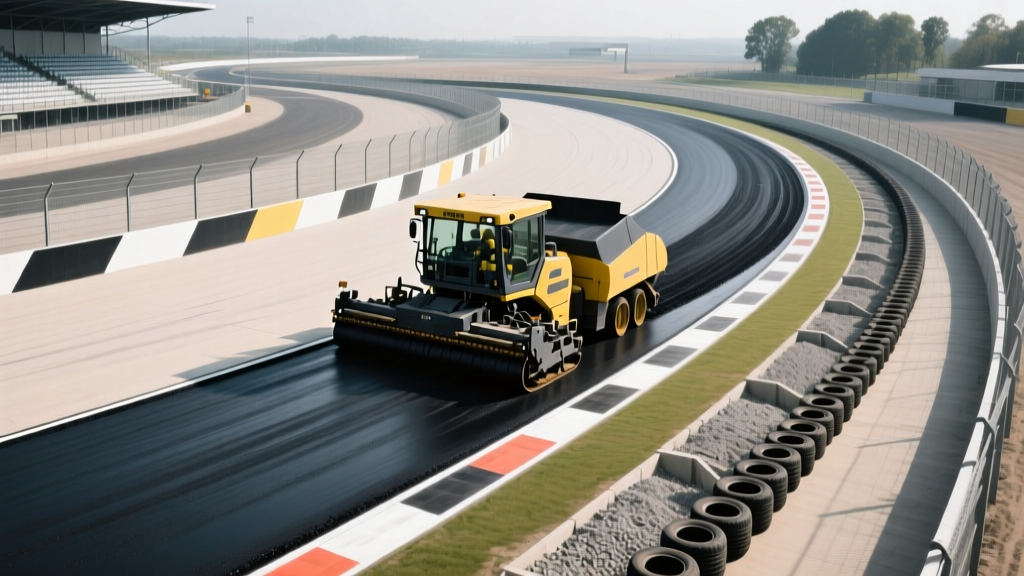
Race track asphalt requires a highly modified binder. The National Asphalt Pavement Association (NAPA) outlines the necessity of Performance Graded (PG) binders tailored to extreme stress. While a standard highway might use a PG 64-22 binder, a race track requires a minimum of PG 76-22, and often PG 82-22 for high-speed braking zones. These polymer-modified asphalt (PMA) binders resist rutting at high surface temperatures while maintaining flexibility to prevent thermal cracking.
The mix design typically utilizes Stone Matrix Asphalt (SMA) or a highly modified Superpave design with a coarse, angular aggregate structure. The typical paving profile consists of:
- Base Course: 2.5 to 3.0 inches of PG 76-22 PMA with larger aggregate (3/4-inch nominal maximum size) for structural strength.
- Surface Course: 1.5 inches of PG 82-22 PMA with fine, highly angular aggregate (1/2-inch or 3/8-inch nominal size) to provide micro-texture and grip.
- Tack Coat: A heavy application of SS-1h or polymer-modified tack coat (0.05 to 0.10 gallons per square yard) between lifts to prevent delamination under lateral shear.
Drainage and Cross-Slope Engineering
Standing water on a race track is a lethal hazard. The pavement must be designed to shed water instantly without creating cross-slopes steep enough to upset the aerodynamic balance or mechanical grip of a race car. The optimal crossfall (cross-slope) for a track straight is between 1.5% and 2.0%. In banking or superelevated curves, the slope transitions to match the designed racing line, requiring complex 3D machine-control grading during the base installation.
Drainage infrastructure must be placed entirely outside the track limits. Slotted HDPE pipe drains and precast concrete catch basins are installed behind the outer curbing. French drains utilizing washed #57 stone wrapped in non-woven geotextile fabric are placed in gravel traps to ensure rapid subsurface water evacuation, keeping the trap surface dry and functional for decelerating vehicles.
Safety Infrastructure and Homologation
If you intend to host sanctioned events, your track must meet the safety standards set by governing bodies like the FIA or FIM. The Fédération Internationale de l'Automobile (FIA) mandates specific barrier systems based on the track's speed profile and the angle of potential impact.
Barrier Systems Breakdown
| Barrier Type | Application | Estimated Installed Cost |
|---|---|---|
| W-Beam Steel Guardrail (Armco) | Low-angle, high-speed impact zones; perimeter fencing support. | $55 - $85 per linear foot |
| Tecpro / Polyethylene Foam Blocks | High-speed, acute-angle impact zones (e.g., outside of tight hairpins). | $450 - $650 per 3-meter block |
| Conveyor Belt Tire Bundles | Low-speed impact zones, pit lane entry/exit, and runoff area boundaries. | $25 - $40 per linear foot (bolted to concrete curb) |
| Debris Fencing (Chain Link + Screen) | Spectator protection; 11-gauge wire, 10-12 ft high with wind screens. | $45 - $75 per linear foot |
Pit Lane and Facility Specifics
A critical, often overlooked cost variable is the pit lane surface. Race fuels, synthetic oils, and solvent-based tire cleaners will rapidly dissolve the asphalt binder in standard paving mixes, leading to severe raveling and potholing within months. Pit boxes and the primary pit lane must be paved with Portland Cement Concrete (PCC).
Specify a minimum 4,000 PSI concrete mix with a hard-trowel finish, followed by a very light broom texture to provide slip resistance without damaging low-clearance aerodynamic components. The concrete must be saw-cut with control joints spaced every 15 feet to manage thermal expansion, and joints should be sealed with a high-modulus, fuel-resistant polyurethane sealant to prevent fluid infiltration into the sub-base.
Timing and Electronics Integration
Modern race tracks require embedded timing infrastructure. This involves saw-cutting the fresh asphalt or concrete to a depth of 1.5 inches and embedding transponder timing loops (such as those manufactured by Mylaps or ALMS). Each loop installation, including the trenching, wire laying, epoxy backfilling, and connection to the trackside decoder node, costs between $2,500 and $4,000. A standard road course requires a minimum of three loops (Start/Finish, and two sector splits), but professional tracks often install loops at every corner apex to provide granular telemetry data.
Common Budget Pitfalls to Avoid
- Ignoring the Runoff Areas: Paving the track is only half the battle. FIA standards require specific depths of clean, washed pea gravel (typically 8 to 12 inches deep) in runoff zones. Sourcing and placing hundreds of tons of spec-grade gravel is a major line item often omitted from early estimates.
- Curbing Failures: Pre-cast concrete curbing must be doweled into the asphalt base and backfilled with concrete. If curbing is simply laid on top of the asphalt, the lateral forces of cars striking the kerbs will dislodge them within weeks, tearing the surrounding asphalt mat.
- Inadequate Lighting for Night Racing: If night operations are planned, standard sports lighting is insufficient. High-speed tracks require specialized, flicker-free LED arrays with a minimum average illuminance of 500 lux on the track surface, requiring heavy-duty galvanized steel poles and complex electrical trenching.
Building a race track is a highly specialized civil engineering project. By prioritizing polymer-modified asphalt, rigorous subgrade proof-rolling, and homologated safety systems, developers can ensure a surface that withstands the extreme physics of motorsport while minimizing long-term maintenance liabilities.
Written by
Marcus ChenMarcus Chen is a licensed structural engineer (PE) and building materials analyst with over 12 years of experience across residential, commercial, and industrial construction. He holds a Master of Science in Civil Engineering from UC Berkeley and spent six years at Thornton Tomasetti before transitioning to independent consulting and technical writing. Marcus specializes in material selection for seismic-prone regions, concrete reinforcement strategies, and lifecycle cost analysis. His work has been cited by the American Concrete Institute (ACI) and the Structural Engineers Association of California (SEAOC). When he is not on a job site or at his desk, you will find him hiking the Sierra Nevada or restoring a 1920s craftsman bungalow in Oakland, CA.
More from Marcus Chen
View all
Construction Cost
How Much Did the Eiffel Tower Cost to Build?
How much did the Eiffel Tower cost to build in 1889? We adjust for inflation and compare its budget to modern skyscraper construction.
Aug 4, 2026

Fire Resistance
What Is a Fire Resistant Material? Testing & Certification Guide
Discover what is a fire resistant material through ASTM and UL testing. Learn how fire ratings, certifications, and assemblies work in construction.
Aug 4, 2026

Construction Cost
How Much Did the Burj Khalifa Cost to Build?
How much did the Burj Khalifa cost to build? We break down the $1.5B project and extract 5 money-saving strategies for your next build.
Jul 30, 2026