How Much Does It Cost to Build an F1 Car? 2026 Guide
Discover how much it costs to build an F1 car in 2026. We break down the $15M+ physical build cost, power unit pricing, and FIA cost cap limits.

The Physical vs. Operational Cost Divide
When engineers and financiers evaluate how much does it cost to build a F1 car, the answer requires splitting the budget into two distinct categories: the physical manufacturing cost of a single track-ready vehicle, and the operational research and development (R&D) cost required to design it. In 2026, the physical build cost of a single Formula 1 car—comprising raw materials, machining, autoclave curing, and assembly—ranges between $15 million and $20 million. However, the intellectual property, wind tunnel testing, and computational fluid dynamics (CFD) required to conceive that car push a team's annual operational expenditure to the FIA's regulated cost cap limit of approximately $140 million.
- Physical Car (Materials & Assembly): $15M - $20M
- Power Unit (Marginal Build Cost): $2M - $3M per unit
- Annual Team Cost Cap (R&D + Operations): ~$140M (Base)
- Steering Wheel Electronics: $100,000+
2026 Component Cost Matrix: Where the Money Goes
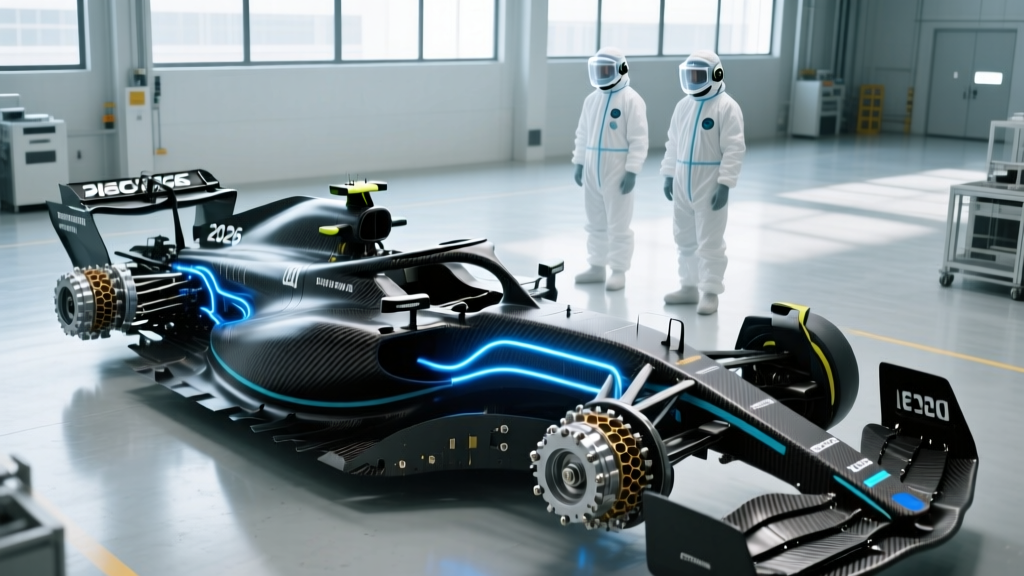
The 2026 technical regulations introduced a radical shift in power unit architecture and active aerodynamics, fundamentally altering the manufacturing bill of materials (BOM). The table below details the estimated physical manufacturing costs for a single chassis based on current aerospace-grade material pricing and precision machining rates.
| Component | Primary Material Spec | Est. Manufacturing Cost | % of Total Build |
|---|---|---|---|
| Power Unit (ICE + Hybrid) | Inconel, Titanium, Copper | $8,000,000 - $10,000,000 | 50% |
| Survival Cell (Monocoque) | T800 Carbon Composite, Kevlar | $1,200,000 | 7% |
| Aero Package (Active) | Pre-preg Carbon, 3D Printed Resins | $2,500,000 | 15% |
| Transmission & Drivetrain | Ti-6Al-4V Titanium, Carbon Casing | $750,000 | 4.5% |
| Suspension & Hydraulics | Carbon Fiber, High-Grade Steel | $500,000 | 3% |
| Electronics & Steering | Silicon, OLED, Gold-plated Connectors | $800,000 | 5% |
| Assembly & Fluids | Sustainable Fuel, Synthetic Oils | $2,500,000 | 15.5% |
The 2026 Power Unit: A $10 Million Engineering Marvel
The most expensive single component on any modern Formula 1 car is the power unit (PU). For the 2026 season, the FIA mandated a complete overhaul of the hybrid system. The complex Motor Generator Unit-Heat (MGU-H) has been permanently removed to lower manufacturing barriers for new OEMs like Ford and Audi. In its place, the electrical side of the powertrain has been massively upscaled.
The 50/50 Power Split and MGU-K
The 2026 MGU-K (Motor Generator Unit-Kinetic) now produces 350kW (nearly 470 horsepower), almost tripling the output of the previous generation. This requires vastly larger copper windings, advanced liquid-cooling jackets, and high-density battery cells capable of massive discharge rates without thermal degradation. The internal combustion engine (ICE) is limited to roughly 400kW. Manufacturing the battery energy store (ES) alone requires aerospace-grade thermal management systems and custom-machined beryllium or titanium housings to save grams, pushing the initial R&D and prototyping cost of a single PU variant well over $10 million, even if the marginal cost to assemble subsequent units drops to roughly $2.5 million.
Furthermore, the exhaust systems must handle extreme thermal loads while running on 100% sustainable laboratory-synthesized fuels. Teams utilize direct metal laser sintering (DMLS) to 3D print complex Inconel exhaust manifolds. According to technical analyses of F1 powertrains, a single Inconel exhaust system can cost upwards of $150,000 and requires 40+ hours of continuous laser sintering followed by extensive X-ray inspection for micro-fractures.
Chassis and Active Aerodynamics Construction
The survival cell, or monocoque, is constructed from hundreds of layers of T800-grade pre-impregnated carbon fiber. The layup process is entirely manual, performed by specialized composite technicians in climate-controlled cleanrooms. Once laid, the chassis is cured in an industrial autoclave at 130°C and 6 bar of pressure. To meet the stringent 2026 FIA crash test mandates, the side-impact structures and the titanium Halo device must absorb massive kinetic energy, requiring precise resin flow and zero voids in the composite matrix.
Active Aero: X-Mode and Z-Mode
A major cost driver for 2026 is the introduction of active aerodynamics. Unlike the Drag Reduction System (DRS) of the past, the 2026 cars feature movable front and rear wing elements that adjust dynamically on the straights (X-Mode for low drag) and in corners (Z-Mode for high downforce). This necessitates the integration of high-torque, ultra-lightweight hydraulic actuators directly into the carbon fiber wing endplates. Designing, machining, and testing these micro-hydraulic systems adds an estimated $400,000 to the physical build cost of the aero package compared to static wing designs.
Navigating the FIA Financial Regulations
Understanding the physical build cost is only half the equation; the operational environment is strictly governed by the FIA Financial Regulations. As detailed in the official F1 cost cap documentation, teams are restricted to a base budget of approximately $135 million to $145 million (adjusted annually for inflation and the number of sprint events). This cap fundamentally changes how teams approach construction and manufacturing.
Cost Cap Exclusions: The FIA cost cap covers all car performance R&D, manufacturing, and track operations. However, it explicitly excludes driver salaries, the salaries of the top three highest-paid executives, marketing expenditures, and the construction of new factory infrastructure (such as building a new wind tunnel or simulator facility). This is why teams continue to invest hundreds of millions in capital expenditures (CapEx) for their campuses, even while operating under the strict operational (OpEx) cap.
Because the budget is capped, teams cannot simply throw money at manufacturing inefficiencies. They must optimize their supply chains, utilizing advanced AI-driven generative design to reduce the weight and machining time of titanium suspension uprights. A part that costs $20,000 to machine in 2024 might be redesigned using topology optimization to cost $8,000 and weigh 15% less in 2026, freeing up vital cap space for aerodynamic development.
Frequently Asked Questions
Can a private individual buy and build an F1 car from scratch?
No. While you can purchase older, decommissioned F1 chassis at auction for $1 million to $5 million, building a current-spec 2026 car from scratch is impossible for a private entity. The intellectual property for the power unit software, hybrid energy deployment maps, and active aero control algorithms is fiercely guarded trade secret data. Furthermore, sourcing the bespoke FIA-homologated carbon fiber weaves and the 100% sustainable laboratory fuel requires OEM-level supply chain contracts that are unavailable to the public.
How many physical cars does a team manufacture per season?
Under the current FIA sporting and technical regulations, teams are restricted in the number of power unit components they can use per season (typically 4 or 5 ICEs and MGU-Ks per driver). However, the carbon fiber components—such as front wings, floors, and suspension arms—are frequently destroyed in crashes or replaced due to fatigue. A top-tier team like Red Bull or Ferrari will manufacture upwards of 8 to 12 complete chassis tubs and hundreds of replacement aerodynamic components over a single 24-race season to ensure both drivers always have fresh, structurally sound equipment.
Why is the steering wheel so expensive?
An F1 steering wheel is essentially a custom-built, carbon-fiber-encased aerospace computer. It features a high-resolution OLED display, custom-machined rotary switches, and quick-release magnetic connectors. The internal wiring harness uses gold-plated contacts to prevent data loss under extreme vibration. The development and assembly of a single wheel, including the bespoke software mapping for brake-by-wire and differential adjustments, costs well over $100,000.
Written by
James ThorntonJames Thornton is a construction industry veteran with 25 years of hands-on experience in wood framing, lumber grading, and residential building codes. He started as a framing carpenter in rural Oregon, earned his ICC Residential Building Inspector certification, and eventually became a senior plan reviewer for the City of Portland Bureau of Development Services. James holds a B.S. in Wood Science & Technology from Oregon State University and is a certified lumber grader through the West Coast Lumber Inspection Bureau (WCLIB). He has inspected over 3,000 residential construction sites and authored the city's internal guide on advanced framing techniques (2x6 at 24" O.C.). James lives in Bend, OR, where he builds custom timber-frame cabins and competes in lumberjack sports.
More from James Thornton
View all
Insulation
Best Home Insulation Materials: Complete 2026 Guide
Compare top home insulation materials for 2026. Find R-values, installed costs per square foot, and best uses for fiberglass, spray foam, and mineral wool.
Aug 4, 2026

Sustainable Building
Certify Your Green Building Material for LEED and WELL
Step-by-step guide to certifying a green building material for LEED v5 and WELL v2. Master EPDs, HPDs, and VOC limits for 2026 project specifications.
Aug 4, 2026

Stone & Masonry
Veneer Stacked Stone Panels: Interior Design & Style Showcase
Discover how veneer stacked stone panels transform interiors. Explore modern design profiles, material pairings, and technical installation specs.
Aug 4, 2026