Sphere Las Vegas Cost to Build: A Detailed Breakdown
Analyze the Sphere Las Vegas cost to build, exploring the $2.3B final price tag, structural steel, LED exosphere, and lessons for mega-project estimating.

The $2.3 Billion Reality: Why the Sphere Las Vegas Cost to Build Doubled
When Madison Square Garden Entertainment (MSG) first proposed a massive, immersive spherical venue in Las Vegas in 2018, the initial construction estimate was pegged at $1.2 billion. By the time the venue opened its doors in late 2023, the final Sphere Las Vegas cost to build had surged to approximately $2.3 billion. For construction cost estimators and project managers analyzing mega-projects in 2026, this 91% cost overrun is not merely a headline—it is a masterclass in the financial risks of First-of-a-Kind (FOAK) engineering, supply chain volatility, and custom technology integration.
The Sphere is not just a building; it is a piece of bespoke audiovisual machinery wrapped in a structural steel exoskeleton. Standard estimating databases like RSMeans or Gordian cannot provide accurate square-foot costs for a 580,000-square-foot exterior LED screen or a 160,000-square-foot interior wraparound display. To understand the true cost breakdown, estimators must deconstruct the project into its core structural, technological, and labor components.
Estimator Warning: The FOAK Premium
When estimating venues that utilize proprietary, never-before-manufactured materials (such as the Sphere's custom exterior LED 'pucks'), standard material contingencies of 5-10% are insufficient. Estimators must apply a 30-50% R&D and integration contingency to account for prototype failures, custom tooling, and extended commissioning timelines. The Sphere's budget overruns were heavily driven by the realization that off-the-shelf AV components could not survive the Mojave Desert climate or meet the required pixel pitch.
Structural Steel and Foundation: Engineering an Asymmetrical Giant
The physical skeleton of the Sphere required immense capital. The structure relies on approximately 13,000 tons of structural steel and 180,000 cubic yards of concrete. However, the cost was not driven by raw material volume alone, but by the complexity of the geometry and the site constraints.
Deep Foundations and Site Constraints
The venue was constructed on a tight parcel of land adjacent to the Venetian Resort. Estimators working on dense urban infill projects know that proximity to existing infrastructure exponentially increases foundation costs. The Sphere required drilled shaft foundations extending up to 100 feet deep to reach stable bedrock, bypassing the complex subterranean utility networks and existing foundations of neighboring casinos. The vibration monitoring and shoring required to protect the Venetian's structure added millions in soft costs and specialized geotechnical labor.
The Asymmetrical Truss System
The roof of the Sphere is supported by massive, asymmetrical steel trusses. Because the sphere is not a perfect geometric globe (it is slightly flattened at the top and bottom to optimize interior sightlines), the steel connections are highly complex. Every node and gusset plate required custom fabrication and 3D modeling. Furthermore, erecting these trusses required some of the largest crawler cranes available in North America. In the Las Vegas market, where crane demand is perpetually high due to continuous resort development, heavy lift rentals command a severe premium.
Material and Systems Cost Allocation
While MSG Entertainment keeps exact vendor contracts proprietary, industry analysis and financial disclosures available via the MSG Entertainment SEC filings portal allow estimators to model the approximate cost allocation of the $2.3 billion budget. The following table illustrates the estimated percentage breakdown of hard and soft costs for the project.
| Cost Category | Estimated Allocation | Primary Cost Drivers |
|---|---|---|
| Interior AV & Acoustics | 30% ($690M) | 16K wraparound screen, Holoplot beam-forming audio, haptic seating |
| Structural Steel & Concrete | 22% ($506M) | 13,000 tons custom steel, deep drilled shafts, heavy crane rentals |
| Exosphere (Exterior LED) | 18% ($414M) | 1.2M custom LED pucks, wind-load scaffolding, weatherproofing |
| MEP & Life Safety | 12% ($276M) | Massive HVAC for heat-generating LEDs, redundant power grids |
| Labor & General Conditions | 10% ($230M) | Pandemic delay premiums, specialized AV integration labor |
| Soft Costs & R&D | 8% ($184M) | Architectural design, proprietary software development, permitting |
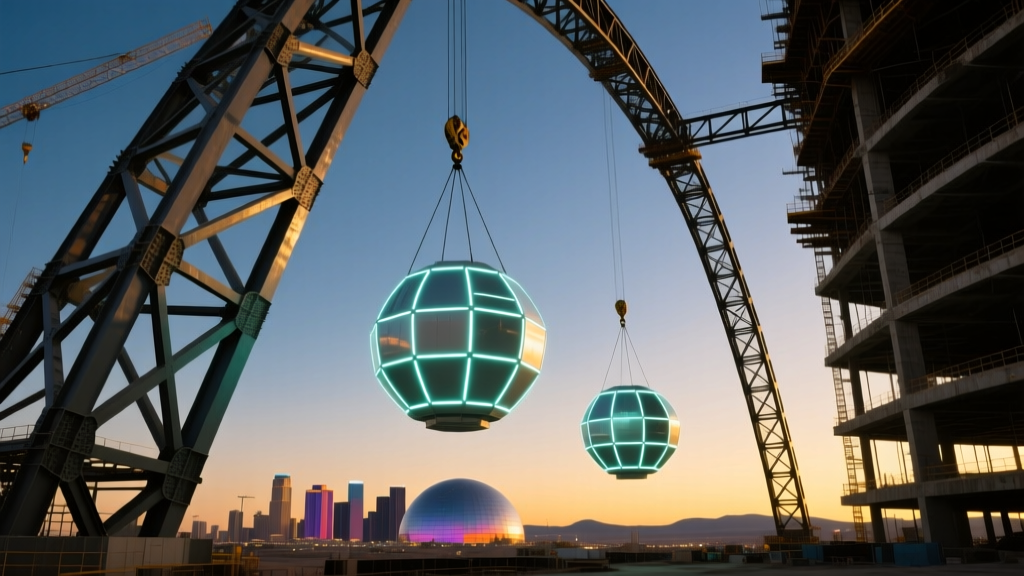
The Exosphere: Pricing the World’s Largest LED Screen
The most visually striking element of the venue is the Exosphere, the 580,000-square-foot exterior display. From an estimating perspective, the Exosphere represents a triumph of value engineering that paradoxically increased upfront costs to save long-term structural expenses.
Initially, engineers considered using traditional, solid LED panels for the exterior. However, a solid screen of that magnitude would act like a massive sail, catching the high desert winds and requiring an exponential increase in structural steel to support the wind load. The solution was to design custom LED 'pucks' spaced apart on a permeable scaffolding grid. This allows wind to pass through the screen, drastically reducing the structural steel requirements.
'The decision to use permeable LED pucks rather than solid panels is a textbook example of cross-disciplinary value engineering. The AV team and the structural steel team had to collaborate to optimize the total installed cost, rather than just minimizing the hardware procurement cost.'
However, manufacturing 1.2 million custom, weather-sealed, UV-resistant LED pucks required setting up entirely new supply chains. According to project data documented on the Sphere venue Wikipedia archive, the custom tooling, rigorous climate testing, and the specialized scaffolding required to install the pucks at extreme heights contributed heavily to the $414 million exterior budget.
Interior Acoustics and Haptic Seating: The Hidden Cost Drivers
While the exterior draws the tourists, the interior is where the most complex AV integration occurred. The 160,000-square-foot interior LED screen boasts a 16K x 16K resolution. But the true hidden cost driver in the interior was the acoustic treatment and the haptic seating infrastructure.
Holoplot Beam-Forming Audio
Traditional arena audio relies on massive line-array speakers that blast sound uniformly, resulting in high reverberation and overlapping audio zones. The Sphere utilizes the Holoplot X1 system, which uses beam-forming technology to steer sound like a laser. This required installing over 160,000 individual speaker drivers hidden behind the acoustic-transparent interior LED screen. The labor cost to wire, address, and digitally map each individual driver to specific seating zones took thousands of hours of highly specialized AV commissioning.
Infrasound and Haptic Infrastructure
The venue features 18,600 haptic seats capable of delivering localized vibrations and infrasound (frequencies below 20 Hz). Estimating the cost of haptic seating goes beyond the unit price of the chairs. It requires reinforcing the concrete seating tiers to handle the resonant frequencies without causing structural fatigue or transferring destructive vibrations to the building's core. The mechanical fastening, specialized wiring, and localized power distribution for these seats added a premium of approximately $15,000 to $20,000 per seat compared to standard arena seating.
Supply Chain and Labor: The Pandemic Multiplier
No analysis of the Sphere Las Vegas cost to build is complete without addressing the macroeconomic environment during its construction. The project broke ground in 2019 and faced the brunt of the 2020-2022 global supply chain crisis.
- Material Escalation: The price of structural steel and copper wiring spiked by over 40% during the peak of the pandemic. Fixed-price contracts signed in 2018 were renegotiated or subjected to massive escalation clauses.
- Specialized Labor Shortages: The integration of the Holoplot audio system and the custom LED screens required AV technicians with niche programming skills. Labor market data for specialized trades in Nevada, trackable via the Bureau of Labor Statistics West Region, showed significant wage inflation for skilled technicians during this period.
- Logistical Bottlenecks: Custom microchips and LED diodes sourced from overseas faced months-long delays at ports, leading to massive schedule extensions. In mega-project construction, time is money; extended general conditions (crane rentals, site security, temporary power, and project management staff) can burn through millions of dollars per month.
What Mega-Project Estimators Can Learn from the Sphere
As the construction industry looks toward the next generation of immersive entertainment venues and smart stadiums in 2026 and beyond, the Sphere provides a critical framework for cost estimating:
- Decouple Hardware from Integration: Never estimate proprietary AV systems based solely on the bill of materials. The software mapping, digital commissioning, and physical integration of systems like beam-forming audio often cost as much as the hardware itself.
- Model Wind and Thermal Loads Early: The Exosphere's permeable design saved millions in steel, but only because AV and structural teams collaborated during the conceptual phase. Siloed estimating leads to catastrophic change orders.
- Hedge for FOAK Contingencies: If a material or system has never been deployed at scale, standard historical cost data is useless. Estimators must build bottom-up quotes from manufacturers and apply aggressive schedule contingencies for prototype iteration.
The Sphere Las Vegas cost to build ultimately reached $2.3 billion because it was not just a building project; it was a massive, multi-year research and development initiative. For estimators, the takeaway is clear: when the blueprint requires inventing new technology, the budget must reflect the price of innovation.
Written by
Priya KapoorPriya Kapoor is a real estate market analyst and construction economics researcher with expertise in housing affordability, development feasibility, and infrastructure investment. She holds a Master of Regional Planning from Cornell University and previously worked as a senior analyst at CBRE's Investment Properties group, where she modeled returns for $4B in mixed-use development pipelines. Priya now runs an independent research practice advising developers, municipalities, and REITs on construction cost forecasting and market timing. She publishes the quarterly "BuildMat Market Pulse" report tracking material price indices across 12 commodity categories. Based in Austin, TX, Priya serves on the board of Habitat for Humanity Austin and is a marathon runner.
More from Priya Kapoor
View all
Construction Cost
Cost to Build a 1600 Sq Ft Home in 2026: Full Breakdown
Accurate 2026 cost to build a 1600 sq ft home—material, labor, and regional pricing breakdowns included. Plan your budget with real-time estimates.
Aug 11, 2026

Wood & Lumber
Name the Types of Wood for Pressure Treatment and Preservation
Learn how to name the types of wood best suited for pressure treatment. Compare species treatability, chemical retention levels, and 2026 preservation costs.
Aug 4, 2026

Stone & Masonry
Stone Veneer Suppliers Lindenhurst: 2026 Cost Analysis
Analyze 2026 stone veneer costs in Lindenhurst, NY. Compare local supplier pricing, delivery fees, and Suffolk County installation labor rates.
Aug 4, 2026