How Much Would a House Cost to Build? 2026 Regional Price Breakdown
Discover how much a house costs to build across different US regions in 2026. Explore regional price variations, labor rates, and material costs.

The Baseline: National Average vs. Regional Reality
The national average to build a single-family home hovers between $155 and $185 per square foot for base construction in 2026. However, relying on a national median to answer the question of how much a house costs to build is a critical budgeting error. Construction costs are inherently hyper-local, driven by municipal building codes, union labor density, soil conditions, and regional freight surcharges. A 2,500-square-foot home that costs $412,500 to build in rural Ohio could easily exceed $725,000 in coastal California, even when utilizing identical architectural plans and material grades.
To accurately forecast your budget, you must deconstruct the national average and apply regional multipliers. According to the U.S. Census Bureau New Residential Construction data, regional disparities in labor and material procurement account for up to a 45% variance in total project costs before land acquisition and site development are even factored in.
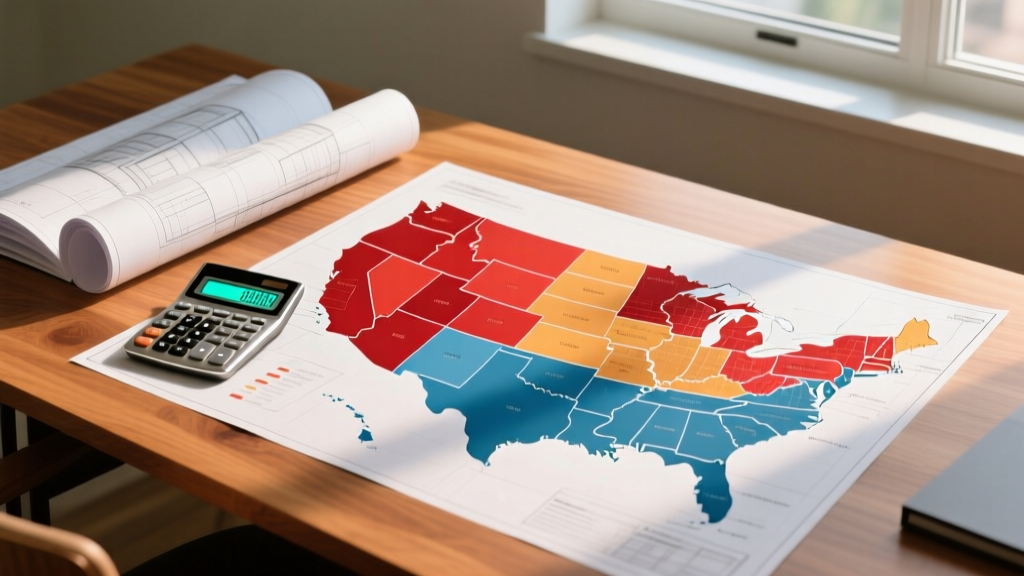
2026 Regional Cost Breakdown Matrix
The following matrix outlines the base construction costs (excluding land, permits, and architectural fees) across the four primary U.S. census regions. These figures assume a mid-tier custom build with standard energy code compliance.
| Region | Cost Per Sq. Ft. (2026) | Labor Index | Primary Cost Drivers |
|---|---|---|---|
| Northeast | $195 - $260 | 1.25x National Avg | Deep frost footings, union labor, strict energy codes |
| Midwest | $145 - $185 | 0.90x National Avg | Basement excavation, weather delays, moderate material freight |
| South | $140 - $190 | 0.95x National Avg | Slab-on-grade foundations, HVAC sizing, hurricane retrofitting (coastal) |
| West | $210 - $290+ | 1.40x National Avg | Seismic engineering, Title 24 compliance, extreme impact fees |
Deep Dive: Why the West Coast and Northeast Command Premiums
When analyzing how much a house costs to build in high-cost corridors, the premium is rarely just about the price of lumber. It is dictated by regulatory friction and geological necessities.
California Title 24 and Seismic Engineering
Building in California or the Pacific Northwest requires navigating some of the most stringent energy and structural codes in the country. California’s Title 24 energy standards mandate advanced building envelope sealing, high-efficiency HVAC systems, and pre-wiring for solar photovoltaics. To meet these insulation requirements, builders frequently upgrade from standard fiberglass batts to Rockwool Comfortbatt R-23 mineral wool or closed-cell spray foam, adding $3.50 to $5.00 per square foot to the insulation budget alone.
Furthermore, seismic zones dictate foundation and framing costs. In high-seismic areas, engineers require continuous load paths using specialized hardware, such as Simpson Strong-Tie holdowns and shear wall nailing patterns. The structural engineering and specialized labor required to execute these plans easily add $25,000 to $40,000 to the framing and foundation phases compared to non-seismic zones.
Northeast Frost Lines and Labor Density
In the Northeast, the primary geological adversary is the frost line. Municipal codes in states like Massachusetts, New York, and Maine require foundation footings to be placed 48 to 60 inches below grade to prevent frost heave. This necessitates extensive excavation, deeper concrete pours, and heavy waterproofing membranes like Tremco Paraseal. A full basement foundation in the Northeast can cost 30% to 40% more than a shallow frost-protected slab in the South.
Labor compounds this issue. The Northeast has a high concentration of unionized trades and a persistent shortage of skilled framers and masons. According to the National Association of Home Builders (NAHB) Housing Economics division, labor shortages in the Northeast consistently drive framing and finishing costs 20% to 30% above the national baseline.
The South and Midwest: Maximizing Budget Efficiency
If your goal is to maximize square footage per dollar, the South and Midwest offer distinct advantages, though they come with their own localized caveats.
In the South (particularly Texas, Georgia, and the Carolinas), the absence of deep frost lines allows for monolithic slab-on-grade foundations. This eliminates the need for deep excavation and basement waterproofing, saving $20,000 to $35,000 on average. However, the hot, humid climate demands robust moisture management. Builders in the South are increasingly utilizing Huber ZIP System sheathing and liquid-applied weather barriers to prevent mold and wood rot, a necessary upgrade that adds roughly $1.50 per square foot to the exterior shell.
While the South is generally affordable, South Florida falls under the High Velocity Hurricane Zone (HVHZ). Building in Miami-Dade or Broward counties requires Miami-Dade Notice of Acceptance (NOA) approved impact windows, concrete block (CBS) construction, and reinforced roof-to-wall connections. These HVHZ requirements can push South Florida construction costs up to $220+ per square foot, entirely erasing the regional 'Southern discount'.
In the Midwest, material costs are highly competitive due to proximity to manufacturing hubs and major freight rail lines. The primary budget variable here is weather. Winter construction requires temporary enclosures, concrete blankets, and ground-thawing equipment, which can introduce $5,000 to $10,000 in seasonal carrying costs if the schedule slips into December or January.
Hidden Regional Costs: Impact Fees and Site Prep
When calculating how much a house costs to build, many estimators overlook municipal impact fees and localized site preparation. These soft costs vary wildly by zip code:
- Impact Fees: In parts of California and the Pacific Northwest, municipal water, sewer, and school impact fees can exceed $50,000 per single-family lot. In contrast, rural municipalities in Texas or Alabama may charge under $3,000 for the same utility connections.
- Soil Remediation: Building on expansive clay soils (common in Texas and Colorado) requires engineered post-tensioned slabs or deep pier-and-beam foundations drilled into bedrock, adding $15,000 to $30,000 to the site prep budget.
- Tree Ordinances and Setbacks: Strict municipal tree preservation ordinances in areas like Austin, TX, or Atlanta, GA, may require expensive root-protection fencing, specialized foundation designs to avoid root zones, and hefty fines for unauthorized clearing.
For comprehensive data on mitigating wind and water risks that affect these regional site preps, the FEMA Building Science Publications provide critical guidelines on regional hazard-resistant construction techniques.
Actionable Framework: Adjusting Your Budget for Local Markets
To transition from a national average to a precise local estimate, follow this three-step adjustment framework:
- Establish the Base Cost: Calculate your desired square footage multiplied by the $165 national median for mid-tier finishes.
- Apply the RSMeans Location Factor: Consult the current Gordian RSMeans construction cost data for your specific city or county. If your city has a location factor of 115 (meaning it is 15% more expensive than the national average), multiply your base cost by 1.15.
- Add Localized Code Premiums: Add fixed costs for regional mandates. For example, add $12,000 for California solar-ready wiring and HVAC upgrades, or add $18,000 for Florida HVHZ impact glazing and concrete framing.
Frequently Asked Questions
Does the cost to build a house include the land?
No. The regional cost per square foot metrics discussed in this analysis strictly cover vertical construction (materials, labor, equipment, and general contractor overhead). Land acquisition, site clearing, grading, and utility tap fees are separate line items that must be underwritten based on local real estate markets.
Are modular homes cheaper to build in high-cost regions like the West Coast?
Yes. Building a modular or prefabricated home in high-labor-cost regions like California or the Northeast can reduce total construction costs by 15% to 25%. Because the modules are assembled in climate-controlled factories (often located in lower-cost states) and shipped to the site, you bypass the premium local framing and finishing labor rates. However, you must still budget for local foundation work, crane rentals, and municipal permitting.
How do regional supply chain issues affect material costs?
Material costs are heavily influenced by proximity to distribution centers. Regions far from major ports or rail hubs (such as rural Mountain West states) will pay a 10% to 20% freight premium on heavy materials like concrete, steel, and brick. Conversely, builders in the Southeast benefit from a high density of regional lumber mills and window manufacturing plants, keeping baseline material freight costs low.
Written by
David NakamuraDavid Nakamura is a licensed architect (AIA) and construction technology writer focused on sustainable building methods, mass timber engineering, and high-performance building envelopes. He holds a Master of Architecture from the University of Washington and is a certified Passive House Consultant (CPHC). David spent eight years at the Seattle firm Mithun, where he led the design of three LEED Platinum projects, before founding his own practice specializing in net-zero residential design. He serves on the editorial advisory board of GreenBuilder Magazine and has authored peer-reviewed papers on cross-laminated timber (CLT) connections for the Journal of Structural Engineering. In his spare time, David teaches woodworking at Pratt Fine Arts Center and kayaks the Puget Sound.
More from David Nakamura
View all
Construction Cost
Labor Cost to Build a Deck Per Sq Ft: 2026 Installation Guide
Discover the exact labor cost to build a deck per sq ft in 2026. This installation guide breaks down contractor rates, complexity factors, and hidden fees.
Aug 4, 2026

Construction Cost
How Much Does It Cost to Build a 3 Bedroom House? Financing Guide
Learn exactly how much it costs to build a 3 bedroom house and explore 2026 financing options, construction loan types, and budget frameworks for your build.
Aug 4, 2026

Construction Cost
Cost to Build a Tennis Court: 2026 Guide
How much does it cost to build a tennis court in 2026? Breakdowns for asphalt, concrete, and synthetic surfaces plus fencing and lighting.
Jul 30, 2026