Cost to Build a Tennis Court: 2026 Regional Price Guide
Discover the true cost to build a tennis court in 2026. We break down regional pricing, soil challenges, and material choices for hard and clay courts.

The True Cost to Build a Tennis Court: National Baselines
Constructing a regulation-size tennis court requires far more than pouring a concrete slab and painting lines. A standard court pad measures 60 feet by 120 feet (7,200 square feet) to accommodate the 78-by-36-foot doubles playing area and necessary runoff zones. In 2026, the national average cost to build a fully equipped hard court ranges from $82,000 to $135,000. However, treating this national average as a definitive budget is a critical estimating error. Regional variations in soil mechanics, frost depths, labor rates, and environmental permitting can swing your final invoice by 30% or more.
2026 National Baseline Cost Breakdown (Standard Hard Court)
- Site Prep & Grading: $12,000 – $22,000
- Base Construction (Asphalt): $32,000 – $45,000
- Base Construction (Post-Tensioned Concrete): $48,000 – $68,000
- Acrylic Surfacing System: $14,000 – $22,000
- 10-Foot Chain-Link Fencing: $16,000 – $24,000
- 4-Pole LED Lighting: $18,000 – $28,000
Regional Price Analysis Matrix
Geography dictates subsurface engineering. The American Sports Builders Association (ASBA) emphasizes that local soil conditions and climate cycles are the primary drivers of base material selection and site preparation costs. Below is a regional cost multiplier and engineering focus for 2026.
| Region | Cost Multiplier | Primary Soil/Climate Challenge | Mandatory Base Specification |
|---|---|---|---|
| Northeast | +15% to +20% | Deep frost lines (48+ inches), freeze-thaw heaving | Deep footings, 4-inch asphalt over 8-inch aggregate |
| Southeast | +5% to +10% | Expansive red clays, high water tables | Lime stabilization, geogrid reinforcement, French drains |
| Southwest | +10% to +15% | Caliche rock, highly expansive desert soils | Post-tensioned (PT) concrete, heavy rock excavation |
| Midwest | +8% to +12% | Severe freeze-thaw cycles, clay-loam soils | Perimeter frost walls, subsurface drainage mats |
| West Coast | +25% to +35% | Seismic activity, strict EPA stormwater runoff rules | Engineered PT concrete, bioswales, high union labor |
The Frost Line Penalty: Northeast and Midwest
In regions where the ground freezes deeply, water trapped in the subgrade expands, causing catastrophic frost heave that will crack an asphalt base and delaminate acrylic coatings within two seasons. To prevent this, contractors must excavate below the local frost line—often 48 to 60 inches deep in states like Minnesota or upstate New York—and install perimeter frost walls. This earthmoving and concrete work adds $12,000 to $18,000 to the site prep budget compared to southern states.
Expansive Soils and Caliche: Southeast and Southwest
In the Southeast, expansive clays swell when wet and shrink when dry. Building directly on this soil guarantees differential settlement. Contractors must perform soil borings and often apply lime stabilization or install biaxial geogrids to lock the aggregate base in place. In the Southwest, excavators frequently hit caliche—a concrete-like layer of calcium carbonate. Breaking through caliche requires heavy machinery like hydraulic rippers, pushing excavation costs from a standard $4,000 up to $15,000 or more.
Base Material Decision Framework: Asphalt vs. Post-Tensioned Concrete
The most critical structural decision in your estimate is the base material. According to the International Tennis Federation (ITF) Facility Guidelines, the base must maintain a planarity tolerance of 1/8 inch over a 10-foot straightedge. Achieving this depends heavily on your material choice.
Asphalt Base
Cost: $32,000 – $45,000
Lifespan: 15–20 years before structural failure.
Best For: Stable, well-draining soils in temperate climates. Asphalt is flexible and handles minor ground movement well, but it is prone to oxidation, birdbaths (depressions), and cracking from tree roots.
Post-Tensioned (PT) Concrete
Cost: $48,000 – $68,000
Lifespan: 40+ years (structural slab).
Best For: Expansive clays, high water tables, and coastal regions. Steel tendons are tensioned after the concrete cures (typically to 150 KSI), compressing the slab and preventing structural cracks. This is the gold standard for 2026 high-end residential and commercial builds.
Surfacing Systems and Pace Ratings
Once the base is cured (asphalt requires 30-45 days to off-gas; concrete requires 28 days), the surfacing system is applied. A standard hard court utilizes a multi-layer acrylic system.
- Standard Acrylic (Non-Cushioned): $14,000 – $18,000. Consists of a resurfacer coat, two texture coats with 60-80 mesh silica sand, and two finish coats. Yields an ITF Medium-Fast to Fast pace rating.
- Cushioned Acrylic System: $20,000 – $26,000. Adds 3 to 5 layers of rubberized acrylic granules beneath the color coats. This reduces leg fatigue and lowers the pace rating to Medium-Slow, which is highly preferred for aging demographics and private clubs.
- Premium Color Upgrades: Standard green and blue are included in base pricing. Custom colors (e.g., Tournament Purple, Slate Grey) or high-UV reflective pigments for Southwest installations add 10% to 15% to the surfacing cost.
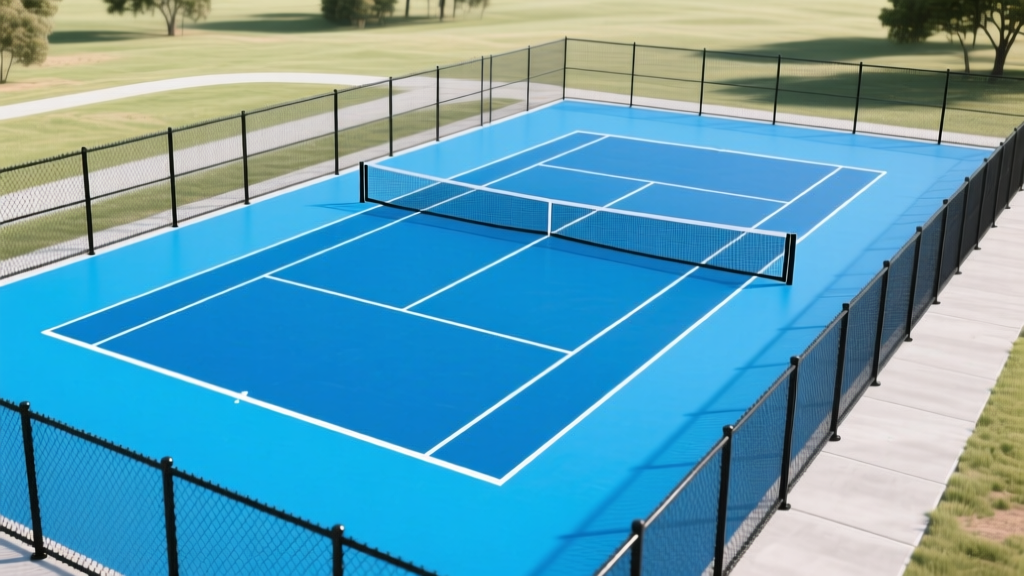
Fencing, Lighting, and Equipment Specifications
Do not rely on generic contractor fencing for a tennis court. The wind load on a 10-foot fence enclosing a 7,200-square-foot area is massive.
For lighting, metal halide systems are entirely obsolete. Modern 4-pole LED systems deliver 35 to 50 foot-candles of uniform illumination with zero warm-up time and 70% lower energy draw. Budget $18,000 to $28,000 for a commercial-grade LED package, which includes the poles, fixtures, photocells, and trenching back to the main electrical panel. Note that if your property requires a new 200-amp sub-panel to handle the lighting load, add $4,000 to $7,000 to your electrical estimate.
The 'Hidden' Site Prep Costs That Destroy Budgets
Estimators frequently miss peripheral site work that is mandatory for a functional court. Before signing a contract, verify if the following are included in your scope:
- Tree Removal and Root Barriers: Any tree within 15 feet of the court pad must be removed. Roots will destroy an asphalt base in under five years. If removal is impossible, a 3-foot deep high-density polyethylene (HDPE) root barrier must be installed.
- Retaining Walls: If your site has a slope greater than 2%, you will need engineered retaining walls to create a level pad. Segmental block walls cost $60 to $95 per square foot of face area.
- Stormwater Management: Municipalities increasingly require zero-runoff mandates for new impermeable surfaces. You may be forced to install underground dry wells or bioswales to capture court runoff, adding $5,000 to $12,000 to the civil engineering and excavation costs.
Accurate cost estimation for a tennis court demands a localized approach. By analyzing your specific regional soil profiles, frost depths, and municipal drainage requirements, you can transition from a vague national average to a precise, defensible construction budget.
Written by
Elena RodriguezElena Rodriguez is a civil engineer and technical writer specializing in concrete technology, masonry systems, and ASTM/ACI compliance. She earned her B.S. in Civil Engineering from Texas A&M University and spent a decade at a materials testing laboratory, performing over 2,000 concrete compressive strength tests and masonry prism evaluations. Elena is an ACI-certified Field Testing Technician (Grade I) and a member of ASTM Committee C12 on Natural Building Stone. She currently consults on forensic engineering cases involving concrete failures and moisture intrusion. Based in San Antonio, TX, Elena is a proud member of the Society of Women Engineers (SWE) and coaches her daughter's FIRST Robotics team.
More from Elena Rodriguez
View all
Walls & Panels
Cost Analysis: Light Gauge Steel Framing Advantages and Disadvantages
Evaluate light gauge steel framing advantages and disadvantages through a strict cost analysis lens, comparing material, labor, and lifecycle expenses.
Aug 4, 2026

Walls & Panels
Gypsum Board Types: Exact Specifications, Thickness & Dimensions
Compare standard, Type X, and moisture-resistant gypsum board types. Get exact specifications, thicknesses, dimensions, and ASTM standards for your project.
Aug 4, 2026

Fire Resistance
Best Fire-Resistant Outdoor Decking Materials: 2026 Buyer Guide
Discover the best fire-resistant outdoor decking materials for 2026. Compare Class A PVC, aluminum, and hardwood options for WUI compliance and safety.
Aug 4, 2026