How Much Does It Cost to Build a Prison in 2026? Complete Guide
Discover how much it costs to build a prison in 2026. Explore per-bed costs, specialized materials, security systems, and hard vs. soft cost breakdowns.
Baseline Metrics: Cost Per Bed and Square Footage
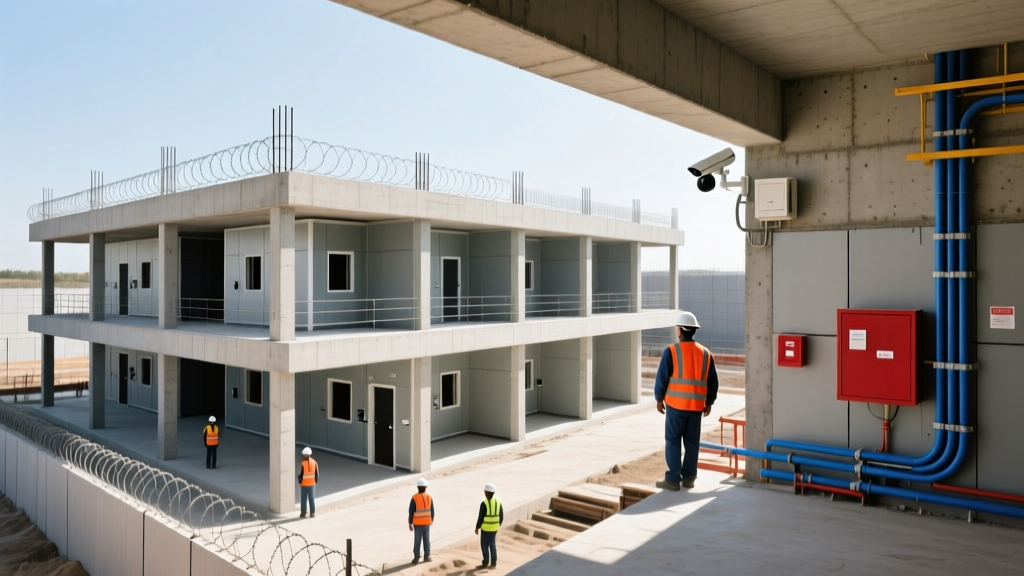
Estimating the cost of a correctional facility requires moving beyond standard commercial construction metrics. Prison construction is governed by extreme security mandates, anti-ligature requirements, and redundant life-safety systems. In 2026, the industry standard for measuring these costs is the 'cost per bed' metric, which encompasses the entire facility footprint—including administrative wings, medical units, sally ports, and perimeter security—divided by the inmate capacity.
According to data synthesized from state legislative budget boards and the National Institute of Corrections (NIC), the national average to build a medium-security prison currently ranges between $220,000 and $280,000 per bed. However, this figure fluctuates wildly based on the security classification and regional labor markets.
| Security Level | Estimated Cost Per Bed (2026) | Estimated Cost Per Sq. Ft. | Primary Design Characteristics |
|---|---|---|---|
| Minimum (Camp) | $130,000 - $170,000 | $260 - $340 | Dormitory-style, standard commercial materials, minimal perimeter fencing. |
| Medium Security | $220,000 - $290,000 | $400 - $520 | Cell-based, reinforced precast concrete, double-fence perimeter with PIDS. |
| Maximum Security | $340,000 - $480,000 | $600 - $850+ | Linear cell blocks, tool-resistant steel, advanced biometric access, mantrap sally ports. |
| Supermax / ADX | $600,000 - $900,000+ | $1,000 - $1,500+ | Podular design, total electronic lockdown, poured-in-place reinforced concrete. |
Hard Costs: Specialized Materials and Construction
The physical shell of a correctional facility utilizes materials engineered to withstand physical abuse, prevent contraband concealment, and eliminate self-harm vectors. Standard commercial building materials are entirely unsuited for secure housing units.
Architectural and Structural Requirements
- Reinforced Precast Concrete Panels: Exterior and interior cell walls typically utilize 8-inch to 12-inch thick precast concrete panels with #6 or #7 rebar grids. These panels cost between $45 and $75 per square foot installed, compared to $12-$18 for standard CMU block walls.
- Tool-Resistant Steel: All exposed metalwork in maximum-security zones, including window frames, grilles, and door tracks, must meet ASTM F1233 standards for tool-resistant steel. This specialized alloy resists cutting from hacksaws and torches, carrying a 300% to 400% price premium over standard structural steel.
- Security Glazing: Windows in housing units and control booths utilize 1.25-inch to 2-inch thick laminated polycarbonate (such as Lexan Margard or Riot Glass). This shatter-resistant glazing costs $140 to $220 per square foot, replacing standard tempered glass which costs roughly $18 per square foot.
Anti-Ligature and Vandal-Resistant Fixtures
Plumbing and electrical fixtures represent a massive cost premium in prison construction. Every item must be 'anti-ligature' (designed so a cord or bedsheet cannot be tied around it) and vandal-resistant.
- Plumbing: Stainless steel combination toilet/sink units from manufacturers like Acorn Engineering or Bradley Corporation cost between $2,800 and $4,500 per unit. These feature concealed piping, flush-mounted push buttons, and timed water shutoffs to prevent flooding.
- HVAC Grilles: Return air grilles must feature perforated, tool-resistant steel with openings no larger than 0.5 inches to prevent the passing of contraband or the creation of makeshift weapons. These custom grilles cost upwards of $400 each.
- Lighting: Recessed, shatter-proof LED fixtures with heavy-duty polycarbonate lenses and tamper-resistant Torx screws cost $350 to $600 per fixture, compared to $80 for standard commercial troffers.
Security Technology and Perimeter Infrastructure
The technological infrastructure of a modern prison extends far beyond standard CCTV. A medium-to-maximum facility requires an integrated network of physical and electronic security measures.
Cost Highlight: Perimeter Intrusion Detection Systems (PIDS)
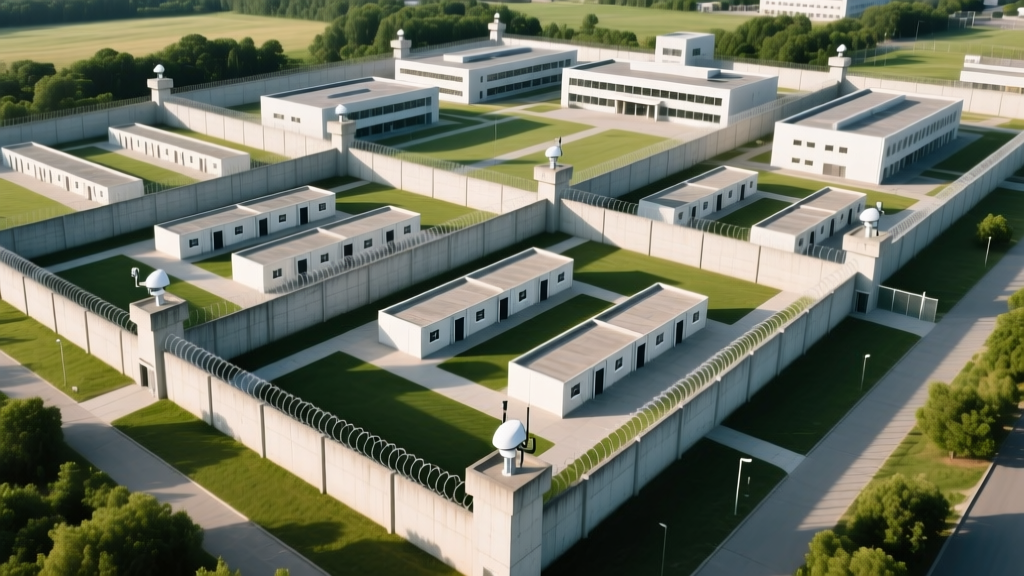
A standard double-fence perimeter with a cleared isolation zone costs roughly $150 per linear foot. However, equipping that fence with a PIDS—utilizing taut wire sensors, fiber-optic vibration detection, and millimeter-wave radar—adds $250 to $450 per linear foot. For a 1,500-bed facility with a 1.5-mile perimeter, the PIDS alone can exceed $2.5 million.
Inside the facility, access control relies on biometric mantrap sally ports. A single secured sally port door assembly—featuring hollow metal doors with internal anti-pry reinforcement, electromagnetic locks (rated for 1,500+ lbs of holding force), and interlocking logic controllers—costs between $18,000 and $25,000 per portal. According to the Federal Bureau of Prisons (BOP), modern facilities are increasingly integrating AI-driven behavioral analytics into their CCTV networks, requiring high-bandwidth fiber backbones and localized server farms that add $1.5 million to $3 million to the IT budget.
Soft Costs, Land, and Regulatory Hurdles
Hard construction costs only tell half the story. Soft costs in correctional facility development frequently consume 25% to 35% of the total project budget. These include architectural and engineering (A/E) fees, which are higher than standard commercial projects due to the niche expertise required in correctional design.
Furthermore, land acquisition and entitlements present unique financial risks. Prisons are highly susceptible to NIMBY (Not In My Back Yard) opposition. Environmental Impact Reports (EIR) and community mitigation agreements can delay projects by years. When state or federal funds are utilized, projects must comply with prevailing wage laws (such as the Davis-Bacon Act), which can increase labor costs by 20% to 30% compared to private-sector commercial builds.
According to research by the Vera Institute of Justice, the hidden costs of prison construction often extend into local infrastructure upgrades. Municipalities frequently require the state to fund new water treatment capacity, highway off-ramps, and electrical substations to support the massive load of a new correctional campus, adding tens of millions to the public ledger.
Hidden Lifecycle and Operational Design Costs
A critical error in early-stage prison cost estimation is ignoring how design choices dictate long-term operational expenses. Two specific engineering requirements drastically inflate both initial construction and lifecycle costs:
- HVAC Compartmentalization: To prevent the spread of airborne chemical agents (like tear gas deployed during riots) or airborne illnesses, housing units require highly compartmentalized HVAC zoning. This requires three to four times the number of air handling units (AHUs), motorized dampers, and exhaust fans compared to a similarly sized office building, increasing mechanical costs by 40%.
- Staffing Geometry: The architectural layout directly dictates the required guard-to-inmate ratio. A 'podular' or 'direct supervision' design costs more upfront due to the need for decentralized control booths and reinforced staff stations within the housing units. However, it reduces blind spots and lowers the long-term overtime and staffing costs associated with older 'linear cell block' designs that require constant foot patrols.
Frequently Asked Questions
Why do prisons cost so much more per square foot than hospitals?
While hospitals have complex mechanical and plumbing needs, prisons require virtually every surface to be abuse-resistant, anti-ligature, and tool-proof. The cost of specialized security hardware, reinforced concrete, and redundant electronic locking systems drives the price per square foot significantly higher than standard healthcare construction.
Does building a private prison cost less than a state-run facility?
Private prison operators often reduce initial capital expenditures by utilizing design-build contracts, value-engineering non-critical aesthetic elements, and avoiding some bureaucratic procurement delays. However, the core costs of secure perimeter systems, anti-ligature fixtures, and prevailing-wage labor remain largely fixed, limiting the actual construction savings to roughly 10% to 15%.
What is the most expensive single room in a prison facility?
The medical infirmary and forensic psychiatric observation rooms are typically the most expensive spaces per square foot. They require a hybrid of hospital-grade medical gas systems, sterile finishes, and maximum-security anti-ligature hardware, resulting in build-out costs that can exceed $1,200 per square foot.
Written by
David NakamuraDavid Nakamura is a licensed architect (AIA) and construction technology writer focused on sustainable building methods, mass timber engineering, and high-performance building envelopes. He holds a Master of Architecture from the University of Washington and is a certified Passive House Consultant (CPHC). David spent eight years at the Seattle firm Mithun, where he led the design of three LEED Platinum projects, before founding his own practice specializing in net-zero residential design. He serves on the editorial advisory board of GreenBuilder Magazine and has authored peer-reviewed papers on cross-laminated timber (CLT) connections for the Journal of Structural Engineering. In his spare time, David teaches woodworking at Pratt Fine Arts Center and kayaks the Puget Sound.
More from David Nakamura
View all
Construction Cost
Labor Cost to Build a Deck Per Sq Ft: 2026 Installation Guide
Discover the exact labor cost to build a deck per sq ft in 2026. This installation guide breaks down contractor rates, complexity factors, and hidden fees.
Aug 4, 2026

Construction Cost
How Much Does It Cost to Build a 3 Bedroom House? Financing Guide
Learn exactly how much it costs to build a 3 bedroom house and explore 2026 financing options, construction loan types, and budget frameworks for your build.
Aug 4, 2026

Construction Cost
Cost to Build a Tennis Court: 2026 Guide
How much does it cost to build a tennis court in 2026? Breakdowns for asphalt, concrete, and synthetic surfaces plus fencing and lighting.
Jul 30, 2026