How Much Does a Pool Cost to Build? 2026 Budget Breakdown
Discover how much a pool costs to build in 2026. Explore detailed budget breakdowns for concrete, fiberglass, and vinyl, plus hidden expenses.

The True Cost of Building a Pool: Beyond the Base Price
When homeowners ask, "how much does a pool cost to build," the answer extends far beyond the advertised base packages. In 2026, the national average for a fully installed, mid-sized inground pool ranges from $55,000 to $85,000. However, custom architectural builds with integrated spas, automation, and premium hardscaping routinely exceed $150,000. Budgeting accurately requires dissecting the project into structural shells, site preparation, mechanical systems, and finishing hardscapes.
- Vinyl Liner Pools: $35,000 - $65,000
- Fiberglass Pools: $45,000 - $85,000
- Concrete (Gunite/Shotcrete): $60,000 - $125,000+
Note: These ranges include standard excavation, basic plumbing, and a standard concrete deck, but exclude premium landscaping and high-end automation.
Material Matrix: Concrete vs. Fiberglass vs. Vinyl Liner
The structural shell accounts for roughly 40% to 50% of your total budget. Each material dictates not only the upfront cost but also the long-term maintenance trajectory and design flexibility.
| Material Type | Base Cost Range | Installation Timeline | Customization Limits | Long-Term Maintenance |
|---|---|---|---|---|
| Gunite/Shotcrete | $60,000 - $125,000+ | 3 to 6 months | Unlimited (any shape, depth, or size) | High (acid washing, replastering every 10-15 years) |
| Fiberglass | $45,000 - $85,000 | 3 to 6 weeks | Restricted (max ~16ft wide for road transport) | Low (non-porous gelcoat resists algae) |
| Vinyl Liner | $35,000 - $65,000 | 4 to 8 weeks | Moderate (custom shapes possible but limited by frame) | Medium (liner replacement every 7-10 years at $4,500+) |
Deep Dive: Concrete Shell Specifications
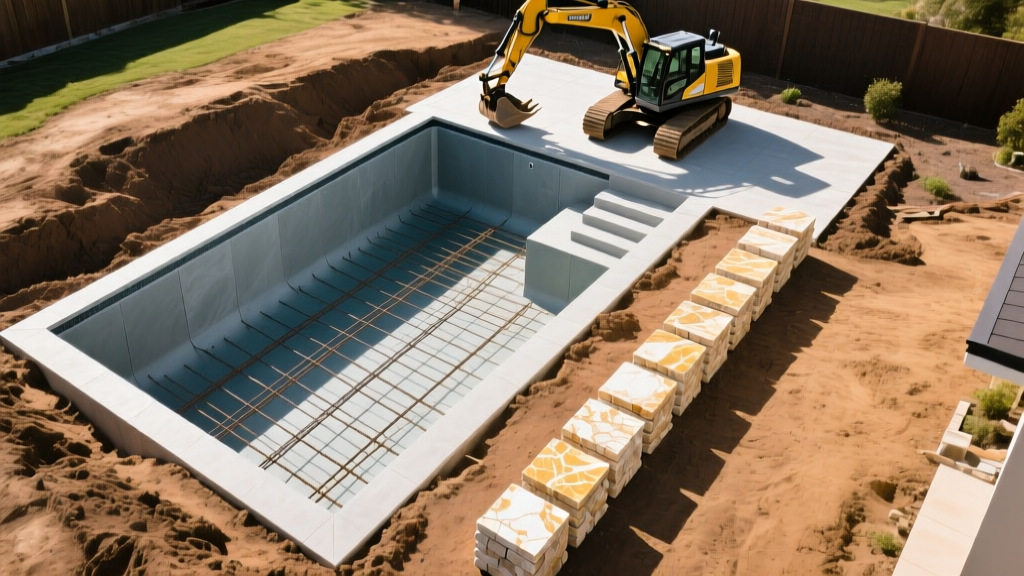
If you opt for concrete, understand the difference between gunite (dry-mix) and shotcrete (wet-mix). Both are pneumatically applied over a #3 or #4 steel rebar grid spaced 10 to 12 inches apart. A structurally sound shell requires a minimum thickness of 6 inches (though 8 to 12 inches is standard on the floor and coves). The interior finish heavily impacts the final price: standard white marcite plaster costs $5 to $7 per square foot, while premium pebble finishes (like PebbleTec) cost $10 to $15 per square foot, and glass bead finishes push past $18 per square foot.
Excavation and Site Preparation: The Unseen Budget Killers
Before a single drop of concrete is poured, the earth must be moved. Standard excavation in easily accessible, loamy soil costs between $3,000 and $6,000. However, site-specific variables can cause this line item to skyrocket.
If your excavator strikes bedrock or heavy caliche, standard digging halts. Hydraulic hammering adds $3,000 to $8,000, while controlled blasting can add $10,000 to $20,000 to your budget. Furthermore, if heavy machinery cannot access your backyard through a standard 10-foot gate, contractors must use mini-excavators and manual labor, or even crane-lift materials, adding $2,500 to $5,000 in access surcharges.
Essential Equipment and Plumbing Upgrades
The mechanical heart of your pool dictates your monthly utility bills and water clarity. Skimping here is a false economy that results in higher operational costs and premature equipment failure.
- Variable-Speed Pumps: According to the U.S. Department of Energy, variable-speed pumps use up to 90% less energy than single-speed models. Expect to pay $1,800 to $2,800 for premium models like the Pentair IntelliFlo3 or Hayward TriStar VS. The ROI typically hits within 18 to 24 months of energy savings.
- Sanitation Systems: Traditional liquid chlorine is labor-intensive. Saltwater chlorine generators (SWCG) cost $1,500 to $2,500 installed and provide softer water, though you must budget for a $600 to $900 replacement cell every 3 to 5 years. For a chemical-free approach, UV-C and Ozone systems cost $2,000 to $3,500 but still require a minimal residual oxidizer.
- Plumbing Diameter: Insist on 2-inch Schedule 40 PVC for all suction and return lines. Contractors who use 1.5-inch piping to save $300 on materials will create higher hydraulic head pressure, forcing your pump to work harder and consume more electricity over the pool's lifespan.
Heating Solutions: Gas vs. Electric Heat Pumps
If you plan to swim outside the peak summer months, heating is mandatory. Natural gas heaters (e.g., 400,000 BTU units) cost $3,500 to $5,500 installed and heat water rapidly, but operational costs are steep. Electric heat pumps cost $5,000 to $8,000 upfront and heat slower, but they cost roughly 60% less to operate monthly, making them the superior choice for extending the swim season in moderate climates.
Hardscaping and Decking: Where Budgets Often Overflow
Industry data from HomeGuide indicates that decking and hardscaping can account for 20% to 35% of the total project cost. The coping (the capstone directly over the pool edge) and the surrounding deck material define the aesthetic and safety of the pool area.
| Decking Material | Cost Per Sq. Ft. (Installed) | Heat Retention | Durability & Maintenance |
|---|---|---|---|
| Broom-Finish Concrete | $8 - $12 | Moderate | High; requires sealing every 2 years |
| Stamped Concrete | $14 - $22 | High (can be hot on bare feet) | Moderate; color can fade in UV exposure |
| Travertine Pavers | $22 - $35 | Low (stays cool to the touch) | Very High; individual pavers can be replaced |
| Porcelain Pavers | $25 - $40 | Low to Moderate | Extremely High; non-porous, stain-resistant |
Hidden Costs, Permitting, and Safety Compliance
Budget planning must account for the bureaucratic and regulatory realities of your local municipality. Permitting fees typically range from $400 to $1,200, but the required inspections often trigger secondary costs.
Expert Insight on Electrical Bonding:
"Many homeowners are surprised by the electrical requirements for pool safety. Per NEC (National Electrical Code) Article 680, all pools require an equipotential bonding grid using a continuous #8 solid copper wire attached to the rebar, pool shell, coping, and all metal fixtures within 5 feet of the water. Upgrading an older home's electrical panel to support a dedicated 50-amp or 60-amp subpanel for pool equipment can add $2,500 to $4,500 to your budget."
Furthermore, fencing is rarely optional. Most jurisdictions mandate a minimum 4-foot or 5-foot non-climbable barrier with self-closing, self-latching gates. Installing a compliant wrought iron or aluminum fence costs $35 to $60 per linear foot, while glass panel fencing—a popular choice for preserving sightlines—costs $200 to $400 per linear foot.
Budget Planning Framework: The 20% Contingency Rule
To prevent project stalls and financial stress, utilize a structured budgeting framework rather than relying solely on contractor estimates. According to Forbes Home Improvement, outdoor construction projects frequently encounter unforeseen underground obstacles or supply chain delays.
The 3-Tier Budget Allocation Model
- Tier 1: The Core Shell & Mechanics (55%) - Excavation, structural shell, plumbing, electrical, and primary filtration. Do not compromise on material quality here.
- Tier 2: Hardscape & Safety (30%) - Coping, decking, fencing, and drainage solutions. This is where you can phase the project (e.g., pour basic concrete now, overlay with pavers in three years) if funds are tight.
- Tier 3: Landscaping & Automation (15%) - Lighting, smart home integration, irrigation repair, and privacy planting.
The Golden Rule: Always hold back 15% to 20% of your total budgeted amount in a separate contingency fund. If your maximum budget is $80,000, design a $65,000 pool. The remaining $15,000 will inevitably be absorbed by rock excavation, upgraded coping, or municipal utility rerouting.
Understanding exactly how much a pool costs to build requires looking past the glossy brochure prices. By meticulously planning for site-specific excavation challenges, investing in high-efficiency mechanicals, and allocating funds for premium hardscaping, you ensure your backyard investment delivers both immediate enjoyment and long-term property value.
Written by
Priya KapoorPriya Kapoor is a real estate market analyst and construction economics researcher with expertise in housing affordability, development feasibility, and infrastructure investment. She holds a Master of Regional Planning from Cornell University and previously worked as a senior analyst at CBRE's Investment Properties group, where she modeled returns for $4B in mixed-use development pipelines. Priya now runs an independent research practice advising developers, municipalities, and REITs on construction cost forecasting and market timing. She publishes the quarterly "BuildMat Market Pulse" report tracking material price indices across 12 commodity categories. Based in Austin, TX, Priya serves on the board of Habitat for Humanity Austin and is a marathon runner.
More from Priya Kapoor
View all
Construction Cost
Cost to Build a 1600 Sq Ft Home in 2026: Full Breakdown
Accurate 2026 cost to build a 1600 sq ft home—material, labor, and regional pricing breakdowns included. Plan your budget with real-time estimates.
Aug 11, 2026

Wood & Lumber
Name the Types of Wood for Pressure Treatment and Preservation
Learn how to name the types of wood best suited for pressure treatment. Compare species treatability, chemical retention levels, and 2026 preservation costs.
Aug 4, 2026

Stone & Masonry
Stone Veneer Suppliers Lindenhurst: 2026 Cost Analysis
Analyze 2026 stone veneer costs in Lindenhurst, NY. Compare local supplier pricing, delivery fees, and Suffolk County installation labor rates.
Aug 4, 2026