True Cost to Build a Small House: Size and Scope Calculator
Accurately calculate the cost to build a small house. Learn how square footage, fixed MEP expenses, and scope variables impact your final construction budget.

The "Small House" Cost Paradox: Why Smaller Isn't Always Cheaper Per Square Foot
When planning a compact residential build, the most common miscalculation is assuming that halving the square footage will halve the budget. In reality, the cost to build a small house (typically defined as 400 to 1,000 square feet) operates on an inverse cost-per-square-foot scale compared to larger homes. A 2,500-square-foot production home might cost $150 per square foot to construct, but a 600-square-foot custom small house can easily push $250 to $325 per square foot.
This paradox exists because construction budgets are divided into two distinct categories: variable costs (which scale with size, like flooring and roofing materials) and fixed costs (which remain largely static regardless of footprint, like utility tap fees, site surveys, and major appliances). According to data tracked by the U.S. Census Bureau's Building Permits Survey, smaller footprints absorb these fixed costs over a much smaller area, drastically inflating the per-square-foot metric. To accurately estimate your project, you must abandon simple square-footage multipliers and adopt a Size & Scope calculation framework.
The Size & Scope Calculator: The Core Formula
To generate a reliable budget, break your estimation down into three distinct buckets. The foundational formula for a small house build is:
The Envelope/Finish Rate covers your foundation, framing, exterior cladding, roofing, and interior finishes. The Fixed MEP (Mechanical, Electrical, Plumbing) costs cover the baseline systems required to make the home habitable, while Fixed Site Costs cover the land preparation and municipal fees that apply to a single-family lot regardless of the home's dimensions.
Baseline Cost Matrix by Square Footage
The table below illustrates how fixed costs skew the final cost-per-square-foot metric for small-scale builds, assuming a mid-range envelope/finish rate of $130 per square foot and standard municipal fee structures.
| Home Size | Variable Envelope Cost ($130/sq ft) | Fixed MEP & Site Costs | Total Estimated Cost | True Cost Per Sq Ft |
|---|---|---|---|---|
| 400 sq ft (Micro) | $52,000 | $68,000 | $120,000 | $300.00 |
| 600 sq ft (Small) | $78,000 | $72,000 | $150,000 | $250.00 |
| 800 sq ft (Compact) | $104,000 | $76,000 | $180,000 | $225.00 |
| 1,000 sq ft (Standard Small) | $130,000 | $80,000 | $210,000 | $210.00 |
Fixed Costs: The Budget Anchors That Don't Scale
To use the calculator effectively, you must accurately price the fixed costs. These are the expenses that remain nearly identical whether you are building a 400-square-foot accessory dwelling unit (ADU) or a 1,000-square-foot primary residence.
- Site Preparation and Utilities: Clearing, grading, and pouring a driveway typically cost between $8,000 and $15,000. Municipal water and sewer tap fees are notoriously rigid, often ranging from $2,500 to $8,000 per connection, regardless of the home's anticipated water usage.
- Permitting and Impact Fees: Local municipalities charge school, road, and park impact fees per residential unit, not per square foot. Expect to pay $3,000 to $10,000 in fixed municipal fees.
- MEP Rough-ins and Panels: A 200-amp electrical service panel costs roughly $2,500 to install whether it powers a tiny home or a massive estate. Similarly, a high-efficiency ductless mini-split system (such as the Mitsubishi M-Series 1-ton unit) requires a base installation labor cost of $3,500 to $5,000, even if the conditioned space is minimal.
- The "Wet Area" Minimums: Every legal dwelling requires at least one full bathroom and a functional kitchen. The plumbing rough-in, venting, and baseline fixtures for these spaces establish a hard floor cost of $18,000 to $25,000 before any premium finishes are selected.
Scope Variables: Where the Budget Bleeds
Once fixed costs are established, your variable costs are dictated by scope decisions. In small home construction, design complexity penalizes the budget far more severely than in larger homes because there is less "simple" square footage to dilute the expensive features.
Foundation and Roof Pitch
The National Association of Home Builders (NAHB) consistently identifies foundation and framing as the largest line items in residential construction. For a small house, a monolithic concrete slab is the most cost-effective foundation, averaging $6 to $8 per square foot. Upgrading to a vented crawlspace adds $10 to $14 per square foot, while a full conditioned basement can add $40 to $60 per square foot—effectively doubling the footprint cost of a small build. Similarly, a simple gable roof with standard asphalt shingles keeps costs low. Introducing hips, valleys, or dormers to a small roofline increases framing labor and waste factor by 20% to 35%.
The Window-to-Wall Ratio Trap
Small houses often rely on large windows to prevent the interior from feeling claustrophobic. However, glass is significantly more expensive than insulated wall assemblies. A standard 2x6 framed wall with R-21 batt insulation and LP SmartSide siding costs roughly $25 to $35 per square foot of wall area. Replacing that wall space with high-performance fiberglass casement windows (such as Marvin Essential series) pushes the cost to $80 to $120 per square foot of opening. Maximizing natural light is crucial for small-space psychology, but it must be calculated as a premium scope upgrade, not a baseline feature.
In a 2,500-square-foot home, a $40,000 kitchen represents 10% to 15% of the total construction budget. In a 600-square-foot home, that same kitchen consumes 25% of the budget. To maintain balance, scale your appliance and cabinetry scope to the home's footprint. Opt for 24-inch apartment-sized appliances (like those from Bosch or Blomberg) and utilize custom built-in millwork rather than standard upper cabinets to maximize vertical storage without overwhelming the floor plan.
Energy Modeling and Envelope Efficiency
Compact homes possess a distinct thermodynamic advantage: a lower surface-area-to-volume ratio compared to sprawling single-story ranches. However, because the interior space is so small, internal heat gains (from appliances, occupants, and electronics) and solar heat gain through windows can cause rapid temperature fluctuations. The Department of Energy's efficient design guidelines emphasize that right-sizing HVAC equipment is critical in small footprints. Oversizing a heating system in a 600-square-foot home will result in "short cycling," which degrades equipment lifespan and ruins humidity control. Budget for a Manual J load calculation ($400-$600) to ensure your MEP scope specifies correctly sized, inverter-driven equipment rather than standard builder-grade units.
Hidden Scope Creep: 4 Edge Cases to Budget For
When running your final numbers, pad your contingency fund for these specific small-lot and small-home edge cases:
- Geotechnical Surprises: Small lots often have limited space for soil boring. If your soil bearing capacity is poor, you may need a structural engineer to design a reinforced grade beam ($2,500 to $4,000 in engineering and extra concrete costs).
- Setback Variances: Building close to property lines to maximize a small footprint often triggers zoning setback rules. Applying for a variance requires legal notices, neighbor notifications, and hearing fees, typically costing $1,500 to $3,000 and adding 60 to 90 days to your timeline.
- Fire Sprinkler Mandates: Many municipalities now require residential fire sprinklers if the home is built within a certain distance of the property line or if the driveway exceeds 150 feet. A small-home sprinkler system tied to the domestic water supply adds $3,500 to $6,000 to the plumbing scope.
- Crane or Manual Labor Premiums: If your small lot is in a dense urban infill area or a steep mountainous region where standard concrete trucks and lumber delivery booms cannot reach the pad, you will pay a premium for concrete pumping ($1,500+ per pour) or manual material staging.
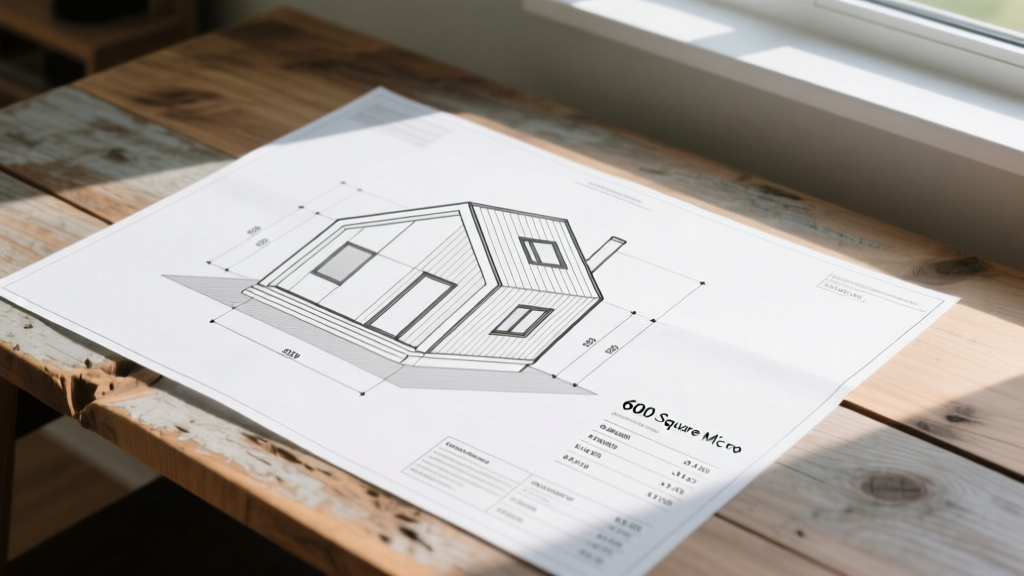
Executing the Final Calculation
To finalize your budget, map your specific material selections to the variable rate, add your localized fixed municipal and MEP costs, and apply a 15% contingency multiplier. By decoupling the fixed infrastructure costs from the variable finish costs, you eliminate the guesswork of generic square-foot estimators. This precise, scope-aware calculation ensures your small house build remains financially viable from the initial site clearing through the final certificate of occupancy.
Written by
Marcus ChenMarcus Chen is a licensed structural engineer (PE) and building materials analyst with over 12 years of experience across residential, commercial, and industrial construction. He holds a Master of Science in Civil Engineering from UC Berkeley and spent six years at Thornton Tomasetti before transitioning to independent consulting and technical writing. Marcus specializes in material selection for seismic-prone regions, concrete reinforcement strategies, and lifecycle cost analysis. His work has been cited by the American Concrete Institute (ACI) and the Structural Engineers Association of California (SEAOC). When he is not on a job site or at his desk, you will find him hiking the Sierra Nevada or restoring a 1920s craftsman bungalow in Oakland, CA.
More from Marcus Chen
View all
Construction Cost
How Much Did the Eiffel Tower Cost to Build?
How much did the Eiffel Tower cost to build in 1889? We adjust for inflation and compare its budget to modern skyscraper construction.
Aug 4, 2026

Fire Resistance
What Is a Fire Resistant Material? Testing & Certification Guide
Discover what is a fire resistant material through ASTM and UL testing. Learn how fire ratings, certifications, and assemblies work in construction.
Aug 4, 2026

Construction Cost
How Much Did the Burj Khalifa Cost to Build?
How much did the Burj Khalifa cost to build? We break down the $1.5B project and extract 5 money-saving strategies for your next build.
Jul 30, 2026