The True Cost to Build the Sphere in Las Vegas: A Full Breakdown
Analyze the $2.3B cost to build the Sphere in Las Vegas. We break down steel, LED, and AV expenses, comparing it to traditional mega-stadiums.

Deconstructing the $2.3 Billion Price Tag
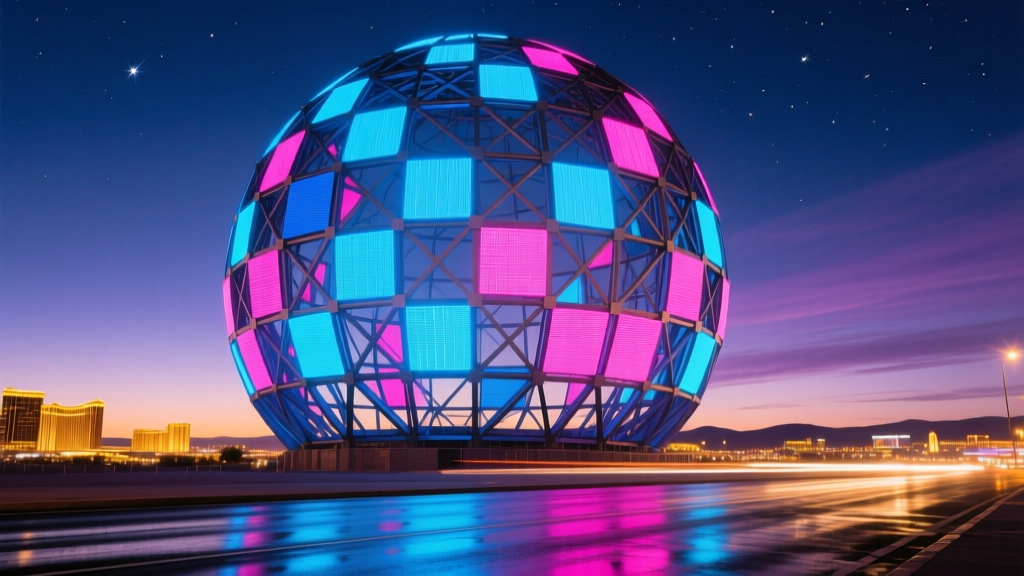
The Sphere in Las Vegas redefined entertainment architecture, but its construction cost tells an equally monumental story. Originally estimated at $1.2 billion when announced in 2018, the final capital expenditure reached $2.3 billion by its opening. For construction estimators and commercial developers analyzing bespoke mega-projects in 2026, understanding where that $1.1 billion overage went is critical. The escalation was not merely a product of inflation; it was driven by first-of-its-kind research and development, custom semiconductor manufacturing, and extreme HVAC engineering.
According to filings from Sphere Entertainment Investor Relations, the venue encompasses 875,000 square feet and stands 366 feet tall. Below is the estimated capital expenditure breakdown based on industry analysis of the project's material and technological requirements.
Capital Expenditure Breakdown (Estimated)
| Construction Phase / System | Estimated Cost | Percentage of Total | Primary Cost Driver |
|---|---|---|---|
| Substructure & Foundation | $280 Million | 12.2% | 150,000+ cubic yards of concrete, deep piling |
| Steel Superstructure | $410 Million | 17.8% | 13,000+ tons of custom curved steel |
| Exosphere (Exterior LED) | $550 Million | 23.9% | 1.2M custom IP65 LED pucks, structural rigging |
| Interior AV & Acoustics | $380 Million | 16.5% | 16K wrap-around screen, 167,000 Holoplot drivers |
| HVAC & MEP Systems | $290 Million | 12.6% | Under-floor displacement, massive chillers |
| Interior Fit-Out & Seating | $190 Million | 8.3% | 18,600 seats, haptic systems, VIP suites |
| Soft Costs, R&D, Logistics | $200 Million | 8.7% | Prototyping, custom software, global shipping |
Material and Engineering Deep Dive
To accurately estimate a structure of this geometry and technological density, estimators must look beyond standard commercial building costs. The Sphere is essentially a massive machine disguised as a building.
The Steel Skeleton and Foundation
The foundation required over 150,000 cubic yards of concrete to support the immense dead load of the steel dome and the live load of the Exosphere. The roof spans 516 feet without interior columns, requiring heavy-duty steel trusses. In 2026, structural steel pricing for complex, curved geometries carries a 20% to 30% premium over standard I-beam commercial framing due to the necessity of 5-axis CNC cutting and specialized welding certifications.
The Exosphere: 1.2 Million Custom LED Pucks
The exterior display covers 580,000 square feet. Rather than using off-the-shelf LED cabinets, engineers designed custom 'pucks' containing multiple diodes to withstand desert heat, UV radiation, and high winds. Manufacturing 1.2 million IP65-rated, custom-PCB LED nodes required securing dedicated semiconductor fabrication lines. The cost per square foot for this bespoke exterior media facade is estimated at over $900, compared to $150-$250 for standard commercial exterior LED walls.
Holoplot Beamforming Audio
Traditional line-array speakers would fail in a spherical, highly reflective environment. The venue utilizes Holoplot beamforming technology, embedding 167,000 individual speaker drivers into the walls. This system uses software to steer sound waves like a laser, allowing different zones of the venue to hear entirely different audio tracks without physical acoustic barriers. The hardware cost is secondary to the immense computational processing power and acoustic modeling software required to calibrate the system.
Estimator Insight: The HVAC Challenge
Cooling a spherical volume is a thermodynamic nightmare. Heat rises, but a dome traps it. Furthermore, the 160,000-square-foot interior LED screen generates massive thermal output. Engineers solved this using under-floor displacement ventilation, pumping chilled air directly beneath the 18,600 seats. When estimating similar enclosed mega-venues, MEP budgets must be increased by at least 40% over standard arena baselines to account for custom air-distribution plenums and redundant chiller plants.
Cost Comparison: The Sphere vs. Traditional Mega-Venues
How does the cost to build the Sphere in Las Vegas compare to other recent mega-projects? By analyzing the cost per square foot and cost per seat, we can contextualize the financial premium of bespoke entertainment architecture.
| Venue | Total Cost | Capacity | Cost Per Seat | Primary Cost Driver |
|---|---|---|---|---|
| The Sphere (Las Vegas) | $2.3 Billion | 18,600 | $123,655 | Bespoke AV/LED R&D, Custom Geometry |
| SoFi Stadium (Inglewood) | $5.5 Billion | 70,240 | $78,302 | Massive scale, ETFE roof, subterranean build |
| Allegiant Stadium (Las Vegas) | $1.9 Billion | 65,000 | $29,230 | Traditional steel/bowl design, ETFE roof |
| MSG Renovation (New York) | $1.0 Billion+ | 20,000 | $50,000 | Retrofitting legacy infrastructure, premium suites |
While SoFi Stadium costs more in absolute terms due to its sheer size and subterranean complexities, the Sphere holds the record for the highest cost per seat. This metric highlights a fundamental shift in venue economics: the value is no longer just in the seating bowl, but in the proprietary technological envelope that envelops the audience.
Why the Budget Escalated: R&D and Supply Chain Realities
The jump from the initial $1.2 billion estimate to the final $2.3 billion cost was largely driven by the 'First-of-its-Kind Tax.' When The Sphere Las Vegas was announced, the Exosphere and interior wrap-around screen existed only as conceptual renders. Realizing them required:
- Prototyping Failures: Early LED puck designs failed thermal testing in simulated Mojave Desert conditions, requiring complete PCB redesigns and new heat-sink extrusions.
- Acoustic Modeling: The interior volume required physical scale models and millions of dollars in supercomputer time to map acoustic reflections before a single speaker was mounted.
- Logistical Bottlenecks: Transporting 516-foot wide curved steel trusses through the Las Vegas corridor required custom heavy-haul permits, temporary road closures, and specialized crane rigs that had to be imported internationally.
'In commercial estimating, the first unit of any bespoke technological structure will always carry a 40% to 60% premium over the theoretical baseline. You are not just paying for materials; you are funding the R&D department.' — Senior MEP Estimator, Mega-Projects Division
Estimating a 'Sphere 2.0' in 2026
As Madison Square Garden Entertainment explores building additional Sphere venues globally, how will the cost structure change in 2026? The second unit of a complex project typically benefits from a steep learning curve.
The 'Second Unit' Cost Reduction
If a second Sphere were to break ground in 2026, estimators project the total cost would stabilize between $1.6 billion and $1.8 billion. This reduction is achieved through:
- Amortized R&D: The $200M+ spent on software development, acoustic algorithms, and LED prototyping is already complete.
- Standardized Supply Chains: Manufacturers now have established assembly lines for the custom Holoplot arrays and Exosphere pucks, eliminating the 'custom fabrication' premium.
- Optimized Steel Detailing: The BIM models and structural engineering for the dome are finalized, reducing architectural and engineering soft costs by up to 50%.
However, this assumes stable global pricing for semiconductors and structural steel. Any geopolitical disruptions to copper or silicon supply chains in 2026 could immediately inflate the AV and MEP budgets, which together account for nearly 30% of the total build cost.
Key Takeaways for Commercial Estimators
The cost to build the Sphere in Las Vegas serves as a masterclass in the financial realities of pushing architectural boundaries. For estimators working on modern commercial, entertainment, or corporate mega-projects, the lessons are clear:
- Never use standard MEP multipliers for complex geometries. Spherical or highly angular buildings require custom displacement ventilation that standard RSMeans data will not accurately capture.
- Separate hardware costs from integration costs. The 167,000 Holoplot drivers are expensive, but the server racks, fiber-optic backbone, and calibration labor required to make them function as a single array often equal the hardware cost.
- Factor in the 'Desert Premium' for exterior tech. Any electronic facade deployed in high-UV, high-heat environments requires custom thermal management that will double the baseline cost of the LED modules.
Ultimately, the Sphere is not just a building; it is a massive, habitable piece of consumer electronics. Estimating its cost requires bridging the gap between heavy civil construction and high-end semiconductor manufacturing.
Written by
James ThorntonJames Thornton is a construction industry veteran with 25 years of hands-on experience in wood framing, lumber grading, and residential building codes. He started as a framing carpenter in rural Oregon, earned his ICC Residential Building Inspector certification, and eventually became a senior plan reviewer for the City of Portland Bureau of Development Services. James holds a B.S. in Wood Science & Technology from Oregon State University and is a certified lumber grader through the West Coast Lumber Inspection Bureau (WCLIB). He has inspected over 3,000 residential construction sites and authored the city's internal guide on advanced framing techniques (2x6 at 24" O.C.). James lives in Bend, OR, where he builds custom timber-frame cabins and competes in lumberjack sports.
More from James Thornton
View all
Insulation
Best Home Insulation Materials: Complete 2026 Guide
Compare top home insulation materials for 2026. Find R-values, installed costs per square foot, and best uses for fiberglass, spray foam, and mineral wool.
Aug 4, 2026

Sustainable Building
Certify Your Green Building Material for LEED and WELL
Step-by-step guide to certifying a green building material for LEED v5 and WELL v2. Master EPDs, HPDs, and VOC limits for 2026 project specifications.
Aug 4, 2026

Stone & Masonry
Veneer Stacked Stone Panels: Interior Design & Style Showcase
Discover how veneer stacked stone panels transform interiors. Explore modern design profiles, material pairings, and technical installation specs.
Aug 4, 2026