How Much Did It Cost to Build the Cowboys Stadium? A Financing Guide
Discover how much it cost to build the Cowboys stadium, exploring the $1.2B financing structure, public subsidies, and private overrun risks.

The $1.2 Billion Reality: Final Costs vs. Initial Estimates
When stakeholders and sports finance analysts ask how much did it cost to build the cowboys stadium, the answer requires separating political promises from construction realities. Initially pitched to Arlington voters in 2004 with a projected price tag of $650 million, the final construction cost of the facility now known as AT&T Stadium ballooned to approximately $1.2 billion by its 2009 completion. Some estimates that include surrounding infrastructure and land acquisition push the total project cost closer to $1.3 billion.
This massive variance between the initial estimate and the final ledger provides a masterclass in mega-project financing, risk allocation, and the escalating hard costs of modern sports architecture.
Deconstructing the Capital Stack: Who Paid for What?
Financing a billion-dollar stadium in the mid-2000s required a complex public-private partnership (P3). The capital stack was bifurcated into a capped public contribution and an open-ended private commitment. Below is the exact breakdown of the funding sources that capitalized the project.
| Funding Source | Amount | Mechanism | Risk Bearer |
|---|---|---|---|
| Arlington Taxpayers | $325 Million | Municipal Bonds backed by dedicated taxes | Public (Capped) |
| Jerry Jones / Cowboys | $875+ Million | Private equity, PSLs, NFL loans, debt | Private (Uncapped) |
| Total Project Cost | ~$1.2 Billion | Blended P3 Capital Stack | Mixed |
The Public Subsidy: Arlington's Tax Mechanisms
The public portion of the financing was secured through a voter-approved referendum in 2004. The City of Arlington agreed to contribute $325 million toward the stadium's construction. To service the municipal bonds issued to raise this capital, the city implemented a targeted, multi-pronged tax strategy designed to capture revenue from both locals and visitors:
- 0.5% Sales Tax Increase: Applied to general retail sales within city limits, forming the baseline of the debt service revenue.
- 2% Hotel Occupancy Tax Increase: Specifically targeting out-of-town visitors attending games and events, capitalizing on the regional tourism draw.
- 10% Rental Car Tax: An additional surcharge on rental vehicles, further capturing tourist and business traveler spending.
According to analyses by the Urban Institute, public subsidies for sports stadiums often fail to generate the promised localized economic growth to justify the tax burden. However, the Arlington model successfully isolated the debt service to specific consumption taxes rather than relying on general property tax hikes, a distinction that made the referendum palatable to local voters. The bonds issued are projected to be fully retired by the late 2020s, at which point the dedicated tax increments are slated to sunset or be redirected to other municipal projects.
Private Equity and the Burden of Cost Overruns
Jerry Jones initially pledged to cover $325 million of the $650 million estimate. When the final cost nearly doubled to $1.2 billion, Jones was contractually obligated to cover the difference. Raising nearly $900 million in private capital in the mid-2000s required aggressive monetization of the stadium's future cash flows before the foundation was even poured.
Revenue Securitization and Capital Generation
The private financing stack was assembled through four primary vehicles:
- Personal Seat Licenses (PSLs): The Cowboys sold approximately 10,000 PSLs, granting fans the right to purchase season tickets. Prices ranged from $2,000 for upper-deck seats to over $150,000 for premium club-level placements, generating an estimated $300 million in immediate, upfront capital.
- Luxury Suite Forward Commitments: With over 150 luxury suites, many were leased on multi-year contracts at rates exceeding $300,000 to $500,000 annually. These forward contracts were securitized to secure favorable private construction debt.
- NFL G-3 Loan Program: The league provided a substantial loan (reportedly around $150 million) backed by the NFL's shared national television revenue, a program designed to help franchises finance stadium construction while keeping them in their home markets.
- Naming Rights Securitization: In 2009, AT&T secured the naming rights in a landmark deal reportedly valued at $19 million per year over 30 years. As noted in Forbes' valuation of the franchise, these massive, guaranteed corporate infusions drastically alter a team's enterprise value and provide the collateral necessary to service massive private construction loans.
Hard Cost Drivers: Where Did the Money Go?
The leap from $650 million to $1.2 billion was not solely due to inflation; it was driven by aggressive mid-construction design enhancements and the sheer scale of the engineering required.
Three specific architectural features caused the most significant budget expansion:
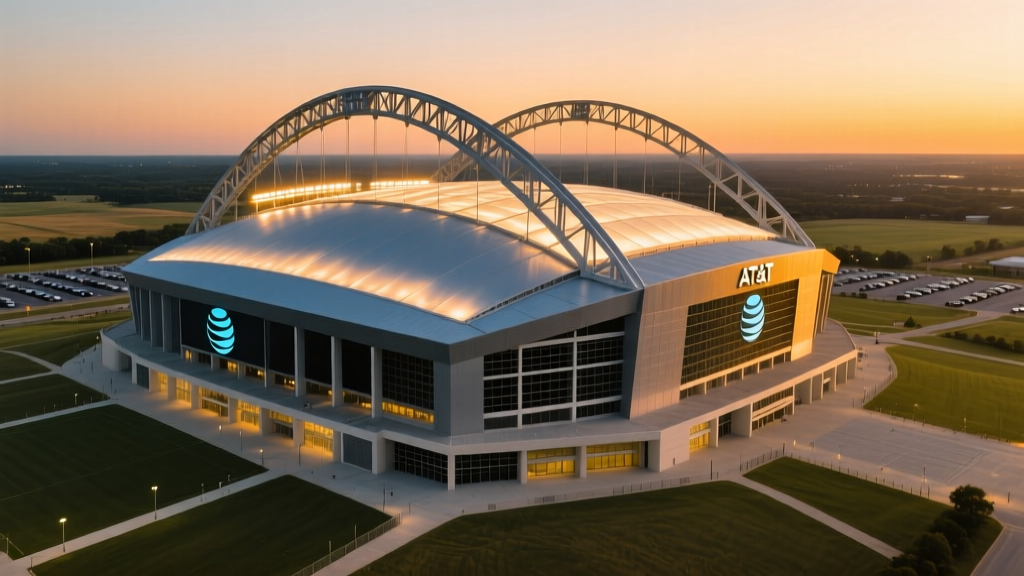
- The Retractable Roof and Arches: The decision to include a mechanized retractable roof required two monumental, 900-ton steel arches spanning 1,000 feet. The specialized engineering, heavy-lift crane operations, and custom mechanized tracks added hundreds of millions to the structural steel and mechanical budgets.
- The Center-Hung Video Board: The 11,200-square-foot Mitsubishi Diamond Vision screen, suspended directly over the field, cost approximately $40 million. At the time, it was the largest high-definition video display in the world, requiring specialized rigging and localized structural reinforcement.
- Premium Interiors and Climate Control: The sheer volume of the 3-million-cubic-foot interior bowl required a massive, custom HVAC system to maintain climate control in the Texas heat, while the fit-out of the luxury club levels utilized high-end architectural finishes that far exceeded standard stadium grade materials.
Lessons for Modern Mega-Project Financing
When analyzing how much it cost to build the cowboys stadium, the most critical takeaway for modern construction estimators and sports financiers is the allocation of overrun risk. In many municipal stadium deals, cost overruns are absorbed by the public sector through supplemental bond issuances or extended tax timelines. The Arlington deal strictly capped the public exposure at $325 million.
Compare this to modern iterations: SoFi Stadium in Los Angeles cost over $5 billion, funded entirely by private equity (Stan Kroenke), while Allegiant Stadium in Las Vegas utilized a similar P3 model but with a different tax mechanism (a special hotel room tax generating $645 million in public bonds). The Cowboys Stadium model proved that a franchise with strong enough brand equity could successfully securitize PSLs, suites, and naming rights to cover massive private overruns without requiring a second public referendum.
Frequently Asked Questions
Are Arlington taxpayers still paying for the Cowboys stadium?
Yes, but the end is in sight. The municipal bonds issued to fund the $325 million public subsidy are serviced by the dedicated sales, hotel, and rental car taxes. These bonds are scheduled to be fully retired between 2025 and 2030. Once the debt is satisfied, the special tax increments are legally required to be phased out or redirected to other city initiatives.
How does the $1.2B cost compare to modern NFL stadiums?
Adjusted for inflation, $1.2 billion in 2009 equates to roughly $1.7 billion today. However, modern stadiums have vastly exceeded this. SoFi Stadium (2020) cost over $5.5 billion, and Allegiant Stadium (2020) cost nearly $2 billion. The escalation is driven by exponential increases in technological integration, premium hospitality square footage, and complex mixed-use real estate developments surrounding the venues.
Did the stadium cost include the surrounding land and infrastructure?
The widely cited $1.2 billion figure primarily covers the hard and soft construction costs of the stadium itself. When factoring in the acquisition of the land (formerly a golf course and amusement park), environmental remediation, and the massive upgrades to surrounding roadways and utility grids required by the City of Arlington and TxDOT, the total localized economic impact and project footprint cost pushes closer to $1.3 billion to $1.4 billion.
Written by
Sarah WhitfieldSarah Whitfield is a chartered quantity surveyor (MRICS) and construction cost analyst with 15 years of experience in material pricing, procurement strategy, and project budgeting. She earned her degree in Construction Management from the University of Reading (UK) and has worked on projects ranging from $2M custom homes to $180M mixed-use developments across North America and Europe. Sarah currently leads cost estimating for BuildMat Insight, maintaining a proprietary database of 4,000+ material price points updated quarterly. She is a frequent contributor to RSMeans cost data panels and has presented at the International Cost Engineering Council (ICEC) congress. Based in Denver, CO, Sarah is an avid trail runner and volunteer mentor for Women in Construction.
More from Sarah Whitfield
View all
Wood & Lumber
What Are the Different Types of Wood? A Builder's Guide
Compare structural softwoods, finish hardwoods, and engineered lumber. Analyze Janka ratings, MOE values, and 2026 pricing for construction.
Aug 4, 2026

Walls & Panels
Steel Framing vs Wood Framing: Corrosion and Moisture Defense
Compare steel framing vs wood framing for moisture resistance. Learn about galvanized coatings, condensation risks, and corrosion protection strategies.
Jul 21, 2026

Stone & Masonry
How to Cut Stone Veneer: Wet Saw vs Grinder Comparison
Compare the best tools for cutting stone veneer. We review wet saws, angle grinders, and chop saws to help you achieve clean, chip-free cuts.
Jul 21, 2026