How Much Does It Cost to Build a Dock? Material and Type Breakdown
Discover exactly how much it costs to build a dock. Compare pricing for floating, piling, and pipe docks, plus wood, composite, and aluminum materials.

The Baseline Economics of Marine Construction
Calculating the exact cost to build a dock requires moving beyond simple square-footage averages. While the national average for residential dock construction hovers between $4,500 and $12,000, the true price is dictated by hydrostatic pressure, substrate composition, and material degradation rates. In 2026, supply chain stabilization has normalized marine-grade aluminum and composite decking prices, but specialized marine labor and heavy equipment mobilization (such as aquatic pile drivers) remain significant cost drivers. A shallow-water pipe dock on a sandy inland lake may cost $18 per square foot, while a deep-water piling dock on a coastal estuary with high wave action can easily exceed $75 per square foot.
Dock Type Cost Comparison Matrix
The structural category of your dock dictates the baseline engineering and installation costs. Below is a comparative breakdown of the five primary dock types, factoring in current material and marine labor rates.
| Dock Type | Avg. Cost (Per Sq. Ft.) | Ideal Water Depth | Substrate Requirement | Expected Lifespan |
|---|---|---|---|---|
| Floating | $18 - $35 | Any (fluctuating) | N/A (Anchored) | 15 - 25 years |
| Piling | $35 - $75+ | Deep (>8 ft) | Sand, Clay, Rock | 30 - 50 years |
| Pipe | $15 - $28 | Shallow (<6 ft) | Sand, Soft Mud | 20 - 30 years |
| Crib | $45 - $80 | Shallow to Medium | Rocky, Hard Bottom | 40 - 60 years |
| Suspension | $60 - $100+ | Deep / Steep Banks | Bedrock (Shoreline) | 50+ years |
Structural Deep Dive: Floating vs. Piling
Floating Docks utilize encapsulated Expanded Polystyrene (EPS) floats or heavy-duty polyethylene drums. They are the only viable option for bodies of water with extreme seasonal level fluctuations (e.g., reservoirs managed by the TVA or Army Corps). The cost variance here is driven by the anchoring system; concrete deadweights cost significantly less than helical screw anchors, which are required in deep or highly turbulent water.
Piling Docks represent the gold standard for permanence. They rely on 10-inch to 14-inch diameter Southern Yellow Pine (SYP) or Douglas Fir pilings, treated to UC4B or UC4C marine retention levels. Installation requires a floating barge equipped with a vibratory or impact pile driver. Expect to pay $45 to $85 per linear foot just for the driving and setting of the pilings, independent of the decking costs.
Decking Material Breakdown: Wood vs. Composite vs. Aluminum
The surface material accounts for 30% to 50% of the total visible project cost. Marine environments are unforgiving, subjecting materials to constant UV radiation, salt spray, and submersion cycles.
Pressure-Treated Southern Yellow Pine (SYP)
Material Cost: $3.50 - $6.00 per sq. ft.
Pros: Lowest upfront cost; high structural load capacity; natural traction when wet.
Cons: Requires annual sealing and bi-annual washing; prone to warping, splintering, and checking over time; chemical leaching concerns in sensitive ecosystems.
Advanced PVC and Capped Composite
Material Cost: $14.00 - $26.00 per sq. ft. (e.g., TimberTech Advanced PVC, Trex Transcend)
Pros: Zero sealing required; highly resistant to rot and marine borers; PVC options reflect heat better than dark composites.
Cons: Higher upfront cost; composite boards can become slick when covered in wet algae; heavier than wood, requiring closer joist spacing (12 inches on-center instead of 16).
Marine-Grade Aluminum
Material Cost: $22.00 - $38.00 per sq. ft. (e.g., ShoreMaster, Alumadock)
Pros: Impervious to rot, rust, and insects; lightweight (reduces substructure load); excellent heat dissipation; 100% recyclable.
Cons: Highest material cost; can be noisy underfoot; requires specific anodized or powder-coated finishes to prevent galvanic corrosion when in contact with dissimilar metals in saltwater.
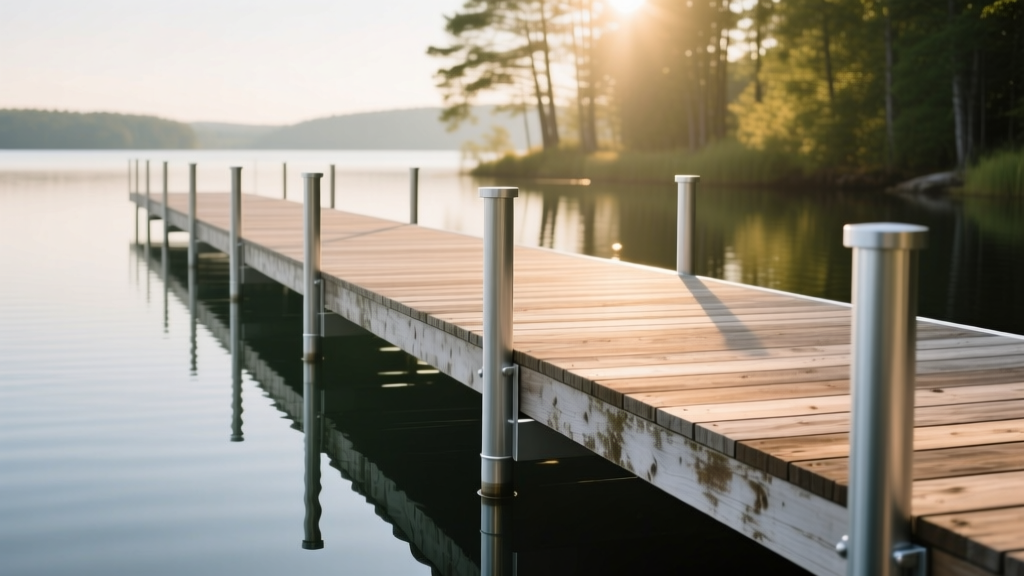
Substructure Engineering: The Hidden Cost Driver
Homeowners often fixate on decking, but the substructure (framing, joists, and hardware) dictates the dock's structural integrity. In freshwater environments, heavily galvanized steel (G-185 coating) or structural aluminum framing is mandatory. Standard pressure-treated wood framing will rot from the inside out due to trapped moisture between the joists and the decking.
- Galvanized Steel Framing: $8 - $12 per linear foot. Highly durable but requires meticulous field-cutting treatment with cold galvanizing compound (e.g., ZRC) to prevent rust at cut joints.
- Structural Aluminum Framing: $14 - $22 per linear foot. Lighter and corrosion-proof, but requires specialized TIG/MIG welding or proprietary mechanical fasteners, increasing fabrication labor.
- Hardware Upgrades: Upgrading from standard galvanized bolts to 316-grade stainless steel hardware adds $1.50 to $3.00 per square foot but is strictly required for saltwater or brackish environments to prevent catastrophic galvanic corrosion.
Regulatory, Permitting, and Site Preparation Costs
Building over navigable waters or wetlands triggers complex regulatory oversight. Failing to account for these soft costs can derail a project budget by 15% to 30%. According to the U.S. Army Corps of Engineers (USACE), any structure placed in navigable waters requires a Section 10 permit, while work impacting adjacent wetlands falls under Section 404 of the Clean Water Act. The EPA also enforces strict guidelines regarding turbidity and benthic habitat disruption during construction.
Common Soft Costs and Site Variables
| Item | Estimated Cost | Trigger Condition |
|---|---|---|
| Joint Permit Application (State/USACE) | $250 - $1,500 | All waterfront structures |
| Bathymetric & Substrate Survey | $800 - $2,500 | Deep water, unknown bottom composition |
| Turbidity Curtains (Silt Fencing) | $15 - $30 per linear ft | Mandated in ecologically sensitive zones |
| Marine Electrical Pedestal (120V/240V) | $1,800 - $4,500 | Adding shore power and lighting to the dock |
20-Year Total Cost of Ownership (TCO) Analysis
Evaluating dock materials solely on initial installation cost is a financial error. Marine environments accelerate depreciation. The following TCO model compares a 400-square-foot dock over a 20-year lifecycle, factoring in initial installation, routine maintenance, and projected material replacement.
| Material Profile | Initial Build Cost (400 sq ft) | 20-Year Maintenance & Upkeep | Estimated 20-Year TCO |
|---|---|---|---|
| Pressure-Treated Pine Deck / Wood Frame | $11,200 | $8,500 (Sealing, board replacement) | $19,700 |
| Capped Composite Deck / Steel Frame | $18,400 | $1,200 (Cleaning, hardware checks) | $19,600 |
| Marine Aluminum Deck / Aluminum Frame | $24,000 | $400 (Rinsing, anodizing touch-ups) | $24,400 |
Insight: By year 12, the cumulative maintenance costs of pressure-treated wood surpass the initial premium paid for capped composite, making composite the mathematically superior choice for long-term holders.
Decision Framework: Matching Dock Type to Waterfront Conditions
Use this diagnostic framework to determine the most structurally sound and cost-effective dock type for your specific parcel:
- High Fluctuation / Reservoir: Choose a Floating Dock with encapsulated EPS and a heavy-duty chain anchoring system. Piling docks in fluctuating waters require expensive slip joints and sliding collars that frequently bind and fail.
- Shallow, Sandy Inland Lake: Choose a Pipe Dock. Driving 2-inch to 3-inch galvanized steel pipes into a sandy substrate is highly cost-effective and minimizes environmental disruption, often expediting the permitting process.
- Deep Coastal / High Wave Action: Choose a Piling Dock with 12-inch+ treated timber or fiberglass composite pilings. Ensure the framing utilizes 316 stainless steel through-bolts rather than lag screws to withstand lateral wave shear forces.
- Rocky Bottom / Heavy Winter Ice: Choose a Crib Dock or a piling dock equipped with ice deflectors (pile sleeves). Standard floating docks will be crushed by shifting ice sheets, and exposed pilings will be snapped by ice jacking.
Written by
Elena RodriguezElena Rodriguez is a civil engineer and technical writer specializing in concrete technology, masonry systems, and ASTM/ACI compliance. She earned her B.S. in Civil Engineering from Texas A&M University and spent a decade at a materials testing laboratory, performing over 2,000 concrete compressive strength tests and masonry prism evaluations. Elena is an ACI-certified Field Testing Technician (Grade I) and a member of ASTM Committee C12 on Natural Building Stone. She currently consults on forensic engineering cases involving concrete failures and moisture intrusion. Based in San Antonio, TX, Elena is a proud member of the Society of Women Engineers (SWE) and coaches her daughter's FIRST Robotics team.
More from Elena Rodriguez
View all
Walls & Panels
Cost Analysis: Light Gauge Steel Framing Advantages and Disadvantages
Evaluate light gauge steel framing advantages and disadvantages through a strict cost analysis lens, comparing material, labor, and lifecycle expenses.
Aug 4, 2026

Walls & Panels
Gypsum Board Types: Exact Specifications, Thickness & Dimensions
Compare standard, Type X, and moisture-resistant gypsum board types. Get exact specifications, thicknesses, dimensions, and ASTM standards for your project.
Aug 4, 2026

Fire Resistance
Best Fire-Resistant Outdoor Decking Materials: 2026 Buyer Guide
Discover the best fire-resistant outdoor decking materials for 2026. Compare Class A PVC, aluminum, and hardwood options for WUI compliance and safety.
Aug 4, 2026