How Much Does It Cost to Build a Koi Pond? 2026 Guide
Discover how much it costs to build a koi pond in 2026. Compare liner types, filtration systems, excavation, and hidden expenses for your backyard oasis.
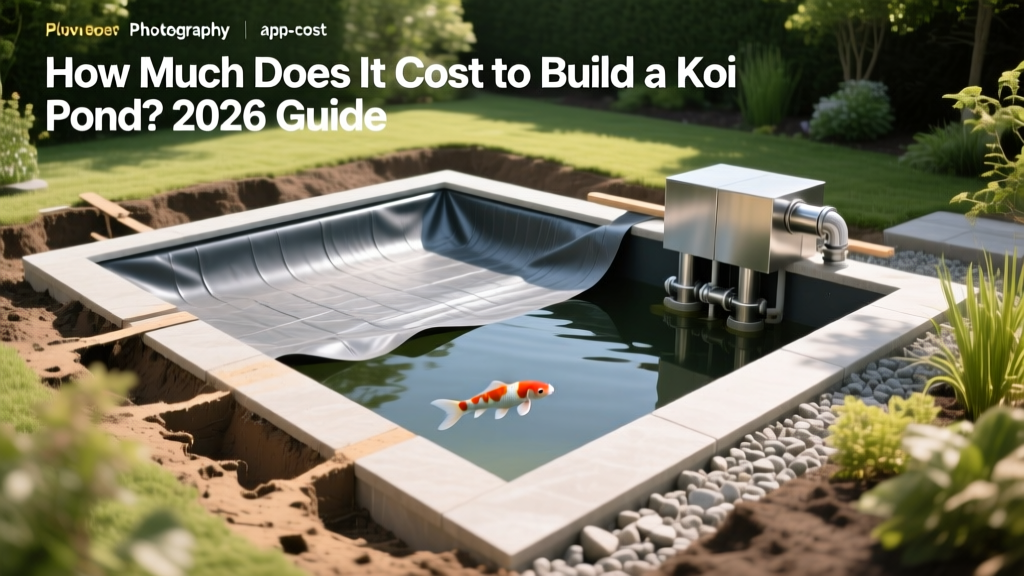
The True Cost of Building a Koi Pond: Beyond the Dig
A koi pond is not merely a decorative water garden; it is a complex, closed-loop life-support system. Unlike standard goldfish ponds or water lily features, keeping Cyprinus rubrofuscus (Amur carp/koi) alive and thriving requires rigorous mechanical and biological filtration, precise water volume, and specialized plumbing. When evaluating how much it costs to build a koi pond, homeowners must look past the initial excavation and focus on the life-support infrastructure that dictates long-term success.
In 2026, the national average for a professionally installed, ecosystem-grade koi pond ranges from $18,000 to $45,000 for a standard 1,500 to 2,500-gallon system. However, this figure fluctuates wildly based on soil composition, filtration choices, and site accessibility. Below is a comprehensive cost comparison breaking down every phase of construction.
Size, Depth, and Excavation: The Primary Cost Drivers
Koi require significant water volume to dilute their heavy biological waste and maintain stable water temperatures. The absolute minimum recommendation by the Associated Koi Clubs of America is 1,000 gallons, but a 2,500-gallon pond is the practical starting point for keeping more than three adult koi.
Depth is equally critical. A true koi pond must be at least 3 feet deep, with 4 to 5 feet preferred in northern climates to provide a thermal refuge during winter and to deter wading predators like the Great Blue Heron.
2026 Koi Pond Construction Cost Matrix
| Pond Volume | Dimensions (Approx) | DIY Cost Range | Professional Cost Range |
|---|---|---|---|
| 1,000 Gallons | 8' x 10' x 3' | $4,500 - $7,000 | $14,000 - $22,000 |
| 2,500 Gallons | 12' x 15' x 4' | $9,000 - $14,000 | $28,000 - $45,000 |
| 5,000 Gallons | 18' x 22' x 4.5' | $18,000 - $25,000 | $55,000 - $85,000 |
| 10,000+ Gallons | Custom Estate | $35,000+ | $110,000 - $250,000+ |
*Professional costs include heavy machinery excavation, engineered filtration, plumbing, and hardscaping. DIY costs assume manual labor and basic equipment rentals.
Excavation costs average $50 to $150 per cubic yard. A 2,500-gallon pond requires moving roughly 15 to 20 cubic yards of soil. If your site features heavy clay, bedrock, or limited access for a mini-excavator, expect excavation costs to double due to the need for manual labor or specialized rock-breaking attachments.
Liner vs. Concrete: Material Cost Comparison
The containment vessel is your largest material expense. While concrete was the standard decades ago, modern flexible liners dominate the industry due to their adaptability to ground settling and freeze-thaw cycles.
45-Mil EPDM Rubber (The Industry Standard)
EPDM (Ethylene Propylene Diene Monomer) remains the most popular choice for koi ponds. It is highly flexible, UV resistant, and fish-safe.
- Cost: $1.50 to $2.20 per square foot.
- Hidden Requirement: You must install a non-woven geotextile underlayment ($0.60/sq ft) to protect against root and rock punctures.
- Lifespan: 20 to 30 years.
RPE (Reinforced Polyethylene) (The Modern Contender)
RPE is rapidly gaining market share among professional pond builders. It is significantly lighter than EPDM, highly puncture-resistant, and does not require a protective underlayment.
- Cost: $2.80 to $3.50 per square foot.
- Trade-off: RPE is stiffer than EPDM, making it difficult to fold neatly into tight, complex corners. It requires skilled seaming using specialized heat-welding or specific contact cements.
Poured Concrete and Shotcrete
Concrete offers a permanent, rigid shell but is highly susceptible to cracking in regions with frost heave. Repairing a cracked concrete pond often requires draining the entire system and relocating the fish.
- Cost: $18.00 to $30.00+ per square foot (includes rebar, forming, and non-toxic epoxy sealing).
- Verdict: Rarely recommended for residential koi ponds unless engineered by a structural specialist in a stable, warm climate.
Filtration and Circulation: The Heart of the Pond
This is where budgets are most frequently underestimated. Koi produce massive bioloads. A standard waterfall bio-filter box (sufficient for a 500-gallon goldfish pond) will fail catastrophically in a 2,500-gallon koi pond, leading to lethal ammonia spikes and green water.
"The golden rule of koi pond filtration is a turnover rate of 1.5 to 2 times the total pond volume per hour. For a 2,500-gallon pond, your system must process 3,750 to 5,000 gallons every 60 minutes." — Aquascape Inc. Water Quality Guidelines
Essential Filtration Components & Costs
- Bottom Drain ($250 - $450): A 3-inch or 4-inch anti-vortex bottom drain is non-negotiable for koi. Koi waste is heavy and sinks. Without a bottom drain plumbed directly to the filter, solids will accumulate on the floor, creating anaerobic dead zones that produce hydrogen sulfide gas.
- External Pump ($600 - $1,400): External pumps (like the Oase AquaMax Dry or Sequence series) are preferred over submersible pumps for large koi ponds. They are more energy-efficient, easier to maintain, and do not add excess heat to the water.
- Biological Filter ($1,200 - $3,500):
- Bead Filters (e.g., PolyGeyser): Excellent for both mechanical and biological filtration. They can be backwashed easily, saving hours of manual cleaning.
- Moving Bed Biofilm Reactors (MBBR): Utilizes K1 micro media suspended in an aerated chamber. Provides massive surface area for nitrifying bacteria but requires a separate mechanical pre-filter (like a sieve or settling chamber) to prevent clogging.
- UV Clarifier ($250 - $500): Sizing a UV unit at 10 to 15 watts per 1,000 gallons effectively destroys suspended single-celled algae (green water) and reduces waterborne pathogens.
Many DIY guides suggest using a standard surface skimmer as the primary intake for a koi pond. While skimmers are great for removing floating leaves, they cannot pull heavy koi feces from the pond floor. A koi pond must utilize a bottom drain for at least 70% of its water intake, with a skimmer handling the remaining 30% for surface debris.
Hidden Costs: Plumbing, Electrical, and Permitting
When calculating how much it costs to build a koi pond, the infrastructure connecting the pond to the equipment pad is frequently overlooked.
- Plumbing Materials ($400 - $900): Use Schedule 40 PVC for all underground and pressure-side plumbing. Flexible PVC is acceptable for above-ground connections to absorb pump vibration, but it is susceptible to UV degradation and termite damage if buried.
- Electrical Trenching ($800 - $2,500): Pumps and UV clarifiers require dedicated GFCI-protected 120V or 240V circuits. Trenching conduit from your main panel to a weatherproof equipment pad adds significant labor costs.
- Permits and Engineering ($200 - $1,500): Many municipalities classify any body of water deeper than 18 to 24 inches as a "swimming pool" or "attractive nuisance," requiring a building permit, engineered grading plans, and mandatory fencing with self-latching gates.
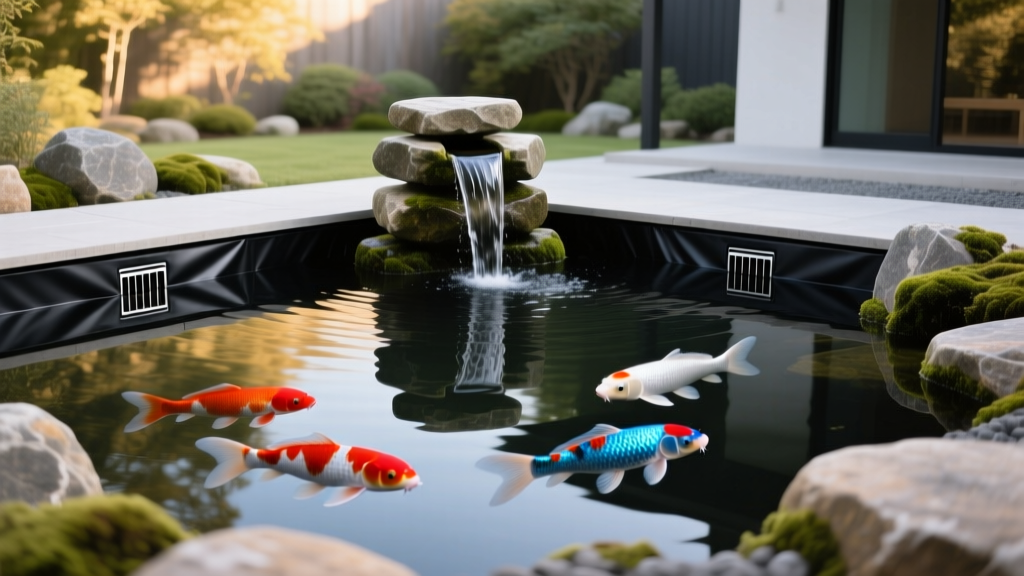
Long-Term Maintenance: The Annual Financial Commitment
A koi pond is a living ecosystem that requires ongoing financial input. Budget for the following annual expenses:
| Maintenance Item | Frequency | Estimated Annual Cost |
|---|---|---|
| Electricity (Pump & UV) | Continuous (24/7/365) | $600 - $1,200 |
| High-Protein Koi Food | Daily (Spring-Fall) | $150 - $400 |
| Beneficial Bacteria & Water Treatments | Weekly / As Needed | $100 - $250 |
| UV Bulb Replacement | Annually (Spring) | $60 - $120 |
| Professional Spring Cleanout | Annually | $400 - $900 |
DIY vs. Professional Installation: Making the Decision
Building a koi pond as a DIY project is entirely feasible for individuals with intermediate landscaping, plumbing, and electrical skills. However, the margin for error is razor-thin. A poorly sloped bottom that fails to direct waste to the drain, or a liner punctured by an exposed tree root, can result in thousands of dollars in lost fish and repair costs.
If you choose the DIY route, prioritize your budget on the filtration and plumbing. It is better to have a simple, unadorned pond with a state-of-the-art bead filter and bottom drain than a beautifully landscaped pond with inadequate biological filtration. If you hire a professional, ensure they are certified water garden contractors who specifically understand the biological demands of koi, rather than general landscapers who primarily install shallow, plant-heavy water gardens.
Written by
Marcus ChenMarcus Chen is a licensed structural engineer (PE) and building materials analyst with over 12 years of experience across residential, commercial, and industrial construction. He holds a Master of Science in Civil Engineering from UC Berkeley and spent six years at Thornton Tomasetti before transitioning to independent consulting and technical writing. Marcus specializes in material selection for seismic-prone regions, concrete reinforcement strategies, and lifecycle cost analysis. His work has been cited by the American Concrete Institute (ACI) and the Structural Engineers Association of California (SEAOC). When he is not on a job site or at his desk, you will find him hiking the Sierra Nevada or restoring a 1920s craftsman bungalow in Oakland, CA.
More from Marcus Chen
View all
Construction Cost
How Much Did the Eiffel Tower Cost to Build?
How much did the Eiffel Tower cost to build in 1889? We adjust for inflation and compare its budget to modern skyscraper construction.
Aug 4, 2026

Fire Resistance
What Is a Fire Resistant Material? Testing & Certification Guide
Discover what is a fire resistant material through ASTM and UL testing. Learn how fire ratings, certifications, and assemblies work in construction.
Aug 4, 2026

Construction Cost
How Much Did the Burj Khalifa Cost to Build?
How much did the Burj Khalifa cost to build? We break down the $1.5B project and extract 5 money-saving strategies for your next build.
Jul 30, 2026