How Much Would It Cost to Build a Go Kart? Full DIY Budget Breakdown
Discover exactly how much it costs to build a go kart from scratch. We break down chassis, engine, and parts costs for a realistic DIY budget.
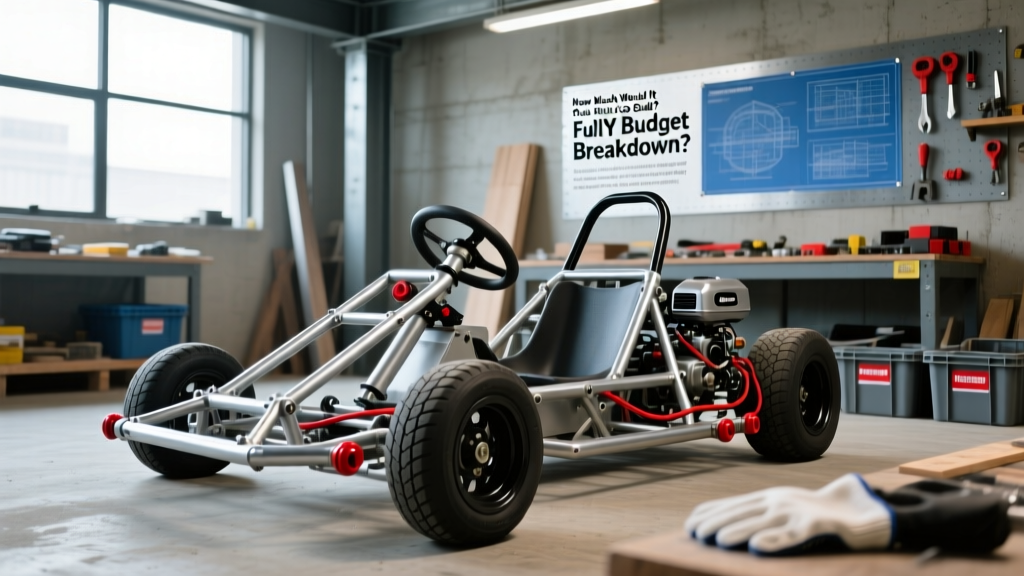
The Core Question: How Much Would It Cost to Build a Go Kart?
When evaluating the feasibility of a backyard fabrication project, the most common question is: how much would it cost to build a go kart from scratch? The short answer is that a functional, safe, DIY go kart built with new mid-tier components typically costs between $650 and $1,100. However, this figure fluctuates wildly based on your sourcing strategy, material choices, and performance targets. A scrap-yard build utilizing a salvaged lawnmower engine and welded square tubing can be completed for under $300, while a high-performance sprint kart featuring a chromoly chassis and a blueprint-built clone engine will easily exceed $2,500.
For the purpose of this budget planning guide, we are analyzing a standard off-road DIY yard kart. This build features a 60-inch wheelbase, a 1-inch outer diameter (OD) tubular steel frame, a 212cc overhead valve (OHV) engine, and a torque converter drivetrain. Below is the high-level cost distribution for this specific configuration.
| Component Category | Budget/Scrap Build | Standard DIY Build | High-Performance Build |
|---|---|---|---|
| Chassis & Steel | $50 - $100 | $180 - $250 | $400 - $600 |
| Engine (Powerplant) | $0 - $50 (Used) | $140 - $180 | $450 - $900 |
| Drivetrain (Clutch/CVT) | $25 - $40 | $120 - $160 | $250 - $400 |
| Steering & Suspension | $40 - $80 | $130 - $180 | $300+ |
| Brakes & Axle Assembly | $60 - $90 | $140 - $200 | $350+ |
| Total Estimated Cost | $175 - $360 | $710 - $970 | $1,750 - $2,550+ |
Chassis and Frame Material Costs
The backbone of any kart is the chassis. For a standard DIY build, you should avoid cheap, thin-walled exhaust tubing or structural square tubing, which lacks the tensile strength to handle dynamic cornering loads and impact forces. The industry standard for DIY yard karts is 1018 Electric Resistance Welded (ERW) steel tubing with a 1-inch outer diameter and a 0.065-inch wall thickness.
Steel Tubing Pricing and Yield
As of current metal market pricing, a 20-foot stick of 1-inch x 0.065-inch ERW steel tubing costs between $45 and $65 depending on your local supplier and freight surcharges. A standard 60-inch wheelbase off-road kart requires approximately 65 to 80 linear feet of tubing for the main frame, roll hoop, and steering column supports. This means you will need to purchase four 20-foot sticks, budgeting roughly $220 for the raw frame material.
Powertrain: Engine and Transmission Budgeting
The engine represents the largest single line item in your budget. The 196cc to 212cc OHV horizontal shaft engine class dominates the DIY market due to its massive aftermarket support and reliability. When browsing Northern Tool's engine catalog or similar industrial suppliers, you will generally face a choice between clone engines and name-brand units.
- Predator 212cc (Clone): Priced around $149 to $169. This is the undisputed king of budget kart builds. It produces roughly 6.5 horsepower out of the box and has a massive ecosystem of aftermarket billet flywheels, cams, and carburetors.
- Honda GX200: Priced between $420 and $480 via the Honda Engines official portal or authorized dealers. The GX200 offers superior metallurgy, tighter factory tolerances, and longer service intervals, but it is difficult to justify for a casual backyard build.
- Duromax or Lifan 212cc: Often found on sale for $120 to $140. These are viable alternatives if the Predator is out of stock, though their internal governor springs and valve seats are generally considered slightly inferior to the Predator Hemi variant.
Drivetrain: Centrifugal Clutch vs. Torque Converter
How you transfer power to the rear axle drastically affects both your budget and the kart's drivability. A standard 12-tooth #35 centrifugal clutch costs about $25 to $35. It engages at a fixed RPM (usually around 2,300 RPM) and provides a direct 1:1 ratio from the engine sprocket to the axle sprocket. This is cheap and simple, but results in poor low-end torque and aggressive engagement.
For an additional $100 to $130, you can install a Comet TAV2 torque converter (Continuously Variable Transmission). Sourced from specialists like BMI Karts, the TAV2 uses a variable-pitch drive pulley and a belt system to provide a low gear for climbing hills and a high gear for top speed. For any off-road or hilly terrain build, the torque converter is a mandatory upgrade that completely transforms the vehicle's performance.
Steering, Brakes, and Suspension Components
Many first-time builders underestimate the cost and complexity of the steering and braking systems. You cannot safely improvise these components; they must be precision-machined to handle dynamic loads.
Steering Geometry and Hardware
A proper front steering assembly requires two spindle brackets, two spindles, a pitman arm, and adjustable tie rods. You can purchase a complete bolt-on spindle kit from manufacturers like Azusa Engineering for approximately $85 to $110. When assembling the steering, pay strict attention to Ackermann steering geometry. By mounting the tie rod ends behind the steering axis (the kingpin), the inside wheel turns at a sharper angle than the outside wheel during a corner, eliminating tire scrub and drastically improving handling. Budget an extra $25 for high-grade (Grade 8) 5/8-inch-18 threaded rod and heim joints for the tie rods.
Braking Systems
Do not rely on simple band brakes or friction pads on the drive clutch. You need a dedicated braking system on the rear live axle.
- Mechanical Disc Brake: A basic Azusa mechanical caliper and rotor kit costs around $45. It uses a cable pull, similar to a bicycle brake. It is adequate for flat yards and lighter drivers but suffers from cable stretch and fade under heavy use.
- Hydraulic Disc Brake: A Sheng Hsing or Wilwood hydraulic caliper, master cylinder, and braided line kit will cost between $90 and $140. The hydraulic fluid provides immense stopping power with minimal lever effort and is highly recommended for any kart exceeding 25 MPH or carrying an adult driver.
Hidden Costs: Tooling, Jigs, and Consumables
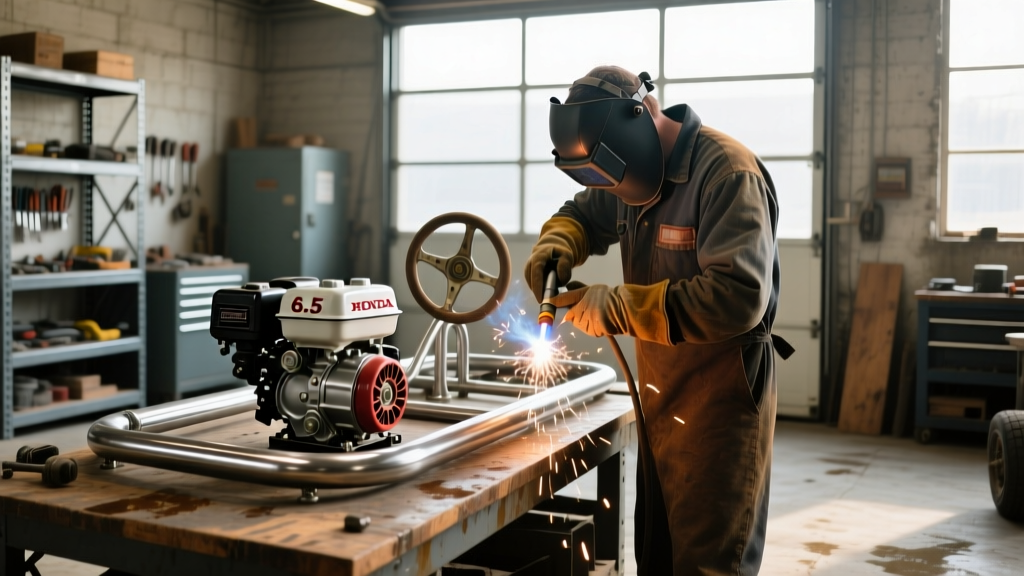
When calculating how much it costs to build a go kart, the raw parts are only half the equation. If you do not already possess a fully equipped metalworking shop, the tooling and consumables will inflate your budget rapidly.
'The most expensive part of building a chassis isn't the steel; it's the gas, wire, and abrasives required to cut, prep, and weld it together safely.' — Custom Kart Fabrication Adage
If you are MIG welding the chassis, a 2-pound spool of 0.023-inch or 0.030-inch ER70S-6 solid mild steel wire costs roughly $25. You will also need a 75/25 Argon/CO2 shielding gas cylinder, which costs about $40 to fill at a local welding supply store (plus a potential $100 deposit if you do not own the tank). Furthermore, cutting and beveling 0.065-inch steel tubing will consume abrasive cutoff wheels and flap discs rapidly. Budget at least $50 for high-quality aluminum oxide cutoff wheels and 60-grit flap discs to ensure your weld joints are perfectly prepped. Poorly prepped joints lead to cold lap weld defects, which can cause the frame to snap under torsional stress.
Decision Matrix: Which Build Path Fits Your Budget?
Use the following framework to determine which construction methodology aligns with your financial and temporal resources.
| Build Path | Estimated Budget | Time Investment | Best Suited For |
|---|---|---|---|
| The Scavenger (Salvaged parts, lawnmower engine, angle iron frame) | $150 - $300 | 40 - 60 Hours | Teens learning basic fabrication; low-speed yard crawling. |
| The Standard DIY (New ERW tubing, Predator 212, Torque Converter) | $700 - $950 | 25 - 40 Hours | Adults wanting a reliable, fast, and safe off-road trail kart. |
| The Bolt-Together Kit (Pre-bent chassis, hardware kit, you supply engine) | $500 - $750 (plus engine) | 10 - 15 Hours | Builders without welding equipment who want a professional result. |
Expert Tips for Sourcing Parts Cheaply
To keep your build within the lower end of the budget spectrum, avoid buying individual components from general hardware stores, which carry massive markups on specialty items like live axle bearings and sprockets. Instead, utilize dedicated karting surplus centers and agricultural surplus outlets. For instance, 1-inch bore pillow block bearings (essential for mounting the rear live axle) can often be found on agricultural surplus websites for $6 each, compared to $18 at a local brick-and-mortar bearing supplier. Additionally, monitor online karting forums and Facebook groups for 'roller' chassis—karts that are fully assembled but missing the engine. You can frequently acquire a high-quality, professionally welded chromoly frame for under $250 from a racer upgrading their rig, saving you dozens of hours of cutting and welding while drastically improving the final vehicle's safety and handling.
Written by
Priya KapoorPriya Kapoor is a real estate market analyst and construction economics researcher with expertise in housing affordability, development feasibility, and infrastructure investment. She holds a Master of Regional Planning from Cornell University and previously worked as a senior analyst at CBRE's Investment Properties group, where she modeled returns for $4B in mixed-use development pipelines. Priya now runs an independent research practice advising developers, municipalities, and REITs on construction cost forecasting and market timing. She publishes the quarterly "BuildMat Market Pulse" report tracking material price indices across 12 commodity categories. Based in Austin, TX, Priya serves on the board of Habitat for Humanity Austin and is a marathon runner.
More from Priya Kapoor
View all
Construction Cost
Cost to Build a 1600 Sq Ft Home in 2026: Full Breakdown
Accurate 2026 cost to build a 1600 sq ft home—material, labor, and regional pricing breakdowns included. Plan your budget with real-time estimates.
Aug 11, 2026

Wood & Lumber
Name the Types of Wood for Pressure Treatment and Preservation
Learn how to name the types of wood best suited for pressure treatment. Compare species treatability, chemical retention levels, and 2026 preservation costs.
Aug 4, 2026

Stone & Masonry
Stone Veneer Suppliers Lindenhurst: 2026 Cost Analysis
Analyze 2026 stone veneer costs in Lindenhurst, NY. Compare local supplier pricing, delivery fees, and Suffolk County installation labor rates.
Aug 4, 2026