How Much Would It Cost to Build a Driveway? Material & Labor Breakdown
Discover how much it would cost to build a driveway. Compare concrete, asphalt, gravel, and paver prices, plus hidden labor and site prep fees.

The True Cost to Build a Driveway: A 2026 Baseline
When homeowners ask how much it would cost to build a driveway, the answer depends heavily on material selection, soil conditions, and regional labor rates. For a standard 600-square-foot, two-car driveway, total project costs typically range from $1,800 for basic gravel to over $18,000 for high-end permeable pavers. The national average for a professionally installed poured concrete driveway sits between $4,800 and $7,200.
Budgeting accurately requires looking beyond the surface material. Site preparation, base compaction, and local permitting often account for 20% to 35% of the total invoice. This guide breaks down the exact material specifications, hidden excavation costs, and long-term maintenance budgets required to plan a driveway project without financial surprises.
Material Cost Comparison Matrix
The surface material dictates both the initial capital expenditure and the lifecycle cost of the driveway. Below is a comparative matrix of the four most common residential driveway materials, priced per square foot including standard base preparation and professional installation.
| Material Type | Installed Cost (per sq. ft.) | Lifespan | Load Capacity |
|---|---|---|---|
| Gravel (DOT Class 5) | $1.50 - $3.50 | Indefinite (with grading) | Moderate |
| Hot Mix Asphalt (HMA) | $5.00 - $12.00 | 15 - 20 Years | High |
| Poured Concrete | $8.00 - $18.00 | 30 - 50 Years | Very High |
| Interlocking Pavers | $15.00 - $35.00 | 25 - 40 Years | High |
Deep Dive: Material Specifications
- Poured Concrete: Do not accept standard 3,000 PSI sidewalk mixes. Specify a 4,000 PSI air-entrained mix conforming to ASTM C94 standards. The slab must be a minimum of 4 inches thick, reinforced with 6x6 W1.4/W1.4 welded wire mesh or #3 rebar spaced at 18 inches on center. For driveways supporting heavy RVs or dump trucks, increase the thickness to 6 inches.
- Asphalt: A durable asphalt driveway requires a 2-inch surface course of fine-graded Hot Mix Asphalt (HMA) over a 1.5-inch binder course. This must be laid over a 4-to-8-inch compacted aggregate base. Edge confinement is critical; asphalt without concrete or stone edge restraints will ravel and crumble at the margins within three years.
- Pavers: For optimal drainage and longevity, specify permeable interlocking concrete pavers (PICP) installed according to EPA Green Infrastructure guidelines. The base requires open-graded crushed stone (ASTM No. 57) rather than standard dense-graded aggregate to allow water infiltration.
Site Preparation: The Hidden Budget Killers
The most common reason driveway budgets balloon is inadequate site assessment. According to Penn State Extension, proper base preparation and drainage planning are the primary determinants of pavement longevity. If your contractor skips soil testing, your driveway will likely fail.
⚠️ Warning: Expansive Clay Soils
If your property contains expansive clay (common in the Southeast and Midwest), standard gravel bases will heave and crack concrete or asphalt during freeze-thaw cycles. You must budget an additional $2.00 to $4.00 per square foot to excavate 12 inches of native clay and replace it with a non-expansive structural fill, or install a biaxial geogrid (such as Tensar or TriAx) to stabilize the subgrade.
Standard Excavation and Grading Costs
- Clearing and Grubbing: Removing topsoil, roots, and organic matter costs $1.00 to $2.50 per square foot. Organic matter decomposes and creates voids under the pavement.
- Subgrade Compaction: The native soil must be compacted to 95% Standard Proctor Density. Renting a vibratory roller or plate compactor adds $150 to $300 per day to DIY budgets, or is rolled into the $0.50–$1.00 per square foot labor rate for pros.
- Base Aggregate: A 4-to-6-inch layer of crushed angular stone (DOT Class 5 or ASTM D2940) is mandatory for asphalt and concrete. Budget $1.50 to $2.50 per square foot for delivery, spreading, and mechanical compaction of the base layer.
Labor, Permits, and Regional Variables
Labor typically accounts for 40% to 60% of the total driveway construction cost. However, regional disparities in union labor rates, material availability, and municipal codes drastically alter the final invoice.
Permitting and Impact Fees
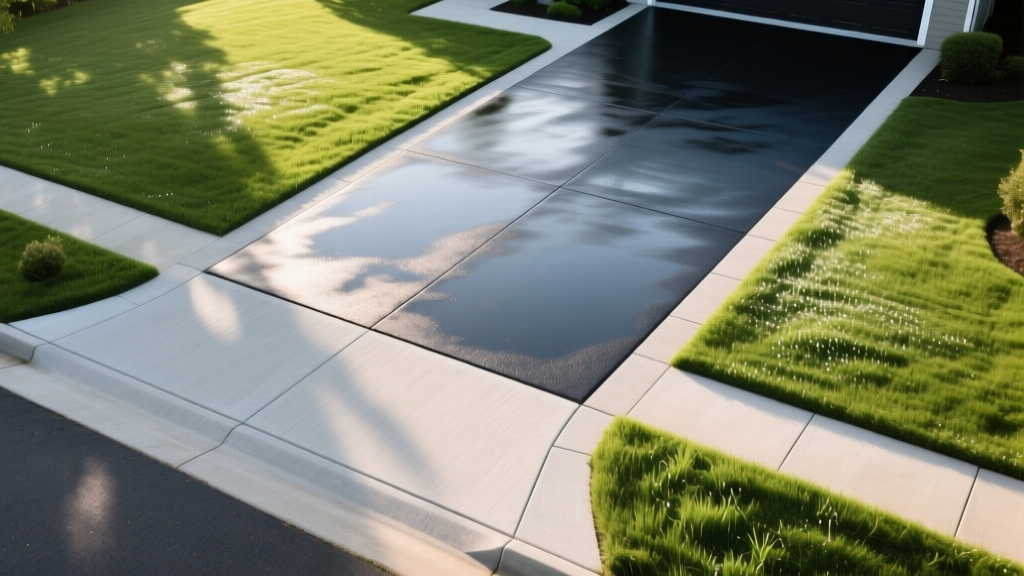
Most municipalities require a right-of-way (ROW) permit if your driveway connects to a public street. This involves an inspection of the apron (the section between the sidewalk and the street) to ensure it meets municipal thickness and slope requirements. Expect to pay $150 to $500 for driveway permits. If your project requires modifying an existing curb or cutting into a sidewalk, curb-cutting fees and concrete restoration can add $1,000 to $3,000 to the budget.
Drainage and Culvert Requirements
If your driveway crosses a drainage swale or ditch, the municipality will require the installation of a culvert pipe. A standard 15-inch corrugated galvanized steel or HDPE culvert pipe, including headwalls and backfill, costs between $1,200 and $2,500 installed. Failing to size the culvert correctly based on local 100-year storm flow data can result in washed-out driveways and municipal fines.
Long-Term Maintenance Budgeting
A comprehensive budget plan accounts for the total cost of ownership over a 30-year horizon. The cheapest material to install is rarely the cheapest to maintain.
Gravel Maintenance
Annual Cost: $0.50 - $1.00 / sq. ft.
Requires annual re-grading and topping up with 2-3 tons of fresh aggregate every 3-5 years to replace material lost to snow plows and washouts.
Asphalt Maintenance
Annual Cost: $0.20 - $0.40 / sq. ft.
Requires crack sealing annually and a coal tar or asphalt-based sealcoat every 3 to 5 years to prevent UV oxidation and water intrusion into the base.
Concrete Maintenance
Annual Cost: $0.05 - $0.10 / sq. ft.
Requires joint resealing every 5-10 years and occasional pressure washing. Highly resistant to UV degradation, though susceptible to de-icing salt spalling.
Step-by-Step Budget Planning Framework
To finalize your budget, follow this sequential framework before soliciting contractor bids:
- Define the Footprint: Measure the exact square footage. A standard single-car driveway is 12x20 feet (240 sq. ft.), while a double-car is typically 16x20 feet (320 sq. ft.) or 20x20 feet (400 sq. ft.). Add 10% for curves or flared aprons.
- Conduct a Soil Bore Test: Hire a geotechnical engineer ($500-$1,200) or dig a 3-foot test pit yourself to identify the water table and soil composition. This dictates your base depth requirements.
- Calculate Base Volume: Multiply your square footage by the required base depth in feet. For a 400 sq. ft. driveway with a 6-inch (0.5 ft) base, you need 200 cubic feet (7.4 cubic yards) of compacted aggregate.
- Request Itemized Bids: Demand that contractors separate excavation, base preparation, forming, and surface material costs in their quotes. This allows you to compare the structural integrity of their proposals, not just the bottom-line price.
- Allocate a Contingency: Reserve 15% of the total budget for unforeseen subgrade issues, such as discovering buried builder's debris or undocumented utility lines during excavation.
By prioritizing subgrade stability and specifying exact material grades, you ensure your driveway budget translates into a structurally sound asset that withstands decades of vehicular load and environmental stress.
Written by
Priya KapoorPriya Kapoor is a real estate market analyst and construction economics researcher with expertise in housing affordability, development feasibility, and infrastructure investment. She holds a Master of Regional Planning from Cornell University and previously worked as a senior analyst at CBRE's Investment Properties group, where she modeled returns for $4B in mixed-use development pipelines. Priya now runs an independent research practice advising developers, municipalities, and REITs on construction cost forecasting and market timing. She publishes the quarterly "BuildMat Market Pulse" report tracking material price indices across 12 commodity categories. Based in Austin, TX, Priya serves on the board of Habitat for Humanity Austin and is a marathon runner.
More from Priya Kapoor
View all
Construction Cost
Cost to Build a 1600 Sq Ft Home in 2026: Full Breakdown
Accurate 2026 cost to build a 1600 sq ft home—material, labor, and regional pricing breakdowns included. Plan your budget with real-time estimates.
Aug 11, 2026

Wood & Lumber
Name the Types of Wood for Pressure Treatment and Preservation
Learn how to name the types of wood best suited for pressure treatment. Compare species treatability, chemical retention levels, and 2026 preservation costs.
Aug 4, 2026

Stone & Masonry
Stone Veneer Suppliers Lindenhurst: 2026 Cost Analysis
Analyze 2026 stone veneer costs in Lindenhurst, NY. Compare local supplier pricing, delivery fees, and Suffolk County installation labor rates.
Aug 4, 2026