Epic Universe Cost to Build: Mega-Project Comparison & Breakdown
Analyze the Epic Universe cost to build against global theme park mega-projects, breaking down per-acre pricing, infrastructure, and hard costs.

The Baseline: Understanding the Epic Universe Cost to Build
When Universal Parks & Resorts announced its massive Orlando expansion, the initial capital expenditure was pegged at roughly $2 billion. However, from a modern construction estimating perspective, analyzing the true epic universe cost to build requires adjusting for post-2020 supply chain volatility, material inflation, and the sheer scale of the 750-acre master-planned site. With the park itself occupying approximately 110 acres, the final hard and soft construction costs are widely estimated by industry analysts to approach $2.5 billion to $3 billion by its 2025/2026 operational launch.
Theme park construction is a highly specialized subset of commercial estimating. Unlike standard retail or office developments, themed entertainment projects require the seamless integration of heavy industrial ride mechanics, theatrical show control systems, and immersive architectural facades. According to initial investment filings reported by Reuters, Comcast's commitment to the project highlighted a strategic shift toward mega-resorts, but the on-the-ground execution involves navigating some of the most complex site-work and structural challenges in North America.
Estimator's Insight: The 'Iceberg' Principle
In theme park estimating, visible structures (castles, coasters, facades) represent only 40% of the total budget. The remaining 60% is buried in subterranean utilidors, central energy plants, massive water retention systems, and advanced IT/AV backbone infrastructure that must be installed before the first show building is erected.
Comparative Cost Matrix: Global Theme Park Mega-Projects
To contextualize the Epic Universe cost to build, we must compare it against other recent themed entertainment mega-projects. Cost-per-acre metrics vary wildly based on land acquisition costs, local labor rates, and the density of high-capacity ride systems.
| Project | Location | Park Acreage | Est. Total Cost | Cost Per Acre |
|---|---|---|---|---|
| Universal Epic Universe | Orlando, FL | ~110 Acres | $2.5B - $3.0B | $22M - $27M |
| Universal Beijing Resort | Beijing, China | ~135 Acres | $6.5B | $48.1M |
| Star Wars: Galaxy's Edge | Anaheim, CA | 14 Acres | $1.0B | $71.4M |
| Shanghai Disneyland | Shanghai, China | 170 Acres | $5.5B | $32.3M |
As highlighted by data from the Themed Entertainment Association (TEA), highly dense, IP-driven lands like Galaxy's Edge command a massive premium per acre due to the concentration of advanced animatronics and trackless ride systems. Epic Universe achieves a lower per-acre cost by spreading its budget across a larger footprint with a mix of high-density portals and expansive, landscaped transitional zones.
Substructure Challenges: Florida Hydrogeology and Deep Piling
Before any steel is erected, the Epic Universe site requires monumental geotechnical engineering. The Orlando site sits on complex karst topography, characterized by porous limestone, high water tables, and sinkhole risks. Standard shallow spread footings are entirely unviable for heavy show buildings and dynamic ride loads.
- Deep Foundation Piling: Estimators must account for driven precast concrete piles or augercast piles extending 60 to 120 feet into the ground to reach stable load-bearing strata. At current Florida commercial rates, deep piling costs range from $150 to $250 per linear foot, including mobilization and load testing.
- Water Management & Retention: Florida mandates strict stormwater runoff controls. Epic Universe requires the excavation of massive, aesthetically themed retention ponds and subterranean drainage networks. Earthwork and grading for a 750-acre master plan easily exceed $150 million in heavy civil costs alone.
- Soil Stabilization: Areas designated for heavy pedestrian traffic and ride queues require deep soil mixing or lime stabilization to prevent differential settling, which could misalign sensitive ride tracks by mere millimeters.
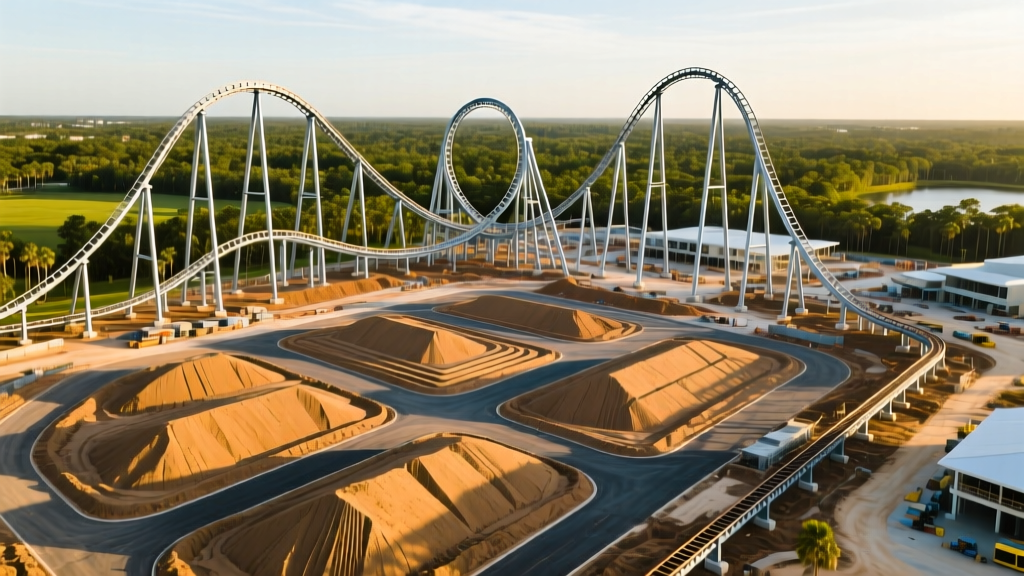
Hard Costs: Show Buildings, Ride Hardware, and GFRC Theming
The transition from civil work to vertical construction introduces the most capital-intensive phases of the epic universe cost to build. Show buildings are not standard warehouses; they are heavily insulated, acoustically treated, clear-span steel structures designed to house massive indoor environments.
Ride System Procurement and Installation
A single modern launched roller coaster or dark ride system represents a massive line item. Procuring hardware from premier manufacturers like Intamin, Mack Rides, or Vekoma involves costs ranging from $25 million to $45 million per major attraction. This figure excludes the building envelope, show lighting, and audio-animatronic integration. Furthermore, the installation requires specialized millwrights and ride-certified ironworkers, whose prevailing wages and per diems significantly inflate local labor budgets.
Themed Facades and GFRC Panels
Standard EIFS or precast concrete panels are insufficient for immersive environments. Theme parks rely heavily on Glass Fiber Reinforced Concrete (GFRC) and themed shotcrete.
Cost Breakdown for Themed Finishes:
• Standard Precast Concrete: $25 - $40 per sq. ft. installed.
• Architectural GFRC Panels: $60 - $120 per sq. ft. installed, depending on mold complexity and faux-finish painting (e.g., aging, rusting, or stone-texturing).
• Themed Shotcrete (Hand-Carved): $80 - $150 per sq. ft., requiring highly specialized artisan sculptors who carve rockwork and architectural details directly from the sprayed concrete matrix.
Warning: Supply Chain Volatility in Specialty Materials
Mega-projects frequently suffer from schedule overruns due to the niche nature of theme park suppliers. According to research on capital projects by Engineering News-Record (ENR), specialized procurement—such as custom linear synchronous motors (LSMs) for launch coasters or proprietary show-control servers—can face lead times of 18 to 24 months. Estimators must build substantial contingency buffers (15-20%) specifically for themed entertainment hardware.
Infrastructure: The Hidden Backbone of the Park
The epic universe cost to build is heavily weighted by off-ride infrastructure. A park of this magnitude operates like a small municipality. It requires dedicated central energy plants (CEPs) for high-voltage distribution, massive water filtration facilities for lagoons and water rides, and a sprawling network of fiber-optic cables to manage thousands of synchronized show elements, RFID tracking, and point-of-sale systems. Utilidors (underground utility corridors) or heavily fortified back-of-house pathways are required to move cast members, waste, and supplies without breaking the guest immersion, adding millions in structural concrete and MEP (Mechanical, Electrical, Plumbing) rough-in costs.
Estimator's FAQ: Theme Park Construction Metrics
How does the cost of a theme park compare to a standard commercial mall?
A regional shopping mall typically costs between $150 and $300 per square foot to build. In contrast, a highly themed entertainment venue can easily exceed $1,000 to $2,500 per square foot when factoring in ride hardware, show control systems, and artisan-level architectural finishes.
What percentage of the budget goes to IP licensing and soft costs?
While hard construction costs dominate, soft costs—including architectural design, engineering, environmental impact studies, and IP licensing fees—typically consume 20% to 30% of the total project budget. For a project utilizing licensed intellectual property (like DreamWorks or Harry Potter), these soft costs skew toward the higher end of the spectrum.
Why do Florida theme parks require higher structural steel tonnage?
Florida's stringent building codes require structures to withstand Category 5 hurricane wind loads (up to 180+ mph). Show buildings, which often feature massive, unsupported roof spans to accommodate indoor ride clearances, require significantly heavier structural steel tonnage and deeper moment connections than commercial buildings in non-coastal regions, driving up the structural framing budget by 15% to 25%.
Written by
Priya KapoorPriya Kapoor is a real estate market analyst and construction economics researcher with expertise in housing affordability, development feasibility, and infrastructure investment. She holds a Master of Regional Planning from Cornell University and previously worked as a senior analyst at CBRE's Investment Properties group, where she modeled returns for $4B in mixed-use development pipelines. Priya now runs an independent research practice advising developers, municipalities, and REITs on construction cost forecasting and market timing. She publishes the quarterly "BuildMat Market Pulse" report tracking material price indices across 12 commodity categories. Based in Austin, TX, Priya serves on the board of Habitat for Humanity Austin and is a marathon runner.
More from Priya Kapoor
View all
Construction Cost
Cost to Build a 1600 Sq Ft Home in 2026: Full Breakdown
Accurate 2026 cost to build a 1600 sq ft home—material, labor, and regional pricing breakdowns included. Plan your budget with real-time estimates.
Aug 11, 2026

Wood & Lumber
Name the Types of Wood for Pressure Treatment and Preservation
Learn how to name the types of wood best suited for pressure treatment. Compare species treatability, chemical retention levels, and 2026 preservation costs.
Aug 4, 2026

Stone & Masonry
Stone Veneer Suppliers Lindenhurst: 2026 Cost Analysis
Analyze 2026 stone veneer costs in Lindenhurst, NY. Compare local supplier pricing, delivery fees, and Suffolk County installation labor rates.
Aug 4, 2026