True Cost to Build Gaming PC in 2026: Financing & Budget Guide
Analyze the true cost to build gaming PC setups in 2026. Compare hardware tiers, calculate financing APRs, and master phased procurement strategies.
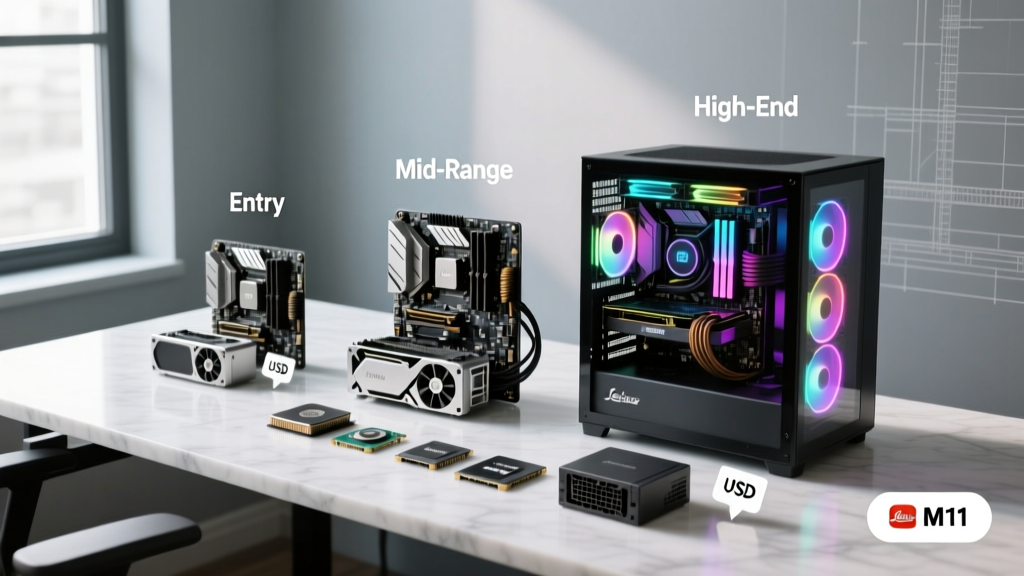
The 2026 Hardware Cost Matrix: Tiered Component Pricing
Estimating the cost to build gaming PC configurations in 2026 requires treating the project like a micro-construction build: you have structural foundations (motherboard/CPU), high-performance finishes (GPU), and essential utilities (PSU/cooling). Hardware pricing has stabilized post-shortage, but the introduction of PCIe 5.0 standards, DDR5 maturation, and next-generation silicon (like NVIDIA's RTX 50-series and AMD's Ryzen 9000 series) has shifted the baseline costs upward.
Below is the current Q1 2026 pricing matrix for three primary build tiers. These figures represent the "hard costs" of the tower components only, excluding peripherals.
| Component Category | Entry-Level (1080p) | Mid-Range (1440p High) | Enthusiast (4K Ultra) |
|---|---|---|---|
| GPU | $299 (RTX 4060 / RX 7600) | $749 (RTX 5070 Ti) | $1,599 (RTX 5090) |
| CPU | $199 (Ryzen 5 7600) | $399 (Ryzen 7 9700X) | $599 (Core Ultra 9 285K) |
| Motherboard | $120 (B650) | $220 (X670E) | $450 (Z890 Hero) |
| RAM (DDR5) | $55 (16GB 6000MHz) | $110 (32GB 6400MHz) | $240 (64GB 7200MHz) |
| Storage (NVMe) | $65 (1TB Gen4) | $130 (2TB Gen4) | $280 (4TB Gen5) |
| PSU, Case, Cooling | $160 | $310 | $650 (Custom Loop) |
| TOTAL HARD COST | $898 | $1,918 | $3,818 |
For a comprehensive look at how these graphics cards perform relative to their price, cross-reference your selections with the Tom's Hardware GPU Hierarchy, which benchmarks cost-per-frame metrics updated for current market realities.
Financing Mechanisms: APR, Terms, and Total Cost of Capital
When the cost to build gaming PC rigs exceeds $1,500, many builders turn to consumer credit. However, treating a depreciating asset like a high-interest loan is a critical financial error. Here is a breakdown of the four primary financing vehicles available in 2026, analyzed by their True Cost of Capital (TCC).
1. 0% Introductory APR Credit Cards
Best for: Builders with FICO scores above 720 who can guarantee payoff within the promotional window.
- Typical Terms: 0% APR for 15–21 months, reverting to 22%–28% variable APR.
- Strategy: Put a $1,918 mid-range build on a 21-month 0% card. Pay exactly $91.33 per month. Total interest paid: $0.
- Risk: Missing a single minimum payment often triggers a penalty APR of 29.99%, retroactively applying interest in some contract clauses.
2. Buy Now, Pay Later (BNPL) Point-of-Sale Loans
Platforms like Affirm or Klarna integrated into retailers (e.g., Newegg, B&H Photo) offer instant underwriting.
⚠️ FINANCING WARNING: The Deferred Interest Trap
Many retailer-branded credit cards offer "No Interest if Paid in Full in 12 Months." This is deferred interest, not 0% APR. If you owe even $1 at the end of month 12, you will be charged interest at 25%+ on the entire original purchase amount from day one. Always choose true 0% APR cards over deferred interest retail cards.
3. Unsecured Personal Loans
According to the Federal Reserve's G.19 Consumer Credit Report, the average interest rate on a 24-month personal loan hovers around 11.5% to 13% for prime borrowers.
Math on a $2,500 Enthusiast Build: At 12% APR over 24 months, your monthly payment is $117.70. You will pay $324 in total interest, bringing the true cost of your PC to $2,824.
4. The "Save and Build" Sinking Fund
Allocate $150 monthly into a High-Yield Savings Account (HYSA) yielding 4.5% APY. It takes 13 months to reach $2,000. You earn roughly $60 in interest, effectively reducing the cost of your build. This is the only mathematically optimal strategy for those without strict immediate timelines.
Soft Costs: The Hidden Expenses That Break Budgets
In construction estimating, "soft costs" refer to non-physical expenses like permits, taxes, and shipping. PC building has exact equivalents that routinely cause budget overruns of 10% to 15%.
Always multiply your hard component cost by 1.15 to find your true out-the-door budget. For a $1,918 hard-cost build, allocate an additional $287 for soft costs.
- Sales Tax: Depending on your state, expect 0% to 9.5% added at checkout. On a $3,800 enthusiast rig, a 7% tax adds $266.
- Operating System: Windows 11 Home OEM licenses cost ~$140 retail, though legitimate gray-market keys can be sourced for $20–$30. Factor in $30 minimum.
- Consumables & Tools: High-end thermal paste (e.g., Thermal Grizzly Kryonaut Extreme at $18), zip ties, modular cable combs ($25), and an iFixit toolkit ($75).
- Shipping & Insurance: Ordering from multiple vendors (e.g., Amazon for the case, Newegg for the GPU) fractures shipping costs. Budget $45 for insured shipping on high-value GPUs.
Phased Procurement: Building on a Cash-Flow Constraint
If financing is not an option and your cash flow is constrained, utilize a Phased Procurement Strategy. This involves buying components in stages, prioritizing parts that are least likely to drop in price or suffer from generational obsolescence while you save for the high-ticket items.
Phase 1: The Foundation (Months 1-2)
Purchase the chassis, power supply, and storage. A high-quality ATX 3.1 compliant 850W+ power supply (like the Corsair RM850x Shift) will last through three GPU generations. Cases and NVMe drives rarely see the massive day-one premiums that GPUs do.
Phase 2: The Core Logic (Month 3)
Buy the Motherboard, CPU, and RAM. Wait for a localized micro-sale or a holiday weekend. Once these are installed, you can boot to BIOS and verify the DOA (Dead on Arrival) status of your core logic board before return windows close.
Phase 3: The Performance Engine (Month 4+)
The GPU accounts for 40% to 50% of the total cost to build gaming PC setups. Wait until you have the full cash reserve. Use an older GPU or integrated graphics as a placeholder. By delaying the GPU purchase, you also protect yourself against mid-cycle price corrections and ensure you are buying the latest silicon revision.
Asset Depreciation and the ROI of Your Build
Unlike a home addition or a garage build, a gaming PC is a rapidly depreciating asset. A $2,000 PC built in January 2026 will have a secondary market resale value of approximately $1,200 by January 2028 (a 40% depreciation over 24 months).
Therefore, if you are financing your build at 15% APR, you are experiencing a negative equity trap: the interest accrual combined with hardware depreciation means you will owe the lender significantly more than the physical tower is worth on eBay. For this reason, financial advisors strongly recommend restricting PC hardware financing exclusively to 0% APR vehicles or cash-flow savings. Treat the build as a luxury consumption expense, not an investment, and structure your capital allocation accordingly.
For further consumer protection guidelines regarding credit card usage and point-of-sale financing, review the educational resources provided by the Consumer Financial Protection Bureau (CFPB).
Written by
Priya KapoorPriya Kapoor is a real estate market analyst and construction economics researcher with expertise in housing affordability, development feasibility, and infrastructure investment. She holds a Master of Regional Planning from Cornell University and previously worked as a senior analyst at CBRE's Investment Properties group, where she modeled returns for $4B in mixed-use development pipelines. Priya now runs an independent research practice advising developers, municipalities, and REITs on construction cost forecasting and market timing. She publishes the quarterly "BuildMat Market Pulse" report tracking material price indices across 12 commodity categories. Based in Austin, TX, Priya serves on the board of Habitat for Humanity Austin and is a marathon runner.
More from Priya Kapoor
View all
Construction Cost
Cost to Build a 1600 Sq Ft Home in 2026: Full Breakdown
Accurate 2026 cost to build a 1600 sq ft home—material, labor, and regional pricing breakdowns included. Plan your budget with real-time estimates.
Aug 11, 2026

Wood & Lumber
Name the Types of Wood for Pressure Treatment and Preservation
Learn how to name the types of wood best suited for pressure treatment. Compare species treatability, chemical retention levels, and 2026 preservation costs.
Aug 4, 2026

Stone & Masonry
Stone Veneer Suppliers Lindenhurst: 2026 Cost Analysis
Analyze 2026 stone veneer costs in Lindenhurst, NY. Compare local supplier pricing, delivery fees, and Suffolk County installation labor rates.
Aug 4, 2026