Financing the Cost to Build a 1800 Square Foot Home in 2026
Discover how to finance the cost to build a 1800 square foot home in 2026. Compare construction loans, rates, and budget frameworks for your build.
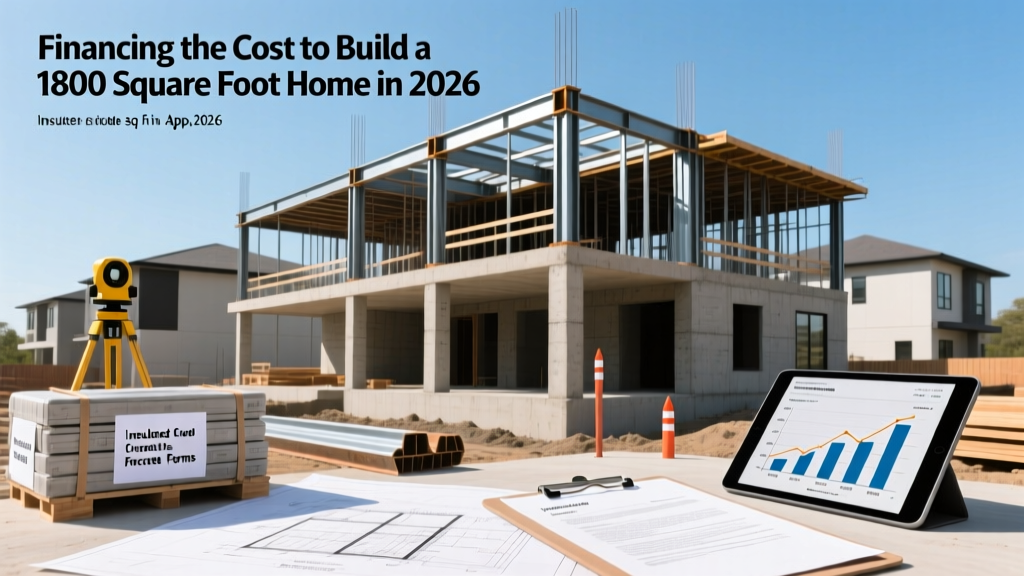
The Real Cost to Build a 1800 Square Foot Home in 2026
Securing financing for a custom build requires more than a pre-approval letter; it demands a granular understanding of hard costs, soft costs, and lender draw requirements. As of 2026, the national average for mid-grade residential construction hovers between $175 and $225 per square foot. When calculating the exact cost to build a 1800 square foot home, you must account for site preparation, material volatility, and regional labor premiums. According to the National Association of Home Builders (NAHB), framing and interior finishes continue to represent the largest capital outlays in single-family construction.
| Cost Category | Estimated Range (2026) | % of Total Budget |
|---|---|---|
| Site Work & Foundation (Slab/Crawlspace) | $28,000 - $45,000 | 10% - 12% |
| Framing & Exterior Envelope | $65,000 - $85,000 | 20% - 22% |
| Major Systems (HVAC, Plumbing, Electrical) | $42,000 - $55,000 | 12% - 14% |
| Interior Finishes (Drywall, Trim, Cabinets) | $85,000 - $115,000 | 25% - 28% |
| Soft Costs (Permits, Architecture, Engineering) | $22,000 - $35,000 | 6% - 8% |
| Contingency Reserve (Mandatory) | $31,000 - $40,000 | 10% |
| Total Estimated Cost | $333,000 - $415,000 | 100% |
The Appraisal Gap: Where 1800 Sq Ft Builds Stall
The most frequent point of failure in construction financing is the appraisal gap. Lenders will fund your project based on the lesser of the total construction cost or the projected appraised value upon completion. If the cost to build a 1800 square foot home is $380,000, but comparable sales in your specific neighborhood cap the appraised value at $350,000, the bank will only base their loan-to-value (LTV) calculation on $350,000.
If your build costs $380,000 and the appraisal is $350,000, a standard 20% down payment requirement means the bank lends 80% of $350,000 ($280,000). You must bring $100,000 to closing, not just the $76,000 you originally calculated. Always run a comparative market analysis (CMA) with your realtor before finalizing architectural plans to ensure your 1800 sq ft footprint aligns with neighborhood ceilings.
Choosing the Right Construction Loan Structure
Not all construction loans function identically. For a 1800 square foot footprint—which typically takes 6 to 8 months to complete—borrowers generally choose between two primary vehicles. The Consumer Financial Protection Bureau (CFPB) advises borrowers to carefully weigh the closing cost implications of each structure before committing.
1. Construction-to-Permanent (C2P) Loan
- Structure: Closes once. Converts to a standard 30-year fixed mortgage after the certificate of occupancy (CO) is issued.
- Best For: Borrowers who want to lock in their permanent interest rate upfront and pay only one set of closing costs.
- 2026 Rate Reality: The construction phase rate is typically 1.00% to 1.50% higher than the locked permanent rate. If your permanent rate is 6.75%, your draw-phase rate will be roughly 7.75% to 8.25%.
2. Standalone Construction Loan
- Structure: Closes twice. You secure a short-term (12-month) construction loan, then apply for a traditional mortgage to pay it off upon completion.
- Best For: Borrowers expecting interest rates to drop significantly before their build finishes, or those making heavy structural modifications mid-build that might violate C2P covenants.
- Drawback: You pay two sets of closing costs and face the risk of not qualifying for the permanent mortgage if your financial profile changes during the build.
The 5-Draw Schedule: Cash Flowing Your Build
Lenders do not hand over $380,000 on day one. Funds are dispersed in tranches, or 'draws,' verified by a third-party inspector. For a standard 1800 square foot single-story or two-story build, lenders utilize a 5-draw schedule. Understanding this schedule is critical for managing your general contractor's cash flow and avoiding mechanic's liens.
- Draw 1: Foundation & Site (15%) - Disbursed after clearing, grading, and pouring the 3000 PSI concrete footings and slab. Includes underground plumbing rough-ins.
- Draw 2: Framing & Dried-In (25%) - Disbursed when the engineered wood I-joists, LVL beams, and roof trusses are set, and the house is wrapped in weather-resistant barrier (WRB) with windows installed.
- Draw 3: Mechanicals & Drywall (25%) - Disbursed after HVAC ductwork, electrical wiring, and plumbing top-outs pass municipal inspection. Includes drywall hanging and taping.
- Draw 4: Interior Finishes & Exterior (25%) - Disbursed upon installation of cabinets, trim, flooring, siding, and roofing materials.
- Draw 5: Final Completion (10%) - Disbursed after final appliances are installed, landscaping/driveway is poured, and the final CO is issued.
Calculating Interest-Only Payments During Construction
During the 6-to-8-month build phase, you only pay interest on the money actually drawn, not the total loan amount. However, you must qualify for the maximum possible interest payment to satisfy the lender's Debt-to-Income (DTI) requirements.
Math Breakdown for a $304,000 Loan (80% LTV on $380,000 Cost)
Assuming an 8.00% construction phase interest rate:
Maximum Monthly Interest: $304,000 x 0.08 / 12 = $2,026 per month.
Note: In month one, you might only pay interest on the 15% foundation draw ($45,600), resulting in a $304 first-month payment. But the bank underwrites you at the $2,026 maximum to ensure you don't default when the final draws hit.
DTI, Reserves, and Lender Requirements
To finance the cost to build a 1800 square foot home, your financial profile must meet stringent 2026 underwriting overlays. According to guidelines outlined by Freddie Mac and major portfolio lenders, construction loans carry higher risk than traditional mortgages, resulting in stricter borrower qualifications.
- Debt-to-Income (DTI) Ratio: Most lenders cap the back-end DTI at 43% to 45%. This includes your current housing payment (if any) plus the maximum calculated interest-only construction payment, auto loans, and credit card minimums.
- Credit Score: While FHA construction loans may accept scores down to 620, conventional portfolio lenders typically require a minimum FICO of 680 to 720 for a C2P loan.
- Liquidity Reserves: Lenders require 6 to 12 months of PITI (Principal, Interest, Taxes, and Insurance) in verified liquid reserves after closing. If your max interest payment is $2,026 and estimated taxes/insurance are $500, you must show at least $15,156 in untapped cash reserves.
- Contingency Fund: Lenders mandate a 10% contingency reserve built into the loan amount. On a $345,000 hard-cost build, $34,500 is set aside. If unused, this contingency is applied to the principal balance upon conversion to the permanent mortgage.
Finalizing Your Financing Strategy
Successfully financing a 1800 square foot build hinges on aligning your architectural plans with neighborhood comps to avoid appraisal gaps, selecting a C2P loan to mitigate closing costs, and maintaining strict liquidity reserves. By mapping your contractor's timeline to the lender's 5-draw schedule, you ensure continuous cash flow and prevent costly construction delays.
Written by
Priya KapoorPriya Kapoor is a real estate market analyst and construction economics researcher with expertise in housing affordability, development feasibility, and infrastructure investment. She holds a Master of Regional Planning from Cornell University and previously worked as a senior analyst at CBRE's Investment Properties group, where she modeled returns for $4B in mixed-use development pipelines. Priya now runs an independent research practice advising developers, municipalities, and REITs on construction cost forecasting and market timing. She publishes the quarterly "BuildMat Market Pulse" report tracking material price indices across 12 commodity categories. Based in Austin, TX, Priya serves on the board of Habitat for Humanity Austin and is a marathon runner.
More from Priya Kapoor
View all
Construction Cost
Cost to Build a 1600 Sq Ft Home in 2026: Full Breakdown
Accurate 2026 cost to build a 1600 sq ft home—material, labor, and regional pricing breakdowns included. Plan your budget with real-time estimates.
Aug 11, 2026

Wood & Lumber
Name the Types of Wood for Pressure Treatment and Preservation
Learn how to name the types of wood best suited for pressure treatment. Compare species treatability, chemical retention levels, and 2026 preservation costs.
Aug 4, 2026

Stone & Masonry
Stone Veneer Suppliers Lindenhurst: 2026 Cost Analysis
Analyze 2026 stone veneer costs in Lindenhurst, NY. Compare local supplier pricing, delivery fees, and Suffolk County installation labor rates.
Aug 4, 2026