Financing the Cost to Build a Small Pool: 2026 Guide
Learn how to finance the cost to build a small pool in 2026. Compare HELOCs, personal loans, and dealer financing with real rate estimates and hidden fees.

Defining the Cost to Build a Small Pool in 2026
The cost to build a small pool—typically defined as a plunge pool, spool, or compact fiberglass shell under 400 square feet—ranges from $30,000 to $65,000 in the current 2026 construction market. Unlike massive custom gunite estates, small pools offer a manageable footprint and lower chemical overhead. However, the fixed costs of excavation, municipal permitting, electrical routing, and heavy equipment mobilization remain largely identical regardless of the pool's size. Financing this investment requires navigating a lending environment where interest rates have stabilized, but home equity remains tightly locked for many homeowners who secured sub-4% mortgages in previous years.
| Pool Type | Typical Dimensions | Primary Material | 2026 Turnkey Cost Range |
|---|---|---|---|
| Plunge Pool | 10' x 16' | Fiberglass Shell | $30,000 - $45,000 |
| Spool (Spa/Pool) | 12' x 18' | Shotcrete / Gunite | $45,000 - $65,000 |
| Compact Lap Pool | 10' x 30' | Vinyl Liner | $38,000 - $52,000 |
Evaluating Your Financing Vehicles
Choosing the right capital source depends entirely on your current Loan-to-Value (LTV) ratio, credit profile, and how quickly you need the funds disbursed. According to the Consumer Financial Protection Bureau (CFPB), leveraging home equity remains the most cost-effective route for major structural improvements, but unsecured alternatives have gained traction for smaller, fixed-cost projects like fiberglass plunge pools.
Home Equity Line of Credit (HELOC)
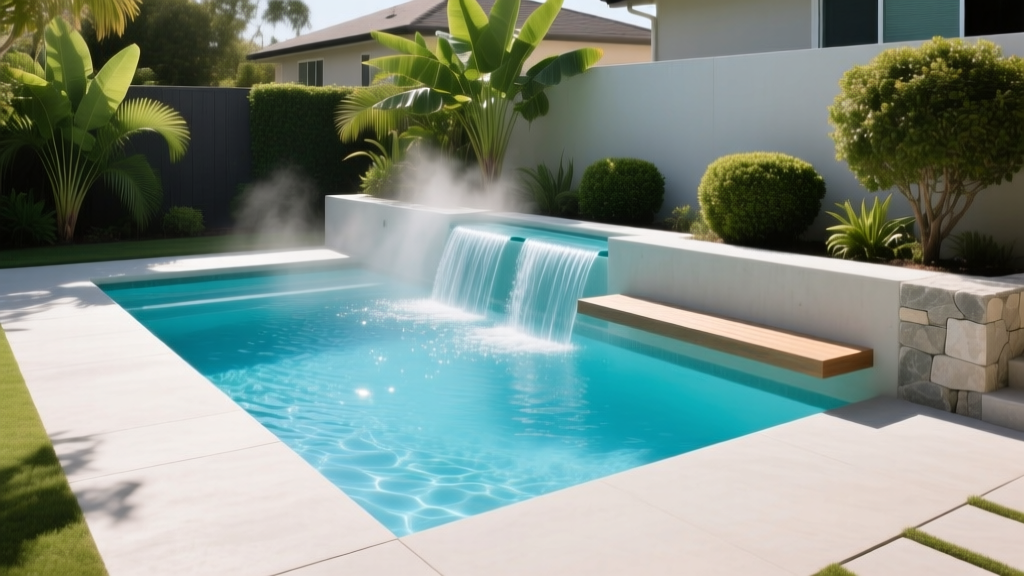
A HELOC functions as a revolving credit line secured by your property. In 2026, HELOC interest rates generally track the Prime Rate plus a margin, resulting in variable APRs hovering between 8.0% and 9.5% for borrowers with excellent credit. This is the ideal vehicle if your pool project involves phased construction—such as pouring the concrete deck in phase one and adding the sheer descent waterfalls and landscaping in phase two. You only pay interest on the capital you actually draw.
Unsecured Personal Home Improvement Loans
For homeowners with high equity lock-in or insufficient CLTV, unsecured personal loans offer rapid funding without placing a lien on the property. As noted by Bankrate, personal loans for home improvements in 2026 carry APRs ranging from 9% to 15% for FICO scores above 720. The critical drawback is the origination fee, which typically ranges from 1% to 8% and is deducted directly from the loan principal. If you borrow $40,000 to cover a fiberglass pool installation and face a 5% origination fee, you only receive $38,000, forcing you to cover the $2,000 shortfall out of pocket.
Manufacturer and Dealer Point-of-Sale Financing
Major fiberglass manufacturers and large regional builders often partner with third-party lenders like GreenSky or Synchrony to offer promotional financing. These frequently advertise "0% APR for 18 months." However, the Federal Trade Commission (FTC) advises consumers to scrutinize these offers for deferred interest clauses. If the $45,000 pool balance is not paid in full by month 18, interest is often applied retroactively to the original purchase date at a punitive rate of 18.99% to 24.99%. True 0% APR loans (where interest does not retroactively apply) are rare and usually reserved for shorter 12-month terms.
Hidden Site-Prep Costs That Break Loan Budgets
The most common financing failure occurs when homeowners borrow the exact quoted price of the pool shell and installation, only to be blindsided by mandatory site-prep requirements. When calculating your total loan amount, you must pad your budget by 15% to 20% to account for these non-negotiable variables:
- Geotechnical Soil Testing ($800 - $1,500): If your municipality requires a soil engineer, and they discover expansive clay or a high water table, you will need over-excavation and engineered fill, adding $3,000 to $8,000 to the dig cost.
- Electrical Sub-Panel Upgrades ($2,500 - $4,500): Modern variable-speed pumps, salt chlorine generators, and electric heat pumps require dedicated 220V circuits. If your home's main panel is maxed out, an upgrade to a 400-amp service is mandatory before the pool inspector will sign off.
- Crane Mobilization ($1,200 - $3,500): For small fiberglass plunge pools installed in backyards with narrow side-gates, a crane is required to lift the shell over the house. Crane permits and road closures add significant one-day expenses.
- Municipal Fencing ($35 - $60 per linear foot): Most jurisdictions require a minimum 4-foot non-climbable barrier with self-closing, self-latching gates. If your yard is not already enclosed, this can add $4,000 to $7,000.
Decision Framework: Matching Capital to Your Profile
Use this matrix to determine the most mathematically sound financing route for your specific property and financial standing.
| Financial Profile | Recommended Vehicle | Why It Works |
|---|---|---|
| CLTV under 75%, long-term hold | Home Equity Loan (Fixed) | Locks in a fixed rate (approx. 7.5% - 8.5%) for the 15-year term, providing predictable monthly payments alongside your primary mortgage. |
| CLTV 75% - 85%, phased build | HELOC | Allows you to draw funds incrementally as the builder completes excavation, plumbing, and final decking, minimizing early interest accrual. |
| CLTV over 85%, FICO > 740 | Unsecured Personal Loan | Bypasses equity requirements and appraisal fees. Ideal for smaller $30,000 plunge pools where a 7-year payoff term keeps monthly obligations manageable. |
| Buying direct from large builder | Dealer Promo (True 0%) | Only viable if you have the cash liquidity to pay off the entire balance before the promotional period expires, avoiding retroactive interest traps. |
"The biggest mistake homeowners make is financing a depreciating lifestyle asset with a 30-year cash-out refinance. Keep the loan term aligned with the asset's lifespan. A 10-to-15-year home equity loan perfectly mirrors the lifecycle of pool equipment and surface finishes."
Appraisal Impact and ROI Realities
When financing the cost to build a small pool, it is vital to separate personal utility from financial return on investment. Appraisers generally do not dollar-for-dollar match the construction cost of a pool to the home's appraised value. In 2026, a well-integrated small pool or spool typically recoups 50% to 70% of its cost upon resale. However, small plunge pools often yield a higher percentage ROI than sprawling custom water features because they appeal to a broader demographic of buyers who want the aesthetic and cooling benefits of a pool without the high weekly maintenance and chemical costs. By keeping the total financed amount strictly under $50,000 and focusing on high-end hardscaping and low-maintenance equipment (like UV sanitizers and robotic cleaners), you maximize both your daily enjoyment and your ultimate equity retention.
Written by
James ThorntonJames Thornton is a construction industry veteran with 25 years of hands-on experience in wood framing, lumber grading, and residential building codes. He started as a framing carpenter in rural Oregon, earned his ICC Residential Building Inspector certification, and eventually became a senior plan reviewer for the City of Portland Bureau of Development Services. James holds a B.S. in Wood Science & Technology from Oregon State University and is a certified lumber grader through the West Coast Lumber Inspection Bureau (WCLIB). He has inspected over 3,000 residential construction sites and authored the city's internal guide on advanced framing techniques (2x6 at 24" O.C.). James lives in Bend, OR, where he builds custom timber-frame cabins and competes in lumberjack sports.
More from James Thornton
View all
Insulation
Best Home Insulation Materials: Complete 2026 Guide
Compare top home insulation materials for 2026. Find R-values, installed costs per square foot, and best uses for fiberglass, spray foam, and mineral wool.
Aug 4, 2026

Sustainable Building
Certify Your Green Building Material for LEED and WELL
Step-by-step guide to certifying a green building material for LEED v5 and WELL v2. Master EPDs, HPDs, and VOC limits for 2026 project specifications.
Aug 4, 2026

Stone & Masonry
Veneer Stacked Stone Panels: Interior Design & Style Showcase
Discover how veneer stacked stone panels transform interiors. Explore modern design profiles, material pairings, and technical installation specs.
Aug 4, 2026