Indoor Pool Cost to Build: 2026 Regional Price Analysis
Discover the true indoor pool cost to build across US regions in 2026. Compare material, labor, and HVAC expenses for your natatorium project.

The True Indoor Pool Cost to Build: Beyond the National Average
Calculating the exact indoor pool cost to build requires moving past misleading national averages. While industry aggregators often cite a baseline of $160,000 to $200,000 for a standard 15x30-foot residential natatorium, this figure ignores the massive regional variances in climate control engineering, local labor rates, and structural code requirements. An indoor pool is not merely a hole in the ground filled with water; it is a complex, high-humidity micro-environment that demands specialized architectural integration.
Cost Reality Check: The 40% Rule
In 2026, environmental controls (HVAC, dehumidification, and vapor barriers) typically consume 35% to 40% of the total indoor pool cost to build. In extreme climates, this percentage can exceed 50%, making regional weather patterns the single largest variable in your budget.
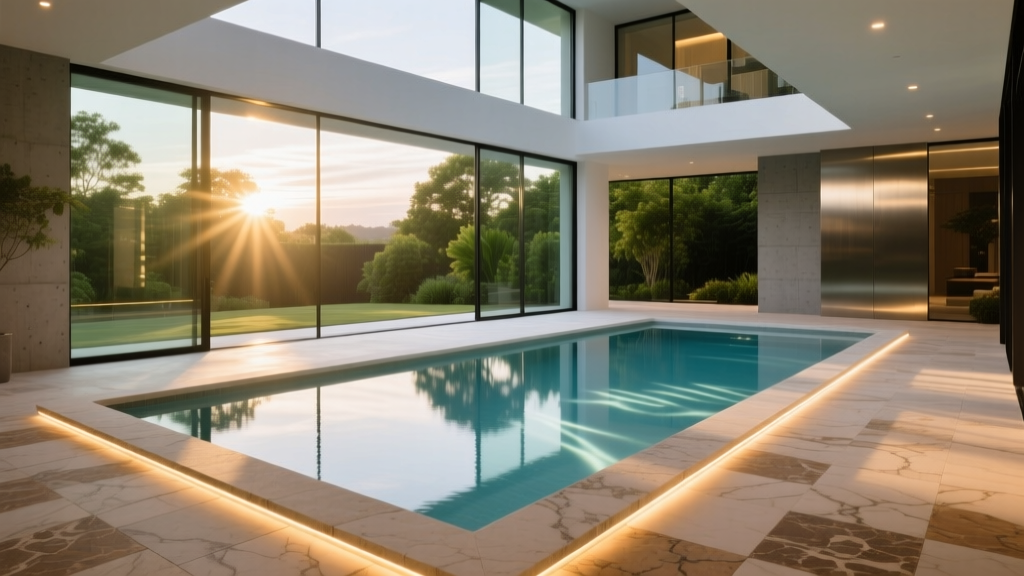
Deconstructing the Indoor Pool Cost to Build by Region
Geography dictates everything from the thickness of your wall insulation to the hourly rate of the unionized pipefitters installing your heat exchangers. Below is a comprehensive regional price matrix for a standard 450-square-foot (15x30) indoor pool with a 10-foot deck perimeter, basic gunite construction, and a commercial-grade dehumidification system.
| Region | Base Construction | HVAC & Dehumidification | Labor Premium | Total Estimated Range |
|---|---|---|---|---|
| Northeast (NY, MA, CT) | $85,000 - $110,000 | $45,000 - $60,000 | +25% | $220,000 - $310,000 |
| Southeast (FL, GA, NC) | $75,000 - $95,000 | $50,000 - $65,000 | Baseline | $175,000 - $240,000 |
| Midwest (IL, OH, MI) | $80,000 - $105,000 | $40,000 - $55,000 | +10% | $185,000 - $260,000 |
| West Coast (CA, WA, OR) | $95,000 - $130,000 | $35,000 - $50,000 | +40% | $250,000 - $380,000+ |
Northeast & Midwest: The Insulation and Dew Point Challenge
Building a natatorium in IECC Climate Zones 5 through 8 (covering most of the Northeast and Midwest) introduces severe dew point risks. The interior air is typically maintained at 82°F with 50% relative humidity. When this moisture-laden air meets a poorly insulated exterior wall during a 10°F January night, condensation forms inside the wall cavity, leading to catastrophic mold growth and structural rot within months.
To mitigate this, builders in these regions must install continuous vapor retarders on the warm-in-winter side (the interior) of the wall assembly. This requires specialized materials like 6-mil cross-laminated polyethylene sheeting or high-density closed-cell spray foam (minimum 2 lb/ft³ density, providing R-7 per inch). Furthermore, windows must be triple-pane, argon-filled, and thermally broken aluminum or fiberglass to prevent interior glass condensation. These strict energy and moisture codes add $25,000 to $40,000 to the enclosure costs compared to southern builds.
Southeast: High Latent Loads and Dehumidification
While the Southeast avoids extreme winter insulation costs, it faces a different enemy: massive summer latent heat loads. The outdoor air in states like Florida or Georgia carries immense moisture. When fresh air is introduced into the natatorium for ventilation (as mandated by the CDC Model Aquatic Health Code), the dehumidification system must work overtime to strip the humidity from the incoming air while simultaneously handling the evaporation from the pool surface.
A standard 15x30 pool evaporates roughly 15 to 25 gallons of water daily. In the Southeast, you will need a robust commercial dehumidifier rated for at least 180 to 220 lbs of moisture removal per hour, such as the Desert Aire AquAire series or PoolPak EntranPak systems. Expect to pay a premium of $10,000 to $15,000 more for oversized HVAC equipment in this region compared to arid climates.
West Coast: Seismic Engineering and Title 24 Compliance
The West Coast commands the highest overall indoor pool cost to build, driven primarily by labor rates and regulatory hurdles. In California, Title 24 energy standards dictate rigorous efficiency requirements for pool pumps, heaters, and building envelopes, often necessitating the integration of solar thermal pre-heating systems or advanced heat recovery chillers.
Additionally, seismic structural requirements in California, Oregon, and Washington mean the pool shell and the surrounding superstructure cannot be treated as independent entities. Engineers must design moment frames and specialized shear walls to ensure the heavy, sloshing mass of the pool water does not compromise the building's foundation during an earthquake. This structural engineering alone can add $15,000 to $30,000 to the pre-construction and framing phases.
Labor Rate Variations Across Major Metro Areas
Labor accounts for 40% to 55% of your total natatorium budget. According to data tracked by the Bureau of Labor Statistics, specialized trades required for indoor pools—specifically HVAC technicians, gunite applicators, and commercial plumbers—command vastly different premiums depending on the local cost of living and union density.
- New York City / Boston Metro: Specialized mechanical contractors charge between $160 and $220 per hour. Expect significant logistical premiums for crane access and material staging in dense urban environments.
- San Francisco / Los Angeles: Prevailing wage equivalents and high union density push specialized labor rates to $150 - $210 per hour. Permitting delays in coastal commission zones can also extend project timelines by 3-6 months, increasing overhead costs.
- Chicago / Detroit: Strong union presence keeps rates steady at $120 - $160 per hour, but winter construction moratoriums may force you to pay for temporary heated enclosures if excavating between December and March.
- Atlanta / Dallas / Phoenix: A highly competitive, non-unionized subcontractor market keeps specialized labor rates between $85 and $130 per hour, offering the most favorable labor-to-material ratios in the country.
Material Sourcing and Regional Freight Costs
The physical materials used in pool construction are heavy and expensive to transport. Gunite (a dry-mix spray concrete) requires local batch plants within a 45-minute drive to ensure proper hydration and curing. If you are building in a rural or remote area (e.g., the mountainous regions of Colorado or rural New England), the lack of nearby batch plants and specialized tile suppliers will trigger substantial freight surcharges.
Furthermore, the interior finishes dictate long-term maintenance costs. While standard white marcite plaster is the cheapest upfront option ($5,000 - $8,000 for a 450 sq ft pool), it degrades faster in indoor environments due to constant chemical off-gassing. Upgrading to a pebble-tec aggregate finish or fully vitrified glass tile (which costs $45 to $85 per square foot installed) is highly recommended for indoor pools to resist chemical etching, but sourcing these materials in the Midwest or Plains states will incur 10-15% higher freight costs than building in the Southwest where these materials are manufactured.
Warning: The Off-Gassing Trap
Never use standard outdoor pool equipment indoors. Gas-fired heaters and saltwater chlorine generators produce chloramines and carbon monoxide. Without a specialized Pool & Hot Tub Alliance certified exhaust and make-up air system, these gases will pool in the ceiling joists, causing severe respiratory hazards and corroding structural steel within the first year of operation.
Actionable Framework: Estimating Your Local Natatorium
To generate an accurate budget for your specific zip code, follow this sequential estimation framework before soliciting contractor bids:
- Calculate the Evaporation Load: Determine your pool's square footage and desired water temperature. Use the ASHRAE natatorium sizing charts to determine the required lbs/hr of dehumidification. Multiply this by $200-$250 per lb/hr to estimate your baseline HVAC equipment cost.
- Assess the Envelope Requirements: Look up your county's specific IECC climate zone. If you are in Zone 4 or higher, allocate a minimum of $35,000 for advanced vapor barriers, closed-cell spray foam, and thermally broken triple-pane glazing.
- Audit Local Utility Rates: Indoor pools require 24/7 dehumidification and water heating. Check your local commercial/residential electricity tiers. If rates exceed $0.22 per kWh, mandate the inclusion of a heat recovery dehumidifier (which captures waste heat to warm the pool water), adding $12,000 upfront but saving up to $4,000 annually in energy costs.
- Factor in Permitting Timelines: Contact your local building department to ask about specific mechanical ventilation permits. In jurisdictions with strict indoor air quality (IAQ) review boards, allocate an extra 8-12 weeks and $5,000 for specialized MEP (Mechanical, Electrical, Plumbing) engineering stamps.
- Solicit Specialized Bids Only: Filter your contractor search strictly for builders who hold CPO (Certified Pool Operator) credentials and have verifiable experience with commercial-grade dehumidification systems. General residential remodelers routinely underestimate the negative air pressure dynamics required to keep pool odors from migrating into the main living spaces of the home.
By isolating the mechanical, structural, and labor variables specific to your geography, you can transform the indoor pool cost to build from a vague estimate into a precisely engineered financial blueprint.
Written by
James ThorntonJames Thornton is a construction industry veteran with 25 years of hands-on experience in wood framing, lumber grading, and residential building codes. He started as a framing carpenter in rural Oregon, earned his ICC Residential Building Inspector certification, and eventually became a senior plan reviewer for the City of Portland Bureau of Development Services. James holds a B.S. in Wood Science & Technology from Oregon State University and is a certified lumber grader through the West Coast Lumber Inspection Bureau (WCLIB). He has inspected over 3,000 residential construction sites and authored the city's internal guide on advanced framing techniques (2x6 at 24" O.C.). James lives in Bend, OR, where he builds custom timber-frame cabins and competes in lumberjack sports.
More from James Thornton
View all
Insulation
Best Home Insulation Materials: Complete 2026 Guide
Compare top home insulation materials for 2026. Find R-values, installed costs per square foot, and best uses for fiberglass, spray foam, and mineral wool.
Aug 4, 2026

Sustainable Building
Certify Your Green Building Material for LEED and WELL
Step-by-step guide to certifying a green building material for LEED v5 and WELL v2. Master EPDs, HPDs, and VOC limits for 2026 project specifications.
Aug 4, 2026

Stone & Masonry
Veneer Stacked Stone Panels: Interior Design & Style Showcase
Discover how veneer stacked stone panels transform interiors. Explore modern design profiles, material pairings, and technical installation specs.
Aug 4, 2026