How to Finance the Cost to Build a Barndominium in Texas
Discover how to finance the cost to build a barndominium in Texas. Learn lender requirements, appraisal workarounds, and construction loan options.

The Real Cost to Build a Barndominium in Texas: Baseline Metrics
Before approaching a lender, you must establish a highly accurate budget. The cost to build a barndominium in Texas varies wildly based on your county, site conditions, and finish level. For a standard 2,000-square-foot post-frame residence, the total turnkey cost typically ranges from $220,000 to $340,000, translating to $110 to $170 per square foot. However, raw shell kits cost significantly less—often between $45 and $65 per square foot—but do not qualify for standard residential mortgages on their own.
2,000 Sq. Ft. Texas Barndo Budget Breakdown
- Land Acquisition (1-5 acres): $30,000 – $90,000 (Highly dependent on proximity to I-35 or I-45 corridors)
- Site Prep & Utilities: $15,000 – $35,000 (Includes well, septic, and driveway)
- Foundation (Slab-on-Grade): $12,000 – $18,000
- Steel Shell & Erection: $55,000 – $75,000
- Interior Framing & Finishes: $100,000 – $150,000
Lenders will not approve a construction loan based on a rough estimate. You must present a line-item budget from a licensed general contractor or a detailed materials invoice from a recognized post-frame supplier. According to the National Frame Building Association (NFBA), post-frame construction is highly efficient, but lenders require proof that the builder has specific experience with barndominium residential conversions, not just agricultural outbuildings.
Why Traditional Mortgages Reject Post-Frame Homes
If you attempt to use a standard 30-year conventional mortgage to finance raw land and a barndo kit, your application will likely be denied. Conventional lenders view post-frame construction as “non-standard” because the structural load is borne by exterior columns embedded in the ground or anchored to a perimeter grade beam, rather than a traditional continuous concrete foundation wall. Furthermore, if the property is zoned agricultural or lacks immediate comparable sales (comps), automated underwriting systems will flag the risk.
To successfully finance the cost to build a barndominium in Texas, you must utilize specialized loan products designed for ground-up construction or rural development.
The Texas Barndo Financing Matrix
| Loan Type | Down Payment | Best For | Texas Availability | Lender Complexity |
|---|---|---|---|---|
| Construction-to-Permanent (Single Close) | 10% - 20% | Turnkey builds with licensed GCs | High (Regional Banks) | Moderate |
| USDA Section 502 Guaranteed | 0% | Rural TX counties (Income restricted) | Very High | High (Strict property specs) |
| FHA Construction (Title II) | 3.5% | Owner-builders with high credit scores | Moderate | Very High |
| Land & Construction Loan (Farm Credit) | 15% - 25% | Ag-exempt land with large acreage | Very High | Low |
Step-by-Step Blueprint for Construction-to-Permanent Loans
The most common route for financing a Texas barndominium is the single-close construction-to-permanent loan. This converts to a standard mortgage once the certificate of occupancy (CO) is issued. Here is the exact sequence to secure it:
- Acquire the Land First: Most Texas lenders prefer you to own the land outright or have significant equity in it. If you own the land, its appraised value can often serve as your down payment.
- Finalize Architectural Plans: Lenders require a complete set of engineered blueprints. For Texas wind loads, ensure your plans specify roof trusses rated for 110+ mph wind speeds, especially in Gulf Coast and Panhandle counties.
- Secure a Fixed-Price Builder Contract: Cost-plus contracts are rarely accepted. You need a fixed-price contract with a draw schedule (typically 5 to 7 draws) tied to specific milestones (e.g., slab poured, shell dried-in, rough-ins complete).
- Order the Appraisal Early: Do not wait for the lender to order the appraisal. Have your builder submit the plans to a local appraiser familiar with post-frame homes to establish the future “as-completed” value.
Navigating the Texas Appraisal Gap
The single biggest point of failure in barndominium financing is the appraisal. Because barndos are custom and often built in rural Texas counties, there are rarely three identical “comps” within a one-mile radius to satisfy the sales comparison approach.
Expert Appraisal Workaround
Instruct your lender to allow the appraiser to use the Cost Approach rather than relying solely on the Sales Comparison Approach. Provide the appraiser with a “Builder’s Spec Sheet” that explicitly details the residential-grade materials used inside the barndo (e.g., R-38 closed-cell spray foam insulation, PEX plumbing, 2x6 interior stud walls, and quartz countertops). This proves the home is a Class-A residential dwelling, not an agricultural shed with living quarters.
Hidden Site-Prep Traps That Derail Loan Draws
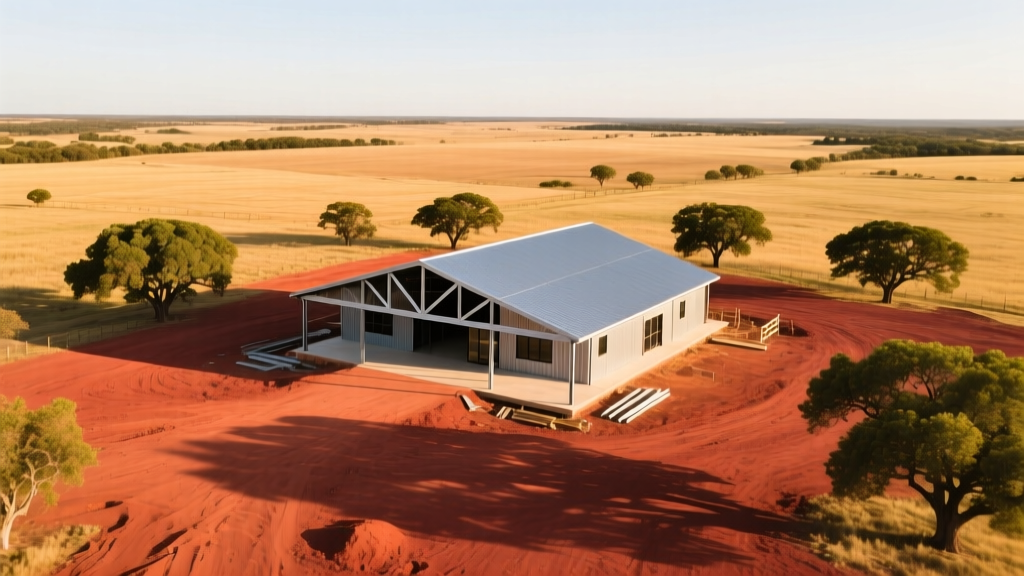
When budgeting the cost to build a barndominium in Texas, failing to account for regional soil conditions will cause you to exhaust your construction loan contingency before the shell even goes up. Lenders disburse funds based on completed work; if your site prep goes over budget, you must cover the difference out-of-pocket.
- Blackland Prairie Expansive Clay: In North and Central Texas, highly plastic clay soils expand and contract with moisture. A standard slab-on-grade will crack and destroy your interior finishes. You must budget an extra $2.50 to $4.00 per square foot for a post-tensioned slab or deep grade beams engineered by a geotechnical firm.
- Hill Country Caliche Rock: If you are building west of Austin or San Antonio, trenching for septic lines and water wells often hits solid caliche rock. Budget $3,000 to $8,000 for rock excavation and heavy machinery surcharges.
- Ag-Exempt Setbacks: Many rural Texas counties have strict setback requirements for aerobic septic systems relative to water wells and property lines. Failing a county health inspection halts your construction loan draws immediately.
Top Texas-Friendly Lenders for Post-Frame Construction
Do not waste time with national megabanks; their underwriting algorithms automatically reject post-frame homes. Instead, target institutions that understand Texas rural real estate:
- Texas Farm Credit System: Through the Farm Credit Council, local cooperatives offer highly competitive land and construction loans. They understand agricultural zoning and barndominium builds implicitly, though they typically require a 20% down payment and the property must have some rural/ag characteristics.
- First United Bank (North Texas): Known for flexible construction-to-permanent loans and a willingness to underwrite custom post-frame homes in counties like Grayson, Cooke, and Montague.
- USDA Direct & Guaranteed Lenders: If your land falls within USDA-eligible rural boundaries (which covers vast swaths of Texas outside major MSA limits), you can utilize USDA Single Family Housing Programs. The catch? The home must be strictly residential (no commercial workshops or large-scale livestock facilities attached) and meet strict energy efficiency standards.
Financial Decision Framework: Shell Kit vs. Turnkey GC
How you choose to build directly dictates your financing options. Use this framework to decide your path:
| Build Strategy | Financing Route | Pros | Cons & Risks |
|---|---|---|---|
| DIY Owner-Builder (Shell Kit) | Cash, HELOC, or Personal Construction Loan | Massive sweat equity; lower overall cost per sq ft. | Nearly impossible to get a single-close mortgage; high risk of builder burnout; lenders require proof of GC experience. |
| Licensed GC Turnkey | Construction-to-Permanent Mortgage | Single-close financing; builder handles permits and inspections; warranty protection. | Higher upfront cost (15-20% GC markup); less customization flexibility mid-build. |
| Hybrid (GC for Shell, DIY Interior) | Shell Construction Loan + Cash for Interior | Finances the most expensive/expert phase; allows DIY finishing to save money. | Requires significant cash reserves to finish the interior; delays in CO issuance. |
Financing a barndominium in Texas requires bypassing traditional residential lending channels and partnering with institutions that understand post-frame engineering and rural land dynamics. By securing your land, engineering a site-specific foundation, and forcing the cost approach during appraisal, you can successfully fund your project and lock in a favorable long-term mortgage rate.
Written by
Sarah WhitfieldSarah Whitfield is a chartered quantity surveyor (MRICS) and construction cost analyst with 15 years of experience in material pricing, procurement strategy, and project budgeting. She earned her degree in Construction Management from the University of Reading (UK) and has worked on projects ranging from $2M custom homes to $180M mixed-use developments across North America and Europe. Sarah currently leads cost estimating for BuildMat Insight, maintaining a proprietary database of 4,000+ material price points updated quarterly. She is a frequent contributor to RSMeans cost data panels and has presented at the International Cost Engineering Council (ICEC) congress. Based in Denver, CO, Sarah is an avid trail runner and volunteer mentor for Women in Construction.
More from Sarah Whitfield
View all
Wood & Lumber
What Are the Different Types of Wood? A Builder's Guide
Compare structural softwoods, finish hardwoods, and engineered lumber. Analyze Janka ratings, MOE values, and 2026 pricing for construction.
Aug 4, 2026

Walls & Panels
Steel Framing vs Wood Framing: Corrosion and Moisture Defense
Compare steel framing vs wood framing for moisture resistance. Learn about galvanized coatings, condensation risks, and corrosion protection strategies.
Jul 21, 2026

Stone & Masonry
How to Cut Stone Veneer: Wet Saw vs Grinder Comparison
Compare the best tools for cutting stone veneer. We review wet saws, angle grinders, and chop saws to help you achieve clean, chip-free cuts.
Jul 21, 2026