Financing the Average Cost to Build a House in Arizona in 2026
Discover how to finance the average cost to build a house in Arizona. Explore 2026 construction loan rates, lender requirements, and hidden desert costs.
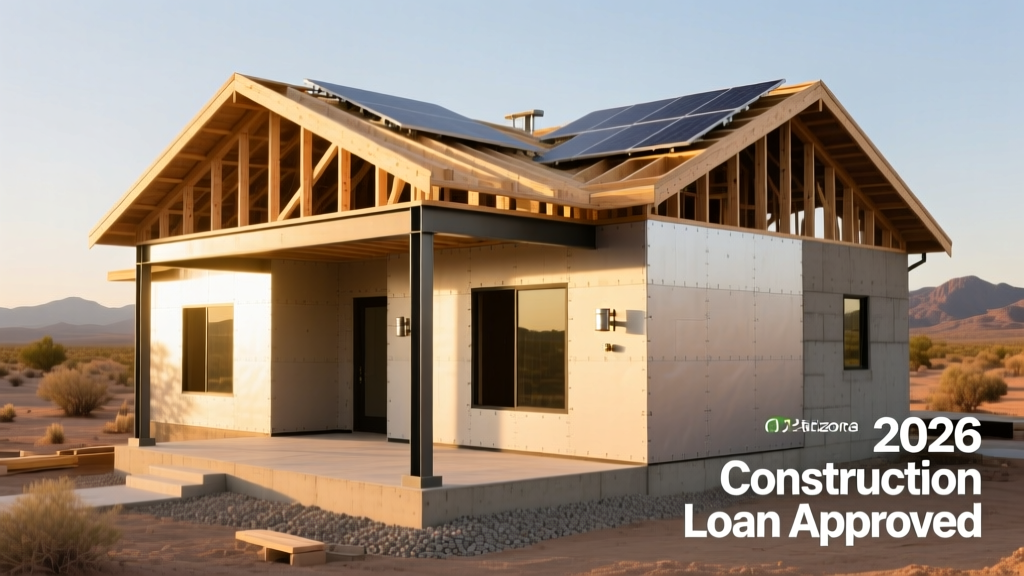
The 2026 Baseline: Average Cost to Build a House in Arizona
Securing financing for a custom build requires more than a pre-approval letter; it demands a hyper-localized understanding of regional construction economics. According to data tracked by the U.S. Census Bureau's New Residential Construction reports, the Sunbelt continues to experience unique pricing pressures. When calculating the average cost to build a house in Arizona, you must account for extreme climate adaptations, varied topography, and localized labor markets.
For 2026, the baseline average cost to build a house in Arizona ranges from $155 to $285 per square foot, depending heavily on the county and site conditions. A standard 2,200-square-foot single-family home will typically require a construction budget between $341,000 and $627,000, excluding land acquisition.
| Arizona Region | Avg. Cost per Sq. Ft. (2026) | Estimated Budget (2,200 Sq. Ft.) | Primary Cost Drivers |
|---|---|---|---|
| Phoenix Metro (Maricopa) | $165 - $225 | $363,000 - $495,000 | Caliche excavation, high SEER2 HVAC, labor demand |
| Tucson Metro (Pima) | $155 - $205 | $341,000 - $451,000 | Slightly lower labor costs, standard soil conditions |
| Prescott / Sedona (Yavapai) | $210 - $285 | $462,000 - $627,000 | Mountain grading, snow load framing, remote logistics |
| Rural / Unincorporated | $175 - $240 | $385,000 - $528,000 | Well/septic installation, off-grid utility trenching |
Desert-Specific Budget Killers Lenders Scrutinize
Construction lenders underwrite your loan based on the detailed line-item budget. If your budget omits Arizona-specific site work, the lender's appraiser will flag the discrepancy, potentially reducing your loan amount. The National Association of Home Builders (NAHB) consistently highlights that site preparation and foundation anomalies are the leading causes of construction loan defaults and draw delays.
1. Caliche Soil Excavation and Foundation Engineering
Caliche is a rock-hard layer of calcium carbonate prevalent in the Phoenix and Tucson basins. Standard trenching equipment cannot penetrate it. If your soil borings reveal shallow caliche, your budget must include D8 bulldozer ripping or localized blasting. Furthermore, foundations often require post-tension (PT) slabs or deep caisson piers to resist the expansive soils that sit above the caliche layer. Budget an additional $4,500 to $9,000 specifically for caliche mitigation and advanced slab engineering.
2. Extreme Heat HVAC Oversizing
Arizona building codes and practical comfort demand HVAC systems engineered for 115°F+ design temperatures. A standard Manual J load calculation in Ohio will not work in Maricopa County. You must budget for high-efficiency SEER2 16.0+ units, often requiring dual-compressor setups or zoned mini-splits for single-story sprawling floor plans. Expect HVAC costs to consume 12% to 15% of your total mechanical budget, compared to the national average of 9%.
3. Monsoon Wind-Load Framing
Summer monsoons bring microbursts with wind speeds exceeding 70 mph. Roof trusses must be secured with specialized hurricane ties, and shear walls require tighter nailing patterns and thicker OSB sheathing (minimum 7/16-inch, often upgraded to 1/2-inch or 5/8-inch for structural rigidity). Lenders require these engineering specs to be stamped by a state-licensed structural engineer before approving the framing draw.
Comparing Construction Loan Programs for Arizona Builds
Financing the average cost to build a house in Arizona requires selecting the right loan vehicle. Unlike traditional mortgages, construction loans disburse funds in "draws" as milestones are met. Below is a comparison of the primary financing structures available to Arizona borrowers in 2026.
| Loan Type | Down Payment | Max Loan Limit (Approx.) | Credit Score Req. | Best Use Case |
|---|---|---|---|---|
| Conventional Construction-to-Permanent | 20% - 25% | Conforming ($766,550) | 720+ | High-net-worth buyers building custom luxury homes in Scottsdale or Paradise Valley. |
| FHA One-Time Close (OTC) | 3.5% | County Limit (~$560k Maricopa) | 620 - 640 | First-time buyers or those with limited cash reserves building in exurbs like Buckeye or Florence. |
| VA Construction Loan | 0% | No limit (No PMI) | 620 (Lender overlay) | Eligible veterans building near Luke AFB or Davis-Monthan AFB. |
| Jumbo Construction Loan | 25% - 30% | $2M - $5M+ | 740+ | Custom architectural builds in Sedona or high-end desert mountain communities. |
Structuring Your Draw Schedule for Monsoon Season
A critical, often overlooked aspect of construction financing in Arizona is aligning your draw schedule with the weather. The North American monsoon season (mid-June through September) severely impacts site work, flatwork (concrete pouring), and roofing. If your draw schedule mandates a foundation pour in July, you risk failing the lender's third-party inspection due to weather delays, which freezes your capital.
Pouring concrete in 110°F heat requires chilled water mixes, liquid nitrogen, and immediate application of curing compounds to prevent flash-setting and structural cracking. Lenders will not release the foundation draw if the third-party inspector notes thermal cracking. Always schedule your major flatwork draws for October through May, or budget an extra $3,500 for specialized hot-weather concrete admixtures and curing blankets.
A standard 6-draw schedule for an Arizona build should look like this:
- Draw 1 (15%): Site clearing, grading, caliche ripping, and underground plumbing rough-in.
- Draw 2 (20%): Foundation pour, post-tension slab curing, and waterproofing.
- Draw 3 (20%): Framing, roof trusses, and monsoon-rated shear wall sheathing (Dry-in stage).
- Draw 4 (15%): MEP (Mechanical, Electrical, Plumbing) rough-ins, including high-SEER2 HVAC ductwork.
- Draw 5 (15%): Insulation (spray foam highly recommended for AZ attics), drywall, and interior trim.
- Draw 6 (15%): Final finishes, landscaping (xeriscaping), and Certificate of Occupancy (CO).
FHA One-Time Close (OTC): Navigating Maricopa County Limits
For buyers looking to finance the average cost to build a house in Arizona without liquidating 20% in cash, the FHA One-Time Close (OTC) loan is the premier vehicle. The OTC wraps the construction phase and the permanent 30-year mortgage into a single closing, saving borrowers thousands in duplicate origination and title fees.
According to HUD's Single Family Housing guidelines, the FHA OTC requires the builder to be registered and approved on the FHA roster. In Maricopa County, the 2026 FHA loan limit for a single-family home sits at approximately $560,000. This limit comfortably covers the average cost to build a 2,000-square-foot home in growing corridors like Queen Creek, San Tan Valley, and Goodyear, provided the land is already owned or rolled into the loan amount.
Pro Tip for FHA OTC Borrowers: The FHA OTC program mandates a 10% contingency reserve built directly into the loan amount. In Arizona, where hidden water-line tapping fees and remote utility extensions can easily add $12,000 to a rural build, this mandatory reserve is your financial shock absorber. If the contingency is not used during construction, it is applied to your principal balance at the end of the build.
Frequently Asked Questions
Do construction loans cover desert landscaping and xeriscaping?
Yes, but with strict limitations. Lenders will finance basic xeriscaping, gravel, drip irrigation systems, and essential shading structures (like a basic pergola) if they are included in the original architectural plans and appraised value. However, luxury outdoor kitchens, elaborate water features, or mature tree transplants are typically excluded from the construction loan and must be paid out-of-pocket post-closing.
How do water rights affect my construction budget in rural Arizona?
If you are building outside of municipal water districts (e.g., in parts of Cochise or Navajo counties), you must budget for a private well. Drilling a 300-to-500-foot well in Arizona bedrock costs between $15,000 and $35,000. Furthermore, you must verify "Assured Water Supply" or secure water rights before the county will issue a building permit, which is a prerequisite for any lender to approve your first draw.
Can I act as my own general contractor (Owner-Builder) to save money?
While acting as an Owner-Builder can reduce the average cost to build a house in Arizona by 15% to 20%, most conventional and FHA construction lenders prohibit it. Lenders require a licensed, insured, and vetted general contractor to manage the draw schedule and assume liability. Only specialized portfolio lenders or private hard-money lenders typically fund Owner-Builder projects, usually at interest rates 3% to 5% higher than standard construction loans.
Written by
Elena RodriguezElena Rodriguez is a civil engineer and technical writer specializing in concrete technology, masonry systems, and ASTM/ACI compliance. She earned her B.S. in Civil Engineering from Texas A&M University and spent a decade at a materials testing laboratory, performing over 2,000 concrete compressive strength tests and masonry prism evaluations. Elena is an ACI-certified Field Testing Technician (Grade I) and a member of ASTM Committee C12 on Natural Building Stone. She currently consults on forensic engineering cases involving concrete failures and moisture intrusion. Based in San Antonio, TX, Elena is a proud member of the Society of Women Engineers (SWE) and coaches her daughter's FIRST Robotics team.
More from Elena Rodriguez
View all
Walls & Panels
Cost Analysis: Light Gauge Steel Framing Advantages and Disadvantages
Evaluate light gauge steel framing advantages and disadvantages through a strict cost analysis lens, comparing material, labor, and lifecycle expenses.
Aug 4, 2026

Walls & Panels
Gypsum Board Types: Exact Specifications, Thickness & Dimensions
Compare standard, Type X, and moisture-resistant gypsum board types. Get exact specifications, thicknesses, dimensions, and ASTM standards for your project.
Aug 4, 2026

Fire Resistance
Best Fire-Resistant Outdoor Decking Materials: 2026 Buyer Guide
Discover the best fire-resistant outdoor decking materials for 2026. Compare Class A PVC, aluminum, and hardwood options for WUI compliance and safety.
Aug 4, 2026