How Much Does It Cost to Build a Gas Station? Cost-Saving Strategies
Discover how much it costs to build a gas station and learn expert money-saving strategies to reduce CapEx on tanks, canopies, and c-stores.

The True Baseline: Breaking Down Gas Station Construction Costs
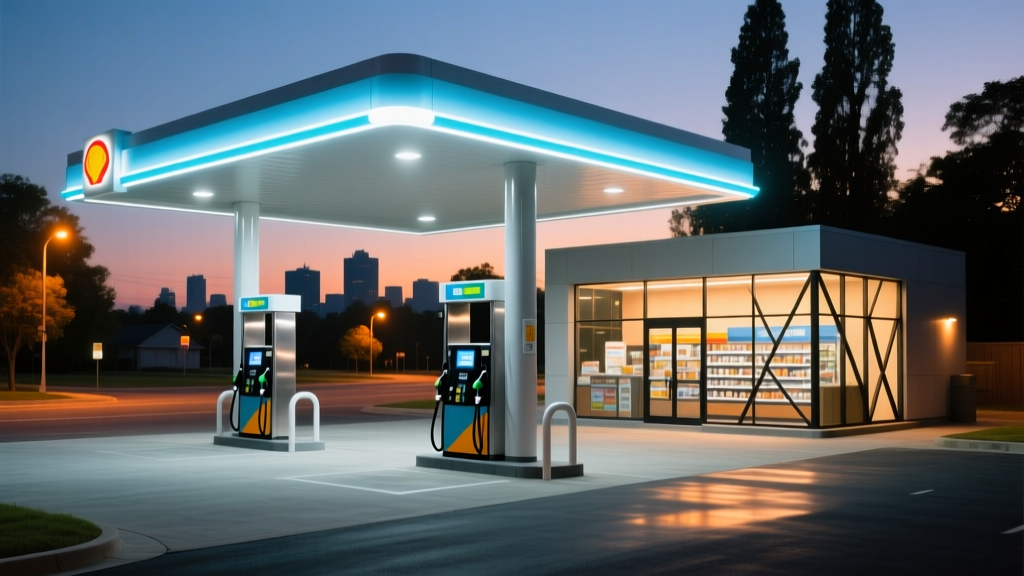
Understanding exactly how much it costs to build a gas station requires moving past industry averages and examining the specific capital expenditure (CapEx) lines that dictate your bottom line. A standard independent fueling facility with a 2,500-square-foot convenience store typically ranges from $1.8 million to $3.5 million, excluding land acquisition. However, developers who fail to value-engineer their builds frequently see costs balloon past $4.5 million due to site-work overruns and premium equipment spec sheets.
Average CapEx Breakdown (Excluding Land)
- Site Preparation & Utilities: $150,000 – $400,000
- Underground Storage Tanks (USTs) & Piping: $150,000 – $250,000
- Fuel Dispensers & Forecourt Concrete: $200,000 – $350,000
- Canopy & Lighting: $150,000 – $300,000
- Convenience Store Build-Out: $450,000 – $800,000
- Permits, Environmental & Soft Costs: $50,000 – $120,000
To protect your profit margins, you must strategically target the highest-variance categories for cost reduction without compromising regulatory compliance or customer throughput.
5 Proven Money-Saving Strategies for Gas Station Builds
1. Lease Dispensers and USTs Instead of Outright Purchase
Fuel dispensers and underground storage tanks represent a massive upfront capital sink. A standard dual-sided, multi-product dispenser (MPD) like the Gilbarco Encore or Wayne Ovation costs between $20,000 and $35,000 per unit. For a four-island, eight-dispenser site, you are looking at $160,000 to $280,000 just for the pumps. Furthermore, equipping them with EMV chip readers and media screens adds another $4,000 per unit.
The Savings Strategy: Utilize Equipment-as-a-Service (EaaS) or lease-to-own programs offered by major distributors. Leasing dispensers can reduce your Day 1 equipment CapEx by up to 70%. While you will pay a premium in monthly operational expenditure (OpEx), this preserves vital working capital for inventory and marketing during the critical first 18 months of operation. Additionally, many leasing agreements bundle preventative maintenance, shielding you from unexpected $3,000 repair bills when a mainboard or hydraulic motor fails.
2. Opt for Prefabricated Modular Convenience Stores
Stick-built convenience stores are subject to volatile labor costs, weather delays, and material shortages. A traditional masonry and steel c-store takes 6 to 9 months to complete and costs between $200 and $275 per square foot.
The Savings Strategy: Commission a prefabricated modular convenience store. Companies specializing in commercial modular construction can deliver a fully finished, plumbed, and wired c-store to your pad in 12 to 16 weeks. The cost drops to $140 to $180 per square foot. Because the modules are built in climate-controlled factories, material waste is reduced by up to 30%, and you can begin generating fuel and inside sales months earlier, drastically improving your project's internal rate of return (IRR).
3. Value-Engineer the Canopy and Forecourt Concrete
Over-engineering the forecourt is a common trap for first-time developers. Standard canopy clearance is 14 to 16 feet, which easily accommodates passenger vehicles, SUVs, and standard pickup trucks. If you arbitrarily increase the canopy height to 20 feet to accommodate commercial box trucks—without a confirmed demographic need or a dedicated truck-diesel lane—you will add $35,000 to $50,000 in structural steel, heavier column foundations, and taller fascia costs.
The Savings Strategy: Stick to a 14-foot to 16-foot clearance for standard retail sites. For the forecourt concrete, specify an 8-inch to 10-inch thick Portland cement slab with a minimum compressive strength of 4,000 PSI. Instead of using traditional welded wire mesh for reinforcement, specify macro-synthetic fibers (such as Fibermesh). Fiber reinforcement is mixed directly into the concrete truck, eliminating the labor cost of tying and placing wire mesh. This reduces slab labor costs by 12% to 15% while providing superior resistance to plastic shrinkage cracking and freeze-thaw cycles.
4. Strategic Franchise Partnerships to Offset CapEx
Building an independent site gives you total margin control, but you bear 100% of the construction risk. Major fuel brands and c-store franchises (like 7-Eleven, Circle K, or Chevron) often have aggressive expansion budgets.
The Savings Strategy: Negotiate a co-op build-out or a franchise subsidy. In exchange for signing a 10- to 15-year fuel supply agreement and adopting their proprietary point-of-sale (POS) system, the franchisor may pay for the canopy, the dispensers, or the exterior branding. According to the National Association of Convenience Stores (NACS), branded sites often see a 15% to 20% uplift in initial fuel volume compared to unbranded independents, which can offset the slightly lower per-gallon margin you surrender to the supplier.
5. Pre-Emptive Environmental Due Diligence
The single fastest way to bankrupt a gas station development project is discovering soil or groundwater contamination after closing on the land. Remediating a historical dry-cleaning solvent plume or an old leaking underground storage tank (LUST) can easily cost $500,000 to $2 million.
The Savings Strategy: Never skip a Phase I Environmental Site Assessment (ESA), which typically costs $2,500 to $4,500. If the Phase I identifies Recognized Environmental Conditions (RECs), commission a Phase II subsurface investigation before finalizing the land purchase. Furthermore, ensure your tank installation strictly adheres to EPA's Underground Storage Tank (UST) regulations, utilizing double-wall fiberglass tanks (like those from Containment Solutions or Xerxes) with secondary containment sumps. This prevents future leaks and qualifies you for state UST trust funds, which cover cleanup costs if a breach ever occurs.
Cost Comparison Matrix: Independent vs. Franchise Build-Out
Choosing your operational model fundamentally alters your construction budget and long-term cash flow. Below is a comparative framework for a standard 6-dispenser, 2,500 sq. ft. facility.
| Cost & Metric Category | Independent Build | Major Brand Franchise |
|---|---|---|
| Initial CapEx (Excluding Land) | $2.2M - $3.0M | $1.4M - $2.1M (Subsidized) |
| Canopy & Dispenser Costs | Developer pays 100% | Franchisor covers 50-100% |
| Inside C-Store Merchandise Margin | 35% - 45% (Keep 100%) | 30% - 40% (Split/Royalties) |
| Fuel Margin Control | 100% Control (High Risk) | Fixed/Split (Lower Risk) |
| POS System Integration | $15k - $25k (自选) | Mandated by Brand (Subsidized) |
Financing Your Build: SBA 504 and Equipment Leasing
Traditional commercial real estate loans for gas stations often require 25% to 30% down payments due to the perceived environmental risk and specialized nature of the improvements. This ties up $500,000 to $900,000 in illiquid equity.
To preserve cash, utilize the SBA 504 loan program. The SBA 504 structure allows owner-occupied commercial projects to be financed with as little as 10% down. The capital stack is split: a traditional bank provides a 50% first mortgage, a Certified Development Company (CDC) provides a 40% second mortgage backed by the SBA, and the developer provides the 10% equity injection. This drastically reduces your barrier to entry and leaves cash reserves for the high-cost convenience store inventory and initial payroll.
Common Budget Killers to Avoid
⚠️ Warning: Department of Transportation (DOT) Access Permits
Do not purchase land without a secured DOT access permit. If your site requires a dedicated deceleration lane, a median cut, or a traffic signal installation to accommodate fueling traffic, the state can force you to pay for the civil engineering and roadwork. A mandatory left-turn lane or traffic light installation can instantly add $150,000 to $400,000 to your site-work budget and delay your opening by 6 to 12 months.
Another frequent budget killer is underestimating the cost of utility tie-ins. Gas stations require massive electrical loads to power canopy lighting, cooler compressors, and fuel pumps simultaneously. If the local grid requires a new transformer or a 3-phase power line extension from a distant pole, utility companies will pass the $40,000 to $80,000 infrastructure cost directly to you. Always verify 3-phase power availability at the property line before closing the land deal.
Action Plan for Developers
- Secure the Land Conditionally: Execute a purchase agreement with a 90-day due diligence contingency specifically for Phase I ESA, DOT access permits, and utility capacity verification.
- Run the Modular vs. Stick-Built Matrix: Get quotes from both local commercial contractors and national modular c-store builders to compare true timeline-to-revenue metrics.
- Lock in Equipment Leases: Negotiate EaaS contracts for your MPDs and POS systems (like Verifone Commander or NCR Ruby) to keep Day 1 CapEx under $1.8 million.
- Value-Engineer the Slab: Work with your civil engineer to specify fiber-reinforced 4,000 PSI concrete for the forecourt, eliminating wire mesh labor costs.
By shifting your focus from premium aesthetic overbuilds to operational efficiency and strategic capital structuring, you can build a highly profitable, compliant fueling facility while keeping millions of dollars in your working capital reserves.
Written by
James ThorntonJames Thornton is a construction industry veteran with 25 years of hands-on experience in wood framing, lumber grading, and residential building codes. He started as a framing carpenter in rural Oregon, earned his ICC Residential Building Inspector certification, and eventually became a senior plan reviewer for the City of Portland Bureau of Development Services. James holds a B.S. in Wood Science & Technology from Oregon State University and is a certified lumber grader through the West Coast Lumber Inspection Bureau (WCLIB). He has inspected over 3,000 residential construction sites and authored the city's internal guide on advanced framing techniques (2x6 at 24" O.C.). James lives in Bend, OR, where he builds custom timber-frame cabins and competes in lumberjack sports.
More from James Thornton
View all
Insulation
Best Home Insulation Materials: Complete 2026 Guide
Compare top home insulation materials for 2026. Find R-values, installed costs per square foot, and best uses for fiberglass, spray foam, and mineral wool.
Aug 4, 2026

Sustainable Building
Certify Your Green Building Material for LEED and WELL
Step-by-step guide to certifying a green building material for LEED v5 and WELL v2. Master EPDs, HPDs, and VOC limits for 2026 project specifications.
Aug 4, 2026

Stone & Masonry
Veneer Stacked Stone Panels: Interior Design & Style Showcase
Discover how veneer stacked stone panels transform interiors. Explore modern design profiles, material pairings, and technical installation specs.
Aug 4, 2026