How Much Would It Cost to Build a Pond? Regional Price Guide
Discover how much it would cost to build a pond in your region. Breakdowns of excavation, liners, and filtration costs across the US for 2026.

Calculating the True Cost of Pond Construction
When homeowners and property managers ask, "how much would it cost to build a pond?", the answer requires looking far beyond the simple volume of dirt removed. While a basic 10x12 foot backyard water garden might start around $3,500, a fully engineered 1-acre agricultural or recreational lake easily exceeds $45,000. The final invoice is dictated by a complex interplay of regional labor rates, subsurface soil mechanics, liner technology, and local environmental permitting. This 2026 regional price analysis breaks down the exact material and labor multipliers you need to build an accurate budget, whether you are installing a compact koi habitat or excavating a sprawling irrigation reservoir.
Regional Excavation and Labor Rate Matrix
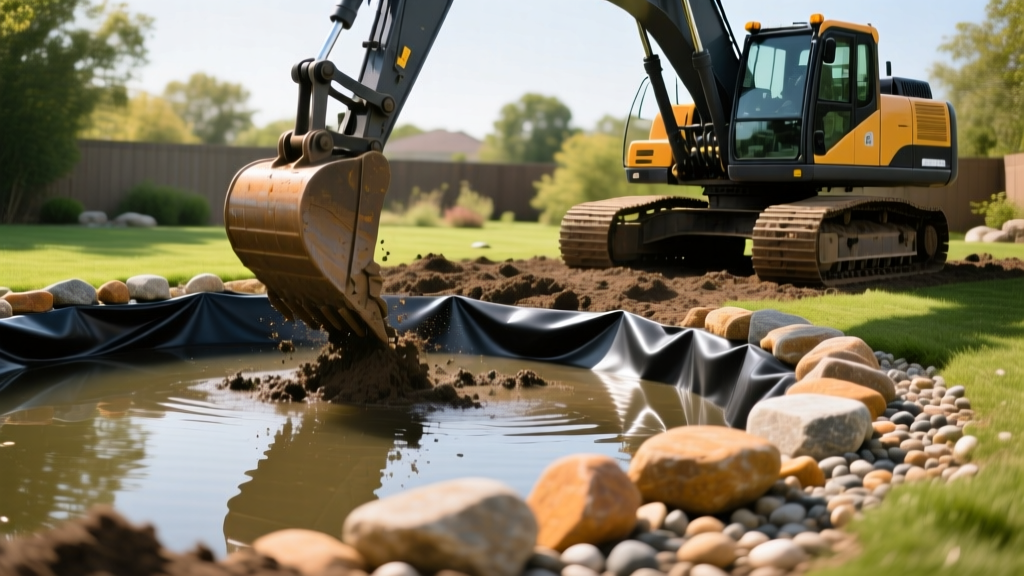
Earthmoving is the single largest variable in pond construction. Heavy equipment operators typically charge by the hour, but regional demand, fuel surcharges, and terrain difficulty create massive price disparities across the United States. Below is the current 2026 baseline for excavator rental with an operator, specifically applied to water feature excavation.
| US Region | Avg. Hourly Rate (Mini-Excavator) | Avg. Hourly Rate (Full-Size Excavator) | Primary Cost Driver |
|---|---|---|---|
| Northeast | $165 - $210 | $280 - $350 | Glacial till, bedrock, high disposal fees |
| Southeast | $130 - $160 | $220 - $275 | Sandy soils requiring imported clay, high water table |
| Midwest | $140 - $180 | $240 - $290 | Heavy clay (ideal for sealing), agricultural demand |
| West / Mountain | $175 - $225 | $300 - $380 | Rock excavation, strict EPA runoff permitting |
Pro Tip: If your site requires a hydraulic hammer attachment to break through shale or limestone (common in the Ozarks and Northeast), expect an equipment surcharge of $400 to $600 per day, plus accelerated wear-and-tear hourly rates.
Pond Liner Materials: Pricing and Lifespan Comparison
Unless you are blessed with a perfect, undisturbed heavy clay basin, you will need a synthetic or chemical liner to retain water. Choosing the wrong liner for your soil type is the most common cause of catastrophic water loss. According to Penn State Extension, proper liner selection must account for subsurface root intrusion and UV degradation.
1. EPDM Rubber (45-mil to 60-mil)
- Cost: $0.65 - $0.95 per square foot (material only).
- Lifespan: 25 to 40 years.
- Best Application: Backyard koi ponds, water gardens, and irregularly shaped ecosystem ponds. EPDM (like Firestone PondGard) remains highly flexible in freezing temperatures and conforms perfectly to complex shelving for aquatic plants.
2. Sodium Bentonite Clay
- Cost: $0.35 - $0.55 per square foot (installed).
- Lifespan: Indefinite (if undisturbed).
- Best Application: Large agricultural ponds and lakes (1/2 acre+). Bentonite swells when wet, creating an impermeable seal. However, it requires a specific sand-to-clay base ratio to work; applying it over pure gravel will result in total failure.
3. Reinforced Polyethylene (RPE)
- Cost: $0.80 - $1.20 per square foot.
- Lifespan: 20+ years.
- Best Application: High-traffic areas, ponds with aggressive root systems, or regions with extreme temperature swings. RPE is significantly lighter and stronger than EPDM but lacks the same elasticity, requiring precise subgrade preparation.
Never install EPDM or RPE directly on bare soil. A non-woven geotextile underlayment (typically 4oz to 6oz weight) is mandatory to prevent punctures from subsurface rocks and roots. Budget an additional $0.25 to $0.35 per square foot for high-quality underlayment.
Hidden Cost Drivers: Soil Percolation and Filtration
Answering the question of how much it would it cost to build a pond accurately requires factoring in the invisible infrastructure beneath and around the water line.
The Percolation Test Factor
Before finalizing your excavation bid, conduct a soil percolation test. If your soil drains at a rate faster than 1 inch per hour, you cannot rely on natural clay sealing. You will be forced to either truck in engineered clay (costing $25 to $45 per cubic yard delivered and spread) or utilize a synthetic liner. As noted by Texas A&M AgriLife Extension, failing to test soil permeability before excavation often doubles the final project cost due to emergency liner purchases.
Filtration and Circulation Budgets
A stagnant pond becomes an algae-filled liability within months. Your filtration budget depends entirely on the pond's biological load.
- Ecosystem / Water Garden (Low Fish Load): A constructed wetland or bog filter utilizing gravel, beneficial bacteria, and marginal plants costs between $1,200 and $2,500 to plumb and plant. This provides natural biological filtration with minimal electrical overhead.
- Dedicated Koi Pond (High Fish Load): Koi produce massive amounts of ammonia. You will need a pressurized bead filter or a gravity-fed drum filter (e.g., Oase ProfiClear or Sievers systems), paired with a high-capacity UV clarifier and a bottom drain. Expect to spend $4,500 to $8,500 on the mechanical and biological filtration loop alone.
Permitting, Riparian Rights, and Legal Fees
You cannot simply dig a hole and fill it with water if your property interacts with municipal drainage or natural wetlands. Under the EPA Clean Water Act Section 404, discharging dredged or fill material into Waters of the United States (WOTUS) requires federal permitting. If your planned pond connects to a seasonal creek, a wetland, or a municipal storm drain, you must hire an environmental consultant to conduct a jurisdictional determination.
- Standard Municipal Grading Permit: $150 - $600 (Required for moving more than 50 cubic yards of soil in most suburban zones).
- State Environmental / DNR Review: $500 - $1,500 (Required if damming a natural watercourse or building a pond over 1 acre).
- Wetland Delineation & Mitigation: $3,000 - $10,000+ (Required if impacting protected wetlands; includes consultant fees and potential off-site mitigation banking).
Step-by-Step Budgeting Framework
To finalize your estimate, use this sequential framework to calculate your specific project costs:
- Define Volume and Footprint: Calculate the total square footage of the surface area, plus the square footage of all vertical walls and shelving. Add 15% for overlap and anchoring trenches.
- Calculate Earthmoving: Multiply the total cubic yards of soil to be removed by your regional excavator rate. Add 20% for soil compaction and swelling (fluff factor).
- Select and Price Liner: Multiply the adjusted square footage by your chosen liner and underlayment cost per square foot.
- Add Plumbing and Filtration: Price your pump, PVC plumbing, skimmers, and biological filters based on the required gallons-per-hour (GPH) turnover rate.
- Factor in Edging and Hardscape: Natural stone coping, boulders, and gravel typically add $15 to $35 per linear foot of pond perimeter.
- Apply the Contingency Multiplier: Always add a 15% contingency fund to cover unforeseen subsurface obstacles, such as buried utilities, unmapped bedrock, or high water table dewatering requirements.
By methodically applying regional labor rates and material-specific multipliers, you can transition from a vague guess to a highly accurate, contractor-ready construction budget.
Written by
David NakamuraDavid Nakamura is a licensed architect (AIA) and construction technology writer focused on sustainable building methods, mass timber engineering, and high-performance building envelopes. He holds a Master of Architecture from the University of Washington and is a certified Passive House Consultant (CPHC). David spent eight years at the Seattle firm Mithun, where he led the design of three LEED Platinum projects, before founding his own practice specializing in net-zero residential design. He serves on the editorial advisory board of GreenBuilder Magazine and has authored peer-reviewed papers on cross-laminated timber (CLT) connections for the Journal of Structural Engineering. In his spare time, David teaches woodworking at Pratt Fine Arts Center and kayaks the Puget Sound.
More from David Nakamura
View all
Construction Cost
Labor Cost to Build a Deck Per Sq Ft: 2026 Installation Guide
Discover the exact labor cost to build a deck per sq ft in 2026. This installation guide breaks down contractor rates, complexity factors, and hidden fees.
Aug 4, 2026

Construction Cost
How Much Does It Cost to Build a 3 Bedroom House? Financing Guide
Learn exactly how much it costs to build a 3 bedroom house and explore 2026 financing options, construction loan types, and budget frameworks for your build.
Aug 4, 2026

Construction Cost
Cost to Build a Tennis Court: 2026 Guide
How much does it cost to build a tennis court in 2026? Breakdowns for asphalt, concrete, and synthetic surfaces plus fencing and lighting.
Jul 30, 2026