How Much Would It Cost to Build a Golf Course? A Detailed Breakdown
Discover how much it costs to build a golf course. Detailed breakdown of earthmoving, irrigation, turf, and design fees for 18-hole championship layouts.

The Financial Reality of Golf Course Development
When developers and municipalities ask how much would it cost to build a golf course, the answer requires moving beyond generic per-acre estimates. Constructing an 18-hole championship golf course in 2026 typically ranges from $14 million to $28 million, excluding land acquisition and clubhouse structures. For a 9-hole executive layout, costs generally fall between $4.5 million and $8 million.
Executive Summary: 18-Hole Championship Cost Matrix
| Development Phase | Estimated Cost Range | Percentage of Budget |
|---|---|---|
| Design & Engineering | $800,000 - $1,500,000 | 5% - 8% |
| Earthmoving & Shaping | $2,500,000 - $4,500,000 | 20% - 25% |
| Irrigation & Drainage | $2,000,000 - $3,200,000 | 15% - 18% |
| Agronomy & Turfgrass | $1,800,000 - $2,800,000 | 12% - 15% |
| Bunkers & Hardscapes | $1,500,000 - $2,500,000 | 10% - 12% |
| Maintenance Facility | $1,200,000 - $2,000,000 | 8% - 10% |
Phase 1: Pre-Construction, Design, and Permitting
The foundation of any successful project begins with an American Society of Golf Course Architects (ASGCA) member or equivalent master planner. Architect fees are rarely flat rates; they are typically structured as a percentage of total construction costs (5% to 8%) or a milestone-based flat fee ranging from $800,000 to $1.5 million.
Engineering and Environmental Permitting
Before a single blade of grass is planted, you must invest in topographical surveys, geotechnical soil borings, and hydrological studies. Environmental permitting, particularly if the site intersects with wetlands or protected habitats, can add $150,000 to $350,000 in consulting and mitigation fees. Water rights acquisition and well-drilling permits can add another $100,000+ depending on the municipality.
Phase 2: Earthmoving, Shaping, and Drainage
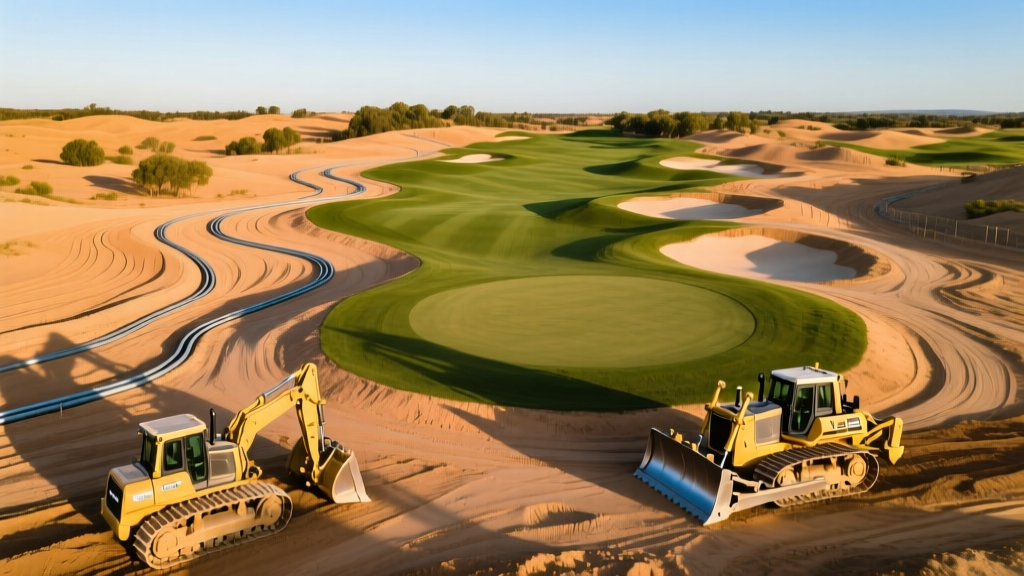
Earthwork is the most capital-intensive phase of golf course construction. An 18-hole course typically requires moving 500,000 to 1.2 million cubic yards of soil. At current heavy equipment rates, bulk earthmoving costs $3.50 to $6.00 per cubic yard.
- Rough Grading: Utilizing GPS-guided CAT D8 bulldozers to establish primary landforms and drainage swales. Cost: $1.2M - $1.8M.
- Fine Shaping: Skilled operators using excavators and motor graders to sculpt green complexes, tees, and bunker faces. Cost: $800k - $1.5M.
- Subsurface Drainage: Installing 4-inch perforated PVC pipes surrounded by gravel envelopes in low-lying areas and fairway landing zones to prevent waterlogging. Cost: $400k - $700k.
Critical Edge Case: If the site features expansive clay soils, you will need to import hundreds of thousands of tons of sandy loam topsoil to ensure proper percolation. Importing soil at $25-$40 per ton can easily double your earthmoving budget.
Phase 3: Irrigation and Infrastructure
Modern golf course irrigation is a highly engineered network. According to industry standards tracked by the National Golf Foundation (NGF), water efficiency is now the primary driver of system design. Expect to spend between $2 million and $3.2 million on a championship-grade system.
The Pump Station: The Heart of the System
A Variable Frequency Drive (VFD) pump station with three to four 100-HP vertical turbine pumps, housed in a climate-controlled concrete block building, costs between $250,000 and $400,000. This system maintains constant pressure while adjusting to the exact number of active sprinkler heads, saving up to 30% on energy costs compared to older constant-speed models.
Smart Sprinkler Heads and Piping
High-end systems utilize individually controlled heads (like the Rain Bird IC Series or Toro Infinity) connected via a two-wire decoder system. This allows the superintendent to water a single dry spot on a green without wetting the surrounding collar.
Material breakdown:
- Mainline PVC piping (8" to 12"): $450,000
- Lateral lines and decoder cables: $600,000
- 1,500 to 2,200 individual smart heads: $900,000 to $1.3M
- Central control software and weather stations: $80,000
Phase 4: Agronomy, Turfgrass, and Bunkers
The agronomic phase transforms dirt into a playable surface. The USGA Green Section provides strict guidelines for rootzone construction, which heavily influences costs in this phase.
Green and Tee Construction (USGA Spec)
Championship greens are built, not grown. The USGA specification requires a 12-inch gravel drainage layer, a 2-inch choker layer (coarse sand), and a 12-inch rootzone mix (typically 80% washed silica sand and 20% sphagnum peat moss).
Cost per green: $45,000 to $75,000. For 18 greens plus 3 practice greens, budget $1.1 million.
Turfgrass Seeding and Sodding
- Greens: Creeping Bentgrass (e.g., Penn A-4 or 007) seeded at 2 lbs per 1,000 sq ft. Cost: $120,000.
- Fairways and Tees: Bermudagrass (warm climates) or Kentucky Bluegrass/Perennial Ryegrass (cool climates). Sprigging Bermudagrass costs $1,500 per acre, while sodding fairways can cost $25,000 per acre. Total fairway turf budget: $600,000 to $1.2M.
- Roughs: Hydroseeded with native fescues or drought-tolerant blends. Cost: $150,000.
Bunker Construction: The Capillary Concrete Method
The industry has largely abandoned traditional gravel-lined bunkers due to washouts and drainage failures. The modern standard is the capillary concrete method (e.g., Better Billy Bunker). This involves spraying a 4-inch layer of porous polymer-bound aggregate over the bunker floor, topped with 6 inches of high-quality washed silica sand.
Cost: $16,000 to $22,000 per bunker. For a course with 65 bunkers, expect to spend roughly $1.2 million.
Phase 5: Hardscapes, Cart Paths, and Maintenance
Cart Paths and Bridges
An 18-hole course requires approximately 4 to 6 miles of cart paths. A 12-foot wide, 4-inch thick steel-troweled concrete path with a broom finish costs $65 to $85 per linear foot installed.
Total cart path cost: $1.4M to $1.8M. Add $150,000 to $300,000 for pedestrian and golf cart bridges over water hazards.
The Maintenance Facility
A fully equipped maintenance complex is non-negotiable. This includes a 10,000 sq ft steel building with climate-controlled bays for equipment storage, a chemical/fertilizer containment room (EPA compliant), a fuel island, and a wash pad with an oil/water separator. Budget $1.5 million for the building, plus $600,000 for the initial fleet of mowers, tractors, and utility vehicles.
Warning: The Grow-In Period
Construction costs do not end when the grass is planted. The 'grow-in' period takes 6 to 9 months. During this time, you must pay for intensive irrigation, daily fertilization, and a full maintenance crew without generating a single dollar in green fee revenue. Budget an additional $400,000 to $600,000 in operating capital to sustain the course through its first year.
Frequently Asked Questions
Can I build a golf course for under $10 million?
Only if you are building a 9-hole par-3 or executive course, or if you are executing a minimalist design on a naturally sandy, open site (like a links course) that requires minimal earthmoving and no complex subsurface drainage. A full 18-hole championship course for under $10M is virtually impossible in the current economic climate due to equipment, labor, and material costs.
How much does it cost to maintain a golf course annually?
Annual maintenance budgets for an 18-hole private or high-end daily fee course range from $1.2 million to $2.5 million. This covers labor (the largest expense), water, chemicals, fertilizers, fuel, and equipment leasing.
What is the ROI timeline for a newly built golf course?
Golf course development is a long-term real estate play rather than a quick-yield business. Standalone courses often take 10 to 15 years to reach operational break-even. The highest ROI is typically realized when the course is used as an amenity to drive premium pricing for adjacent residential real estate developments.
Written by
David NakamuraDavid Nakamura is a licensed architect (AIA) and construction technology writer focused on sustainable building methods, mass timber engineering, and high-performance building envelopes. He holds a Master of Architecture from the University of Washington and is a certified Passive House Consultant (CPHC). David spent eight years at the Seattle firm Mithun, where he led the design of three LEED Platinum projects, before founding his own practice specializing in net-zero residential design. He serves on the editorial advisory board of GreenBuilder Magazine and has authored peer-reviewed papers on cross-laminated timber (CLT) connections for the Journal of Structural Engineering. In his spare time, David teaches woodworking at Pratt Fine Arts Center and kayaks the Puget Sound.
More from David Nakamura
View all
Construction Cost
Labor Cost to Build a Deck Per Sq Ft: 2026 Installation Guide
Discover the exact labor cost to build a deck per sq ft in 2026. This installation guide breaks down contractor rates, complexity factors, and hidden fees.
Aug 4, 2026

Construction Cost
How Much Does It Cost to Build a 3 Bedroom House? Financing Guide
Learn exactly how much it costs to build a 3 bedroom house and explore 2026 financing options, construction loan types, and budget frameworks for your build.
Aug 4, 2026

Construction Cost
Cost to Build a Tennis Court: 2026 Guide
How much does it cost to build a tennis court in 2026? Breakdowns for asphalt, concrete, and synthetic surfaces plus fencing and lighting.
Jul 30, 2026