How Much Did It Cost to Build the Hoover Dam? Cost-Saving Lessons
Discover how much it cost to build the Hoover Dam and explore the historical money-saving strategies that modern construction estimators can apply today.

The True Price Tag: How Much Did It Cost to Build the Hoover Dam?
When analyzing historical megaprojects to extract modern value engineering principles, one question inevitably arises: how much did it cost to build the Hoover Dam? The original construction contract, awarded in 1931 to Six Companies, Inc., was precisely $48,890,995. Adjusted for inflation to 2026 dollars, that equates to roughly $1.15 billion. For context, a modern dam of similar scale and complexity—factoring in current environmental impact studies, OSHA safety compliance, and prevailing wage laws—would easily exceed $5 billion to $8 billion today.
However, the raw number is less important to modern cost estimators than the methodology behind it. The Hoover Dam was completed two years ahead of schedule and came in under its original budget. This was not an accident; it was the result of aggressive logistical foresight, innovative material science, and risk-sharing structures. By deconstructing these historical money-saving strategies, modern construction estimators can apply these exact levers to reduce overhead on today's large-scale commercial and infrastructure bids.
| Cost Category | 1936 Actual Cost | 2026 Adjusted Estimate | Modern Equivalent Strategy |
|---|---|---|---|
| Base Construction Contract | $48,890,995 | ~$1.15 Billion | Joint-Venture Risk Pooling |
| Concrete Materials (3.25M yd³) | ~$15,000,000 | ~$350 Million | Fly-Ash Substitution & Ice Batching |
| Worker Housing (Boulder City) | ~$2,500,000 | ~$58 Million | Modular Temporary Camps vs. Per Diem |
| Delay Penalties (Risk Exposure) | $3,000 / day | ~$70,000 / day | Schedule Contingency & Acceleration Clauses |
The 'Six Companies' Model: Joint Venture Risk Mitigation
No single contractor in 1931 had the financial bonding capacity or equipment fleet to tackle the Hoover Dam. The solution was the formation of Six Companies, Inc., a joint venture (JV) of six major construction firms. This was not merely a partnership; it was a masterclass in risk allocation and overhead reduction.
Modern Application for Estimators
When estimating projects in the $100M+ range, single-entity bidding requires massive performance and payment bonds. Bonding premiums typically range from 1% to 2% of the total contract value. On a $500M project, that is $5M to $10M in pure overhead. By structuring a Joint Venture, estimators can distribute the financial burden across multiple balance sheets, drastically reducing the bonding premium percentage. Furthermore, JVs allow firms to share specialized equipment—such as tower cranes, batch plants, and heavy earthmovers—eliminating the need for redundant capital expenditures. When building your estimate, explicitly model a JV structure to show owners how shared mobilization costs directly lower the bottom line.
Mass Concrete Thermal Management: The Pipe Cooling Innovation
The Hoover Dam required 3.25 million cubic yards of concrete. Engineers calculated that if the dam were poured in a single continuous monolith, the heat generated by the curing process would take 125 years to dissipate, and the resulting thermal expansion and contraction would crack the structure into uselessness. The money-saving innovation was the installation of 582 miles of 1-inch steel cooling pipes embedded within the concrete blocks, circulated with river water and later chilled water from an on-site ammonia refrigeration plant.
Translating Thermal Innovation to Modern Cost Savings
Today, mass concrete thermal cracking remains a primary driver of post-construction repair costs. Unmitigated thermal cracking in modern foundations or retaining walls can lead to epoxy injection and post-tensioning repairs costing upwards of $150 per cubic yard of affected concrete. Modern estimators can borrow the Hoover Dam's proactive thermal management strategy to save money:
- Liquid Nitrogen Dosing: Instead of building multi-million-dollar on-site refrigeration plants, modern batch plants inject liquid nitrogen directly into the mix, dropping the placement temperature to the required 50°F-60°F range. Budget an additional $15 to $25 per cubic yard for LN2 cooling.
- Supplementary Cementitious Materials (SCMs): Substitute 30% to 50% of Portland cement with Class F fly ash or slag cement. This dramatically reduces the heat of hydration while lowering the raw material cost per yard by $10 to $18.
- Embedded Cooling Pipes: For ultra-mass pours (over 10 feet thick), HDPE piping networks connected to temporary chillers remain the most cost-effective method, saving millions in future structural remediation.
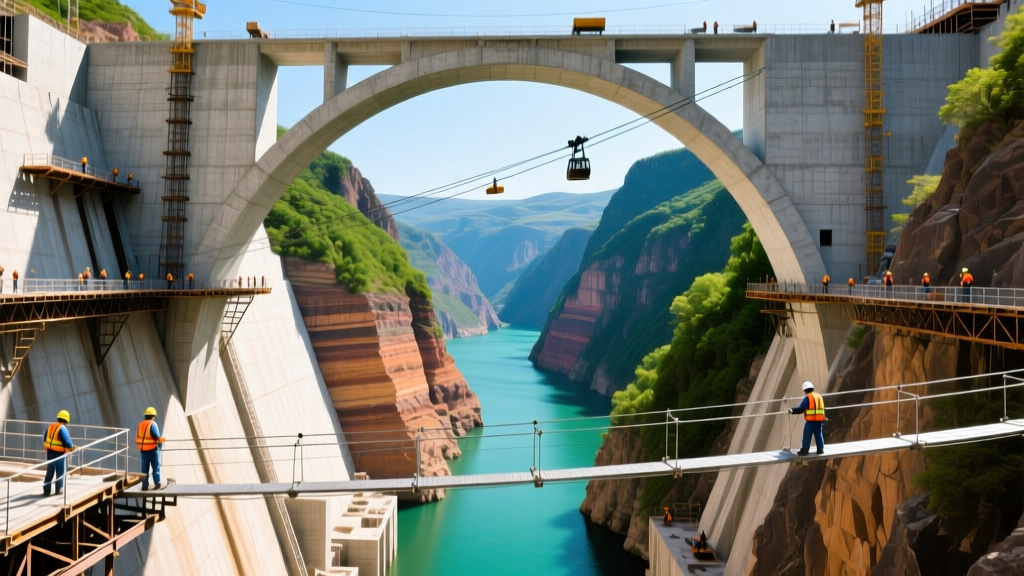
Logistics and On-Site Infrastructure: The Boulder City Solution
The dam site was located in a barren, unforgiving desert with no existing infrastructure to support a workforce of 5,000 men. Rather than paying exorbitant daily travel per diems or suffering the productivity losses of long commutes, the government and contractors built Boulder City from scratch. According to the Bureau of Reclamation, this purpose-built municipality provided housing, dining, and medical facilities directly adjacent to the work site.
Modern Remote Site Logistics
For modern remote infrastructure projects—such as wind farms, data centers, or highway expansions—estimators often default to standard per diem and hotel rates. This is a costly mistake. Hotel rates fluctuate, and commute times destroy billable hours. The modern equivalent of Boulder City is the modular temporary workforce camp.
When estimating remote projects lasting longer than 8 months, price out a modular camp facility. Leasing, transporting, and operating a 500-bed modular camp typically costs between $45 and $65 per worker, per day (inclusive of catering and utilities). Compare this to the current 2026 average rural hotel rate of $130/night plus $60/day in meals and travel time, and the modular camp yields a 40% to 50% savings on indirect labor logistics, while drastically improving shift punctuality and site safety.
Actionable Money-Saving Frameworks for Modern Megaprojects
The American Society of Civil Engineers recognizes the Hoover Dam as a landmark of civil engineering, but its financial structuring is equally monumental. To apply these historical lessons to your next major bid, implement the following framework:
- Audit the Delay Penalties: The Hoover Dam contract carried a $3,000/day penalty for delays. Today's liquidated damages (LDs) can exceed $50,000/day. Never estimate a schedule without pricing acceleration contingencies (e.g., overtime, extra formwork sets) against the probability-weighted cost of the LDs.
- Centralize Material Production: Just as the Hoover Dam utilized on-site aggregate crushing and concrete batching, modern estimators should price temporary on-site batch plants for projects requiring over 50,000 cubic yards of concrete. The capital cost of the plant is quickly offset by the elimination of transit-mix delivery premiums and traffic delay risks.
- Invest in Early Access Infrastructure: The Hoover Dam builders invested heavily in early access roads and rail lines before the main pour began. In your estimate, front-load the budget for heavy-duty temporary access roads. Skimping on access roads leads to equipment undercarriage wear, mud-related delays, and crane mobilization failures that cost far more than the initial gravel and geotextile investment.
Frequently Asked Questions
Did the Hoover Dam construction actually make a profit?
The construction itself was a cost-recovery project funded by the federal government. However, the project was completed under its $48.9 million contract budget. The dam's hydroelectric power generation was designed to pay back the original construction costs with interest over 50 years, a financial model that successfully retired the debt by 1987.
How does the inflation-adjusted cost of the Hoover Dam compare to modern dams?
At roughly $1.15 billion in 2026 dollars, the Hoover Dam is significantly cheaper than modern equivalents. For comparison, the New Melones Dam in California, completed in 1979, cost over $1.5 billion in today's dollars despite generating a fraction of the Hoover Dam's power output. The difference lies in modern environmental compliance, land acquisition costs, and stringent seismic safety requirements that did not exist in the 1930s.
What was the most expensive single material on the Hoover Dam?
Cement was the most expensive and logistically complex material. The project required millions of barrels of cement. To save money and ensure supply, the government negotiated direct purchases with cement manufacturers, bypassing traditional middlemen, a strategy modern estimators use today via 'owner-furnished' or 'contractor-furnished' direct-purchase agreements for bulk commodities like steel and cement.
Written by
James ThorntonJames Thornton is a construction industry veteran with 25 years of hands-on experience in wood framing, lumber grading, and residential building codes. He started as a framing carpenter in rural Oregon, earned his ICC Residential Building Inspector certification, and eventually became a senior plan reviewer for the City of Portland Bureau of Development Services. James holds a B.S. in Wood Science & Technology from Oregon State University and is a certified lumber grader through the West Coast Lumber Inspection Bureau (WCLIB). He has inspected over 3,000 residential construction sites and authored the city's internal guide on advanced framing techniques (2x6 at 24" O.C.). James lives in Bend, OR, where he builds custom timber-frame cabins and competes in lumberjack sports.
More from James Thornton
View all
Insulation
Best Home Insulation Materials: Complete 2026 Guide
Compare top home insulation materials for 2026. Find R-values, installed costs per square foot, and best uses for fiberglass, spray foam, and mineral wool.
Aug 4, 2026

Sustainable Building
Certify Your Green Building Material for LEED and WELL
Step-by-step guide to certifying a green building material for LEED v5 and WELL v2. Master EPDs, HPDs, and VOC limits for 2026 project specifications.
Aug 4, 2026

Stone & Masonry
Veneer Stacked Stone Panels: Interior Design & Style Showcase
Discover how veneer stacked stone panels transform interiors. Explore modern design profiles, material pairings, and technical installation specs.
Aug 4, 2026