How Much Does It Typically Cost to Build a House? Cost-Saving Tips
Discover how much does it typically cost to build a house. Explore expert money-saving strategies, material swaps, and budget frameworks for your build.
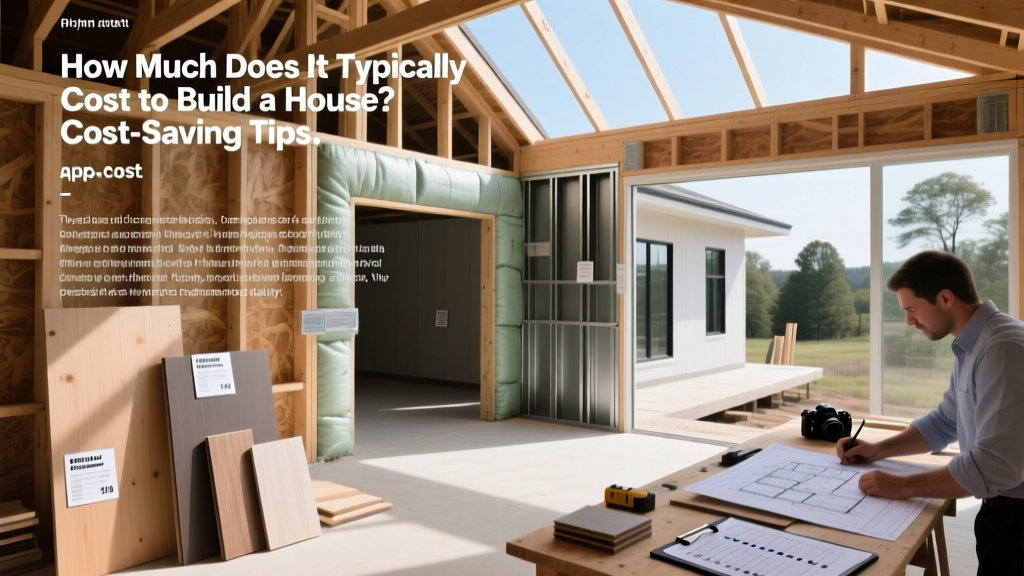
The Real Answer: How Much Does It Typically Cost to Build a House?
When evaluating residential construction, the question of how much does it typically cost to build a house does not have a single flat-rate answer. In 2026, the national average for a semi-custom, stick-built home ranges from $150 to $250 per square foot, translating to $300,000 to $500,000 for a standard 2,000-square-foot floor plan. Fully custom architectural builds routinely exceed $400 per square foot. However, these baseline figures assume standard topography, conventional material selections, and zero budget optimization.
• Pacific West & Northeast: $220 - $350+
• Mountain & Midwest: $160 - $220
• South & Southeast: $140 - $190
According to U.S. Census Bureau construction data, the median sales price of new homes continues to fluctuate based on lumber indices and local labor availability. The difference between a financially strained build and a highly optimized one lies in structural decisions made before the first shovel hits the dirt.
The 40/30/20/10 Construction Budget Breakdown
To effectively cut costs, you must understand where the capital is actually deployed. Most novice builders focus entirely on interior finishes, unaware that the shell and site work consume the lion's share of the budget. Below is the standard allocation for a mid-tier residential build.
| Phase | Budget % | Cost on a $400k Build | Primary Cost Drivers |
|---|---|---|---|
| Site Work & Foundation | 20% | $80,000 | Excavation, soil engineering, concrete, permits |
| Framing & Exterior Shell | 20% | $80,000 | Lumber package, roofing, windows, siding |
| Major Systems (MEP) | 20% | $80,000 | HVAC, plumbing, electrical, insulation |
| Interior Finishes | 30% | $120,000 | Drywall, cabinets, flooring, trim, paint |
| Final Grade & Landscaping | 10% | $40,000 | Driveway, grading, utility tap fees |
High-Impact Money-Saving Strategies (Without Sacrificing Quality)
Cutting costs does not mean buying substandard materials that will fail in five years. It means applying value engineering to reduce material waste and labor hours.
1. Optimize the Footprint (The 'Stacked Box' Rule)
The most expensive components of a house are the foundation and the roof. A 2,000-square-foot single-story ranch requires 2,000 square feet of concrete slab and 2,000 square feet of roofing. A 2,000-square-foot two-story home requires only 1,000 square feet of foundation and 1,000 square feet of roof. By building up rather than out, you instantly reduce site-work and shell costs by 15% to 20%. Keep the footprint as close to a simple rectangle as possible; every bump-out, dormer, or angled wall introduces complex framing labor and custom flashing requirements.
2. Implement Advanced Framing Techniques
Conventional framing uses 2x4 studs placed 16 inches on-center (O.C.). Transitioning to Optimum Value Engineering (OVE), or advanced framing, utilizes 2x6 studs placed 24 inches O.C. According to the U.S. Department of Energy, this method reduces lumber usage by up to 20% while allowing for thicker cavity insulation (R-21 instead of R-13). You save money on the wood package and simultaneously lower your long-term heating and cooling loads.
3. Strategic Material Swaps
Visual appeal can be maintained while drastically reducing material costs by selecting high-performance alternatives to legacy products.
| Application | Premium Choice (High Cost) | Value Swap (Budget Friendly) | Estimated Savings |
|---|---|---|---|
| Exterior Siding | James Hardie Fiber Cement | LP SmartSide Engineered Wood | 25% - 30% |
| Hardwood Flooring | Solid White Oak (Site Finished) | 20-mil Wear Layer LVP | 50% - 65% |
| Countertops | Imported Quartzite Slabs | Prefabricated Quartz | 40% - 55% |
4. Pre-Plumb and Pre-Wire for Future Additions
Tearing out finished drywall to add a basement bathroom or a garage EV charger five years from now is a financial disaster. During the rough-in phase, spend an extra $800 to $1,500 to run capped water lines, drain stubs, and 240V conduit to unfinished spaces. The labor cost to run these lines while the walls are open is a fraction of the cost to retrofit them later.
Hidden Costs That Destroy Budgets (And How to Cap Them)
Never purchase unimproved land without a perc test, soil boring report, and a written estimate for utility tap fees. Municipal water tap fees alone can range from $2,000 in rural districts to over $15,000 in high-growth suburban corridors.
Unexpected site conditions are the primary reason builds exceed their initial budgets. To mitigate this, implement the following due diligence framework before closing on a lot:
- Geotechnical Soil Report ($1,500 - $3,000): Identifies expansive clay or bedrock. Hitting bedrock during excavation can add $10,000+ in blasting or rock-breaking equipment fees.
- Topographical Survey ($800 - $1,500): Dictates retaining wall requirements. A 4-foot drop across the building pad might require a $15,000 engineered retaining wall system.
- Impact Fees & Capacity Charges: Contact the local municipality directly to ask for the exact current schedule of school, road, and park impact fees for new residential connections.
Decision Framework: Where to Splurge vs. Where to Save
Allocating capital efficiently requires knowing which components degrade rapidly if cheapened, and which components offer diminishing returns at high price points. Data from the National Association of Home Builders consistently shows that structural and envelope integrity should never be compromised.
| Category | Splurge (Do Not Cheap Out) | Save (Diminishing Returns) |
|---|---|---|
| Windows | Double-pane, Low-E, Argon-filled vinyl | Triple-pane or fiberglass frames (unless in extreme climates) |
| HVAC | 16+ SEER2 Heat Pump with variable speed | Complex multi-zone smart thermostats |
| Cabinetry | Plywood box construction, soft-close hardware | Custom hand-glazed doors (use standard Shaker MDF) |
| Roofing | Architectural asphalt shingles (30-year) | Standing seam metal (unless required by HOA or fire zone) |
Final Execution Strategy
Understanding how much does it typically cost to build a house is only the baseline. The true savings are unlocked during the bidding phase. Always solicit three distinct bids for every major trade (foundation, framing, MEP). Ensure each bid is based on the exact same architectural plans and material specification sheet. Reject any contractor who provides a vague 'allowance' for critical items like cabinets or flooring; demand fixed-price contracts with clearly defined change-order hourly rates to protect your capital from scope creep.
Written by
Marcus ChenMarcus Chen is a licensed structural engineer (PE) and building materials analyst with over 12 years of experience across residential, commercial, and industrial construction. He holds a Master of Science in Civil Engineering from UC Berkeley and spent six years at Thornton Tomasetti before transitioning to independent consulting and technical writing. Marcus specializes in material selection for seismic-prone regions, concrete reinforcement strategies, and lifecycle cost analysis. His work has been cited by the American Concrete Institute (ACI) and the Structural Engineers Association of California (SEAOC). When he is not on a job site or at his desk, you will find him hiking the Sierra Nevada or restoring a 1920s craftsman bungalow in Oakland, CA.
More from Marcus Chen
View all
Construction Cost
How Much Did the Eiffel Tower Cost to Build?
How much did the Eiffel Tower cost to build in 1889? We adjust for inflation and compare its budget to modern skyscraper construction.
Aug 4, 2026

Fire Resistance
What Is a Fire Resistant Material? Testing & Certification Guide
Discover what is a fire resistant material through ASTM and UL testing. Learn how fire ratings, certifications, and assemblies work in construction.
Aug 4, 2026

Construction Cost
How Much Did the Burj Khalifa Cost to Build?
How much did the Burj Khalifa cost to build? We break down the $1.5B project and extract 5 money-saving strategies for your next build.
Jul 30, 2026