How Much Does It Cost to Build a Hydro Dam? A Detailed Breakdown
Discover exactly how much it costs to build a hydro dam. Detailed pricing for micro, small, and utility-scale hydroelectric projects by component.

The Economics of Water Power: Understanding Dam Scale
Calculating the capital expenditure for hydroelectric infrastructure requires abandoning a one-size-fits-all approach. The financial reality of water power is dictated entirely by scale, topography, and hydrological flow. When stakeholders ask how much it costs to build a hydro dam, the answer spans from $150,000 for a rural micro-hydro setup to over $5 billion for a utility-scale mega dam. According to the U.S. Department of Energy Water Power Technologies Office, the defining metric for hydro construction is the cost per installed kilowatt ($/kW), which fluctuates wildly based on the civil engineering required to harness a specific river's kinetic energy.
• Micro-Hydro (5–100 kW): $4,000 – $8,500 / kW
• Small-Scale (100 kW–10 MW): $3,000 – $6,500 / kW
• Utility-Scale (>10 MW): $2,500 – $5,500 / kW
Note: Mega-projects exceeding 500 MW frequently experience scope creep, pushing effective costs above $7,000/kW due to complex environmental mitigation and population resettlement.
Detailed Cost Breakdown by Dam Classification
Micro-Hydropower Systems (5 kW to 100 kW)
Micro-hydro systems rarely require massive impoundment dams. Instead, they utilize "run-of-river" designs with small diversion weirs. For a 50 kW system capable of powering a large agricultural facility or a small off-grid community, expect total project costs between $200,000 and $425,000. The primary expense here is not the dam itself, but the penstock (the pipeline carrying water to the turbine) and the custom electromechanical equipment. Because these systems lack economies of scale, the per-kW cost is the highest in the industry. A 500-foot run of 12-inch Schedule 40 steel penstock alone can consume 15% of the total budget, costing upwards of $35,000 installed.
Small-Scale Hydroelectric Dams (100 kW to 10 MW)
Small hydro represents the sweet spot for municipal power and private industrial investment. A 2 MW facility utilizing an earthfill or concrete gravity dam typically costs between $6 million and $13 million. At this scale, civil works become a dominant factor. You are no longer just diverting water; you are building a reservoir, which necessitates spillway engineering, upstream fish passage ladders, and sediment flushing gates. Roller-compacted concrete (RCC) is the standard material for small-to-medium gravity dams, currently pricing between $140 and $190 per cubic yard in place, depending on aggregate availability and site access.
Utility-Scale and Mega Dams (10 MW to 1,000+ MW)
Utility-scale dams are multi-year, billion-dollar mega-projects. The International Hydropower Association (IHA) notes that while the $/kW ratio drops as capacity increases, the absolute capital required is staggering. A 100 MW dam will cost between $250 million and $550 million. These projects require massive earthmoving operations, cofferdams to divert the river during construction, and high-voltage switchyards. For mega-dams (like the 22,500 MW Three Gorges Dam or the 16,000 MW Belo Monte), costs are heavily skewed by "soft costs"—specifically, the relocation of local populations and the construction of entirely new highway and rail infrastructure to support the construction site.
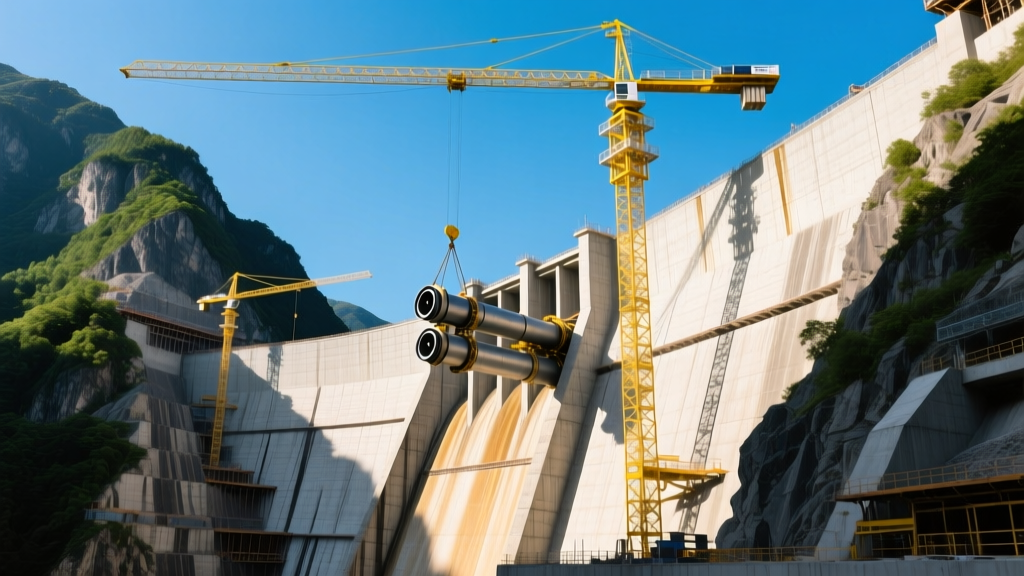
Capital Expenditure (CapEx) Distribution Matrix
Understanding where the money goes is critical for feasibility studies. The table below illustrates the typical CapEx distribution for a mid-sized (5 MW) concrete gravity dam project.
| Cost Category | Percentage of Total | Estimated Cost (5 MW Project) | Key Components |
|---|---|---|---|
| Civil Works & Dam Structure | 40% - 45% | $8.0M - $9.0M | Excavation, RCC/Earthfill, Spillway, Intake structures |
| Electromechanical Equipment | 25% - 30% | $5.0M - $6.0M | Turbines, generators, governors, control systems |
| Hydraulic Structures (Penstock) | 10% - 15% | $2.0M - $3.0M | Steel penstock, surge tanks, draft tubes, valves |
| Electrical & Grid Interconnection | 5% - 10% | $1.0M - $2.0M | Transformers, switchyard, transmission line tying |
| Soft Costs & Permitting | 10% - 15% | $2.0M - $3.0M | FERC licensing, environmental studies, engineering design |
Turbine Selection and Electromechanical Budgets
The electromechanical package is the heart of the dam, and its cost is strictly dictated by the site's "head" (vertical drop) and "flow" (water volume). Selecting the wrong turbine type will not only destroy your efficiency but will drastically inflate your civil works budget.
- Pelton Wheel (High Head, Low Flow): Ideal for mountainous terrain with drops exceeding 300 meters. The turbine itself is relatively compact and inexpensive (e.g., $120,000 for a 2 MW unit). However, the high-pressure steel penstock required to deliver the water from that elevation is incredibly expensive, requiring thick-walled, welded steel pipe that can cost over $1,500 per linear foot installed.
- Francis Turbine (Medium Head, Medium Flow): The most common turbine globally, handling heads between 30 and 300 meters. A 5 MW Francis turbine package typically costs between $800,000 and $1.2 million. It requires a balanced budget allocation between moderate civil works (a standard gravity dam) and mid-range penstock infrastructure.
- Kaplan Turbine (Low Head, High Flow): Used on wide, slow-moving rivers with drops under 30 meters. Because the water pressure is low, the penstock costs are minimal. However, the Kaplan turbine features complex, adjustable propeller blades. A custom-engineered 5 MW Kaplan runner can cost upwards of $2.5 million. Furthermore, the dam itself must be massive to impound the huge volume of water required, driving civil costs to the top of the budget.
Soft Costs: Permitting, FERC Licensing, and Geotechnical
Before a single cubic yard of concrete is poured, a hydro project must survive the regulatory gauntlet. In the United States, the Federal Energy Regulatory Commission (FERC) mandates rigorous licensing for non-federal hydro projects. The licensing process takes an average of 3 to 5 years and can cost between $500,000 and $2.5 million in soft costs alone.
"The most common point of failure for small hydro developers is underestimating the biological assessment phase. Designing and modeling a $1.2 million fish bypass ladder to satisfy state wildlife mandates can easily consume 10% of a small dam's total CapEx before ground is broken."
Geotechnical investigations also represent a massive upfront risk. Core drilling into the riverbed to determine bedrock depth is mandatory. If drilling reveals deep, unstable alluvial silt instead of solid granite, the foundation costs can triple, as engineers must drive steel sheet piling or install deep grout curtains to prevent water from piping under the dam.
Operation, Maintenance, and Levelized Cost of Energy (LCOE)
While the upfront CapEx of a hydro dam is daunting, the operational expenditure (OpEx) is remarkably low, which is why hydro remains the gold standard for baseload renewable energy. Annual O&M costs typically range from 1% to 2% of the initial CapEx. Unlike solar panels that degrade or wind turbines that suffer gear-box fatigue, a well-maintained concrete dam and steel turbine can operate for 80 to 100 years with only periodic runner refurbishments.
This longevity results in an exceptionally low Levelized Cost of Energy (LCOE). Modern hydro facilities frequently achieve an LCOE between $0.04 and $0.08 per kWh, making it highly competitive with natural gas and significantly cheaper than new nuclear or offshore wind installations. When evaluating the cost to build a hydro dam, developers must look past the initial sticker shock and model the century-long revenue stream of zero-fuel-cost power generation.
Written by
James ThorntonJames Thornton is a construction industry veteran with 25 years of hands-on experience in wood framing, lumber grading, and residential building codes. He started as a framing carpenter in rural Oregon, earned his ICC Residential Building Inspector certification, and eventually became a senior plan reviewer for the City of Portland Bureau of Development Services. James holds a B.S. in Wood Science & Technology from Oregon State University and is a certified lumber grader through the West Coast Lumber Inspection Bureau (WCLIB). He has inspected over 3,000 residential construction sites and authored the city's internal guide on advanced framing techniques (2x6 at 24" O.C.). James lives in Bend, OR, where he builds custom timber-frame cabins and competes in lumberjack sports.
More from James Thornton
View all
Insulation
Best Home Insulation Materials: Complete 2026 Guide
Compare top home insulation materials for 2026. Find R-values, installed costs per square foot, and best uses for fiberglass, spray foam, and mineral wool.
Aug 4, 2026

Sustainable Building
Certify Your Green Building Material for LEED and WELL
Step-by-step guide to certifying a green building material for LEED v5 and WELL v2. Master EPDs, HPDs, and VOC limits for 2026 project specifications.
Aug 4, 2026

Stone & Masonry
Veneer Stacked Stone Panels: Interior Design & Style Showcase
Discover how veneer stacked stone panels transform interiors. Explore modern design profiles, material pairings, and technical installation specs.
Aug 4, 2026