2026 Cost to Build an Inground Pool: Budget Guide
Discover the true 2026 cost to build an inground pool. Break down gunite, fiberglass, and vinyl expenses, plus hidden fees to plan your backyard budget.

The Financial Baseline: 2026 Construction Costs by Material
Calculating the accurate cost to build an inground pool requires moving beyond national averages and understanding the structural variables that dictate your final invoice. In 2026, supply chain stabilization has leveled out material costs, but specialized labor shortages continue to push installation premiums higher. According to Forbes Home, the national average for a standard 14x28-foot inground pool ranges from $55,000 to $85,000, but custom architectural designs easily exceed $125,000.
Quick 2026 Budget Baselines (Standard 14x28 ft. Rectangle)
- Vinyl Liner: $35,000 – $60,000
- Fiberglass Shell: $50,000 – $85,000
- Gunite / Shotcrete: $70,000 – $115,000+
Material Comparison Matrix: Long-Term Value vs. Upfront Cost
Choosing your pool shell material is the single largest budget decision you will make. Each material carries distinct installation requirements, lifespan limitations, and maintenance overheads that impact your total cost of ownership.
| Feature | Vinyl Liner | Fiberglass | Gunite/Concrete |
|---|---|---|---|
| Installation Time | 4–6 Weeks | 3–5 Weeks | 8–12 Weeks |
| Shell Lifespan | Structure: 50+ yrs Liner: 7–10 yrs |
50+ Years | 100+ Years |
| Customization | Moderate (Pre-set shapes) | Low (Mold limitations) | Infinite (Custom formed) |
| Surface Texture | Smooth, non-abrasive | Smooth, non-porous | Rough (Pebble/Plaster) |
| Algae Resistance | Moderate | Excellent | Low (Requires brushing) |
Hidden Budget Killers: What Contractors Don't Quote Upfront
The most common budgeting failure occurs when homeowners only allocate funds for the 'turnkey' pool shell and equipment pad. Site-specific variables frequently generate change orders that can inflate the final cost to build an inground pool by 15% to 30%.
1. The 'Rock Clause' Contingency
When excavators dig the initial hole, they are operating on assumptions based on surface soil tests. If the backhoe strikes bedrock or massive subterranean boulders, standard excavation halts. Breaking bedrock requires specialized pneumatic hammers or controlled blasting, costing an additional $800 to $2,500 per cubic yard. Always negotiate a capped 'rock clause' in your contract or set aside a strict 10% contingency fund specifically for subsurface surprises.
2. Utility Rerouting and Easements
If your planned pool footprint intersects with buried gas lines, sewer mains, or electrical conduits, you must pay to reroute them. Relocating a municipal sewer lateral can cost between $3,000 and $8,000. Furthermore, local zoning laws dictate setback requirements—typically 5 to 10 feet from property lines and utility easements. Failing to verify easement maps before signing a contract can result in expensive redesign fees.
3. Soil Engineering and Dewatering
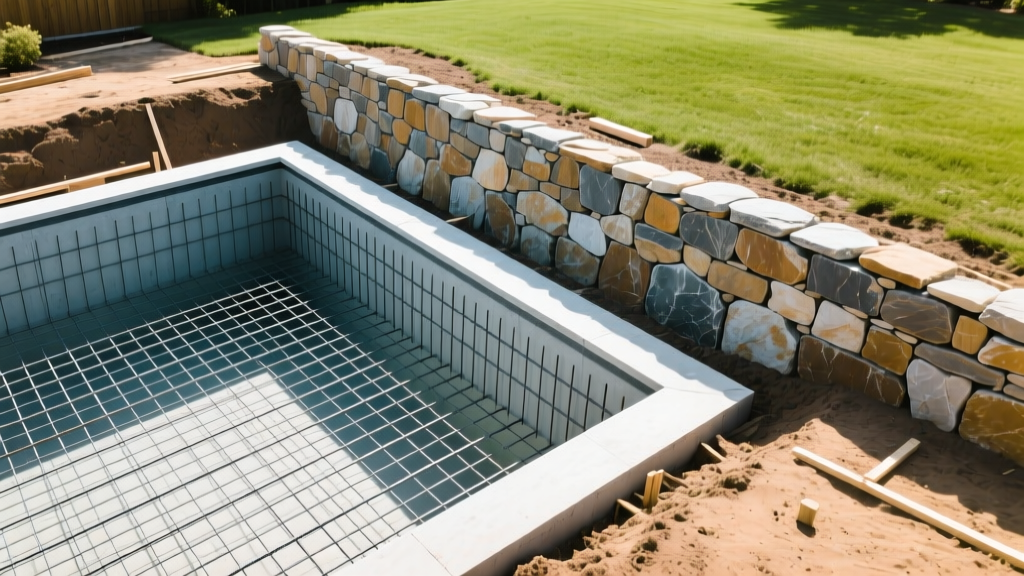
In regions with high water tables or expansive clay soils, standard excavation will collapse without intervention. Installing a well-point dewatering system during construction adds $2,500 to $5,000 to the project. Expansive clay requires over-excavation and backfilling with structural gravel to prevent the pool shell from heaving and cracking over time, adding roughly $4,000 in earthwork costs.
Equipment and Automation: Where Budgets Balloon
The mechanical heart of your pool dictates both your installation costs and your long-term utility bills. Upgrading from builder-grade equipment to high-efficiency systems requires a larger upfront capital outlay but drastically reduces the 10-year operational cost.
- Variable Speed Pumps: Building codes in most states now mandate variable speed pumps. The Pentair IntelliFlo VSF is the industry benchmark, costing around $1,800 to $2,400 installed. It uses up to 85% less energy than single-speed models.
- Filtration Systems: Cartridge filters (e.g., Hayward StarClear Plus) are standard and cost $800–$1,200. Upgrading to a Diatomaceous Earth (DE) filter like the Hayward ProGrid ($1,400–$1,800) provides superior water clarity but requires periodic DE powder replenishment and tear-down cleaning.
- Sanitation: Saltwater chlorine generators (SWCG) are preferred over traditional liquid chlorine. A Pentair IntelliChlor IC40 system adds $1,500 to $2,200 to the build. Note that saltwater does not mean 'chlorine-free'; it simply generates chlorine on-site, eliminating the need to store and handle harsh liquid chemicals.
- Automation: Full smart-home integration via systems like the Jandy AquaLink RS or Pentair IntelliCenter allows you to control heating, lighting, and pump schedules via smartphone. Budget an additional $2,500 to $4,500 for the control panel, actuators, and wiring.
Hardscaping and Decking Multipliers
The pool shell is only half the visual equation. The coping (the capstone bordering the pool edge) and the surrounding decking significantly impact the final invoice. Data from HomeGuide indicates that premium decking can add $15 to $45 per square foot to your project.
Budget-Friendly: Broom-Finished Concrete
Cost: $8 – $12 per sq. ft.
Pros: Highly durable, fast installation, excellent traction when wet.
Cons: Absorbs heat (hot on bare feet), prone to hairline cracking over time.
Mid-Tier: Stamped Concrete or Pavers
Cost: $15 – $25 per sq. ft.
Pros: Aesthetic versatility, pavers allow for easy utility access and shifting repair.
Cons: Stamped concrete requires resealing every 2 years; pavers can harbor weeds in joints.
Premium: Travertine or Kool Deck
Cost: $25 – $45+ per sq. ft.
Pros: Travertine stays naturally cool underfoot; Kool Deck reduces surface temp by 20+ degrees.
Cons: High material cost; natural stone requires specialized masonry labor.
The 5-Year Operational Cost Projection
Proper budget planning extends beyond the ribbon-cutting ceremony. You must underwrite the ongoing operational costs to ensure the pool does not become a financial burden. Below is a realistic annual projection for a standard 15,000-gallon gunite pool in a temperate climate.
| Operational Category | Annual Cost Estimate | Cost Mitigation Strategy |
|---|---|---|
| Electricity (Pump & Heater) | $800 – $1,600 | Use a pool cover to retain heat; run variable speed pump at low RPM overnight. |
| Chemicals (Chlorine, Acid, Algaecide) | $400 – $700 | Maintain cyanuric acid (CYA) levels between 30-50ppm to prevent chlorine burn-off. |
| Water (Refill & Backwashing) | $150 – $300 | Switch to a cartridge filter to eliminate water-wasting DE backwashing. |
| Professional Opening/Closing | $400 – $800 | DIY winterization using an ASTM F1346-compliant safety cover. |
| Routine Maintenance (Cleaning/Netting) | $600 – $1,200 | Invest in a robotic cleaner (e.g., Polaris VRX) to eliminate weekly manual vacuuming. |
Strategic Bidding: Protecting Your Capital
To ensure the cost to build an inground pool aligns with your financial parameters, you must control the bidding process. Do not accept 'allowance-based' estimates where critical components like coping, tile, or lighting are listed as vague placeholders.
- Demand Fixed-Price Contracts: Ensure the contract specifies exact model numbers for all equipment (e.g., 'Pentair IntelliFlo VSF 3HP' rather than 'Energy Efficient Pump').
- Verify Insurance and Bonding: Request a certificate of insurance directly from the builder's provider, confirming both general liability and workers' compensation. If an uninsured subcontractor is injured on your property, you are financially liable.
- Tie Payments to Milestones: Never front-load payments. A standard, safe draw schedule allocates 10% at signing, 25% after excavation and steel reinforcement, 25% after gunite/fiberglass shell installation, 20% after plumbing/electrical rough-in, and the final 20% only after the pool is filled, chemically balanced, and the automation system is fully operational.
- Require a Soil Report: For gunite pools exceeding $100,000, hire an independent geotechnical engineer ($1,500–$3,000) to analyze soil bearing capacity before the builder finalizes the structural steel engineering plans.
By mapping out these structural, mechanical, and site-specific variables, you transition from guessing the cost to build an inground pool to engineering a precise, defensible backyard budget.
Written by
James ThorntonJames Thornton is a construction industry veteran with 25 years of hands-on experience in wood framing, lumber grading, and residential building codes. He started as a framing carpenter in rural Oregon, earned his ICC Residential Building Inspector certification, and eventually became a senior plan reviewer for the City of Portland Bureau of Development Services. James holds a B.S. in Wood Science & Technology from Oregon State University and is a certified lumber grader through the West Coast Lumber Inspection Bureau (WCLIB). He has inspected over 3,000 residential construction sites and authored the city's internal guide on advanced framing techniques (2x6 at 24" O.C.). James lives in Bend, OR, where he builds custom timber-frame cabins and competes in lumberjack sports.
More from James Thornton
View all
Insulation
Best Home Insulation Materials: Complete 2026 Guide
Compare top home insulation materials for 2026. Find R-values, installed costs per square foot, and best uses for fiberglass, spray foam, and mineral wool.
Aug 4, 2026

Sustainable Building
Certify Your Green Building Material for LEED and WELL
Step-by-step guide to certifying a green building material for LEED v5 and WELL v2. Master EPDs, HPDs, and VOC limits for 2026 project specifications.
Aug 4, 2026

Stone & Masonry
Veneer Stacked Stone Panels: Interior Design & Style Showcase
Discover how veneer stacked stone panels transform interiors. Explore modern design profiles, material pairings, and technical installation specs.
Aug 4, 2026