True Installed Cost of Solar Panels: Maintenance & Cleaning Factors
Discover the true installed cost of solar panels by factoring in 25-year maintenance, inverter replacements, and professional cleaning playbooks.
Beyond the Upfront Quote: Redefining the Installed Cost
When homeowners and commercial developers request quotes, the installed cost of solar panels typically reflects only the day-one hardware and labor. In 2026, the national average for residential solar installations ranges from $2.70 to $3.30 per watt, meaning a standard 8 kW system costs between $21,600 and $26,400 before incentives. However, viewing the installed cost as a static, one-time expense is a critical financial miscalculation.
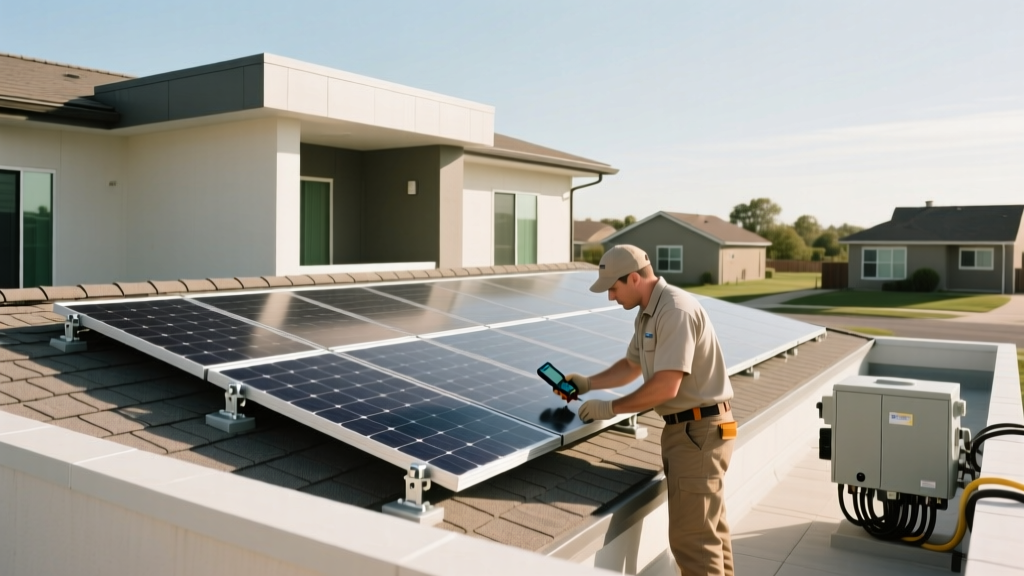
To accurately estimate construction and lifecycle budgets, project managers and property owners must adopt a 25-year Maintenance & Cleaning Playbook. Solar arrays are not entirely "set it and forget it" assets. Environmental soiling, thermal degradation, and electronic component fatigue all demand scheduled interventions. By factoring in long-term operational expenditures (OPEX), you transition from a naive upfront estimate to a precise Total Cost of Ownership (TCO).
Data Highlight: 25-Year Lifecycle Cost (8 kW System)
- Upfront Installed Cost: $21,600 – $26,400
- Estimated 25-Year Cleaning: $1,500 – $3,200
- Inverter Replacement (Year 12): $1,800 – $2,500 (String) or $0 (Microinverters)
- Racking/Flashing Maintenance: $400 – $800
- True 25-Year TCO: $25,300 – $32,900
The Component Maintenance Playbook: What Actually Fails?
Solar modules (the glass-and-silicon panels themselves) are remarkably resilient. According to the National Renewable Energy Laboratory (NREL), median annual degradation rates for premium monocrystalline panels hover around 0.4% to 0.5%. The panels will likely outlast the roof. The true maintenance liabilities lie in the balance of system (BOS) components.
Inverters: The Weakest Link in the Chain
Inverters convert the DC power generated by the panels into usable AC power. They endure intense thermal cycling and electrical stress. String inverters (like those from SolarEdge or SMA) contain electrolytic capacitors that gradually dry out, typically leading to failure between years 10 and 14. Microinverters (such as the Enphase IQ8 series) distribute this thermal load across the array and usually carry 25-year warranties, effectively eliminating mid-life replacement costs.
| Component | Expected Lifespan | Mid-Life Replacement Cost | Common Failure Mode |
|---|---|---|---|
| String Inverter | 10 – 15 Years | $1,800 – $2,500 | Capacitor drying, thermal throttling |
| Microinverters | 25+ Years | $0 (Covered by warranty) | Lightning surges, grid voltage spikes |
| Roof Flashings | 15 – 20 Years | $400 – $800 | UV degradation, rubber seal cracking |
| MC4 Connectors | 25+ Years | $200 – $400 (if mismatched) | Moisture ingress, thermal expansion |
Racking and Roof Penetrations
Aluminum racking systems (e.g., IronRidge or Unirac) are engineered to withstand 160 mph wind loads and will not corrode. However, the roof flashings and L-feet seals degrade under UV exposure. A critical maintenance playbook requires a roof inspection at year 10 and year 15 to re-apply polyurethane sealants (like ChemCurb or Geocel) around lag bolt penetrations to prevent catastrophic interior water damage.
The Cleaning Protocol: Chemistry and Equipment
Soiling from dust, pollen, agricultural exhaust, and bird guano can reduce solar yield by 5% to 20% annually, depending on the region and tilt angle. The U.S. Department of Energy's Solar Energy Technologies Office notes that while rain provides some natural cleaning, it is insufficient for removing baked-on organic matter or hard water spots.
Never use standard municipal tap water or well water to clean solar panels. Tap water contains dissolved minerals (calcium and magnesium). When the water evaporates, it leaves behind a calcium carbonate scale that bakes onto the panel's anti-reflective coating. This scale can permanently reduce light transmission by up to 4%. Always use de-ionized (DI) or reverse osmosis (RO) filtered water with a Total Dissolved Solids (TDS) reading of 0 ppm.
Professional vs. DIY Cleaning Playbook
For residential arrays, professional cleaning services typically charge $150 to $300 per visit, utilizing water-fed pole systems. For DIY maintenance, the equipment investment and procedural steps must be strictly followed to avoid voiding the manufacturer's warranty.
- Timing: Clean panels only in the early morning or late evening. Spraying cold water on 150°F glass at noon can cause thermal shock, resulting in micro-fractures that shatter the tempered glass.
- Equipment: Use a pure boar-hair or soft synthetic brush attached to a water-fed telescopic pole. Never use abrasive scrub pads, squeegees with metal edges, or pressure washers exceeding 400 PSI.
- Water Filtration: Connect a multi-stage DI water filtration vessel (such as a Xero Pure or Tucker system) to your hose. Verify the TDS meter reads 000 ppm before applying water to the glass.
- Agitation: Gently agitate the surface with the brush to loosen bird droppings and sap. Guano is highly acidic and can etch the glass if left for more than a few weeks, creating localized hot spots that degrade the solar cells beneath.
- Rinsing: Rinse thoroughly with the DI water. Because DI water lacks minerals, it will sheet off the hydrophobic glass coating and air-dry completely spot-free without the need for manual squeegeeing.
Calculating Your True 25-Year Budget
When estimating the installed cost of solar panels for a commercial or residential pro forma, establish a dedicated OPEX reserve. A standard financial model should allocate 0.5% to 1.0% of the initial capital expenditure annually for operations and maintenance.
For a $25,000 system, this means setting aside $125 to $250 per year. This reserve comfortably covers bi-annual professional cleanings in high-soiling environments (like agricultural zones or arid climates) and fully funds the inevitable string inverter replacement in year 12. By integrating this maintenance playbook into your initial construction cost estimating, you protect your ROI and ensure the asset performs at its modeled capacity through its entire warranted lifespan.
Frequently Asked Questions
Does standard homeowner's insurance cover solar panel maintenance?
No. Insurance covers sudden, accidental damage (like hail or falling trees). Routine maintenance, cleaning, and degradation-related efficiency losses are considered normal wear and tear and are strictly the owner's financial responsibility.
Do robotic solar panel cleaners make financial sense?
For residential roofs, no. The capital cost of a robotic cleaner ($1,500+) outweighs the cost of manual cleaning. However, for commercial ground-mount arrays or flat-roof installations exceeding 50 kW, waterless robotic cleaners (like the Ecoppia E4) provide an excellent ROI by enabling daily micro-cleaning without the labor costs of manual crews.
Can I claim the 30% Federal Solar Tax Credit on maintenance and cleaning?
No. The Investment Tax Credit (ITC) applies only to the initial installed cost of the solar energy property, including hardware, labor, and permitting. Ongoing maintenance, cleaning, and mid-life inverter replacements do not qualify for the tax credit.