Smart Ways to Reduce the Average Cost to Build an Inground Pool
Discover actionable strategies to reduce the average cost to build an inground pool, from shell material selection to phased plumbing and off-season timing.

The True Baseline: What Drives the Average Cost to Build an Inground Pool
When evaluating backyard renovations, the average cost to build an inground pool currently ranges from $55,000 to $110,000, with high-end custom shotcrete projects easily exceeding $150,000. This massive variance is not arbitrary; it is dictated by soil composition, shell material, equipment efficiency, and decking square footage. Many homeowners attempt to cut costs by negotiating contractor margins, but true savings are realized during the design and engineering phases. By manipulating the geometry of the pool, phasing non-essential plumbing, and selecting materials based on lifecycle maintenance rather than just day-one installation costs, you can shave 15% to 30% off your final invoice without sacrificing structural integrity.
Shell Material Matrix: Vinyl vs. Fiberglass vs. Concrete
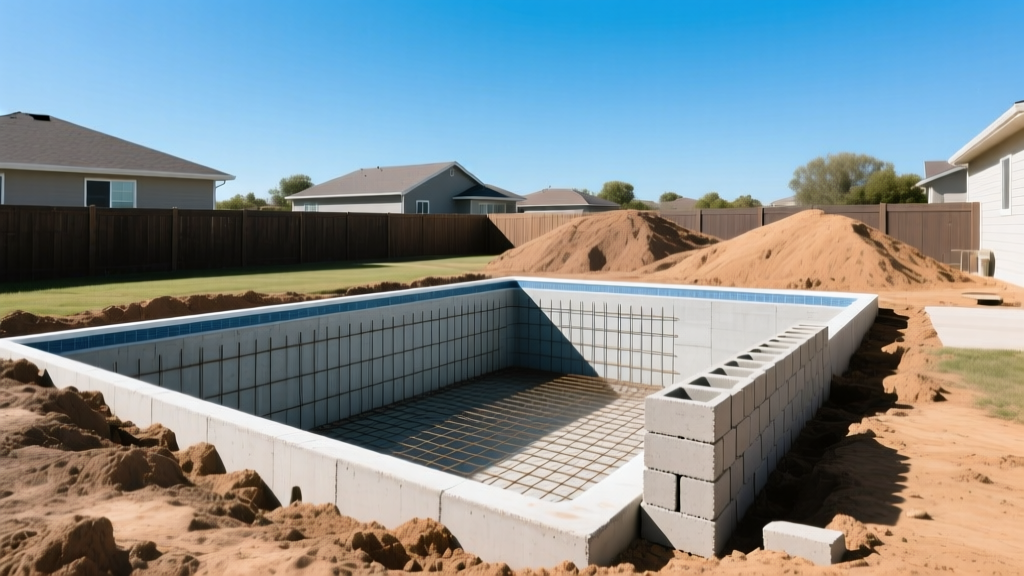
The pool shell accounts for roughly 45% of your total budget. Each material carries distinct upfront costs and long-term financial implications. While concrete (shotcrete or gunite) is the traditional standard for custom shapes, it is rarely the most economical choice for budget-conscious builders.
| Material | Average Installed Cost | Installation Timeline | 10-Year Maintenance Reality |
|---|---|---|---|
| Vinyl Liner | $45,000 - $65,000 | 3 - 5 Weeks | Liner replacement required at year 8-10 ($4,500 - $6,000). |
| Fiberglass | $55,000 - $80,000 | 2 - 4 Weeks | Near-zero shell maintenance; occasional gel coat buffing. |
| Concrete (Shotcrete) | $70,000 - $120,000+ | 8 - 12 Weeks | Acid washing, replastering at year 10-15 ($8,000 - $12,000). |
The Geometry of Pricing: Perimeter and Depth Multipliers
Pool builders do not price projects strictly by square footage of water surface; they price by perimeter and excavation volume. Every linear foot of pool wall requires steel rebar, forming, shotcrete application (or fiberglass bracing), and coping. Furthermore, excavators charge by the cubic yard of dirt removed and hauled away.
The Depth Trap
A 16x32 foot pool with a flat 4.5-foot depth requires significantly less excavation, less backfill, less steel, and less concrete than a 16x32 foot pool with a 3.5-foot shallow end sloping to an 8-foot deep end. The 8-foot deep end adds roughly 15% to 20% to the total shell cost due to the engineering required to handle increased hydrostatic pressure and the sheer volume of displaced soil. Unless you are installing a diving board (which requires a massive, code-mandated diving envelope that drastically inflates the average cost to build an inground pool), cap your maximum depth at 5.5 feet. This accommodates jumping and treading water while keeping excavation and material costs firmly in check.
Phased Construction: The 'Stub-Out' Strategy
One of the most effective ways to manage cash flow and reduce initial capital outlay is phased construction. You can build the primary pool shell and equipment pad now, while pre-plumbing for future features. This is known as the 'stub-out' strategy.
Instead of paying for a fully integrated spa, sheer descent waterfalls, or an automated cleaning system on day one, have your plumber run capped Schedule 40 PVC lines from the equipment pad into the ground. Bury these capped lines just outside the pool deck footprint.
- Future Spa Integration: Stub out two 2.5-inch suction lines and two 2-inch return lines near the planned spa location.
- Water Features: Run a dedicated 1.5-inch high-pressure line to the back of the pool wall for future sheer descents or deck jets.
- Gas Lines: If you plan to add a pool heater or spa later, have the gas company or a licensed plumber run a 1-inch polyethylene gas line with a capped shut-off valve to the equipment pad. Trenching gas lines after the deck is poured costs upwards of $2,500.
Equipment Selection: Upfront Cost vs. Lifetime Savings
While the pump and filtration system represent a small fraction of the initial build cost, they dictate your monthly operating expenses. According to the U.S. Department of Energy, upgrading to a variable speed pool pump can reduce pool pumping energy costs by up to 70% compared to single-speed models.
A standard 1.5 HP single-speed pump costs about $600 to install but will pull roughly 2,000 watts continuously while running. A variable speed pump like the Pentair IntelliFlo3 VSF or Hayward EcoStar costs $1,800 to $2,500 installed. However, because variable speed pumps use permanent magnet motors and can be dialed down to 600 RPM for daily filtration (pulling under 150 watts), the ROI is typically realized within 14 to 18 months. When negotiating your pool contract, demand that a variable speed pump be included in the base bid; many builders default to single-speed or dual-speed pumps to artificially lower their initial quote.
Decking and Coping: Managing the Hardscape Budget
The pool deck is the second largest expense after the shell. Builders often quote expansive travertine or stamped concrete decks that wrap entirely around the pool. To lower the average cost to build an inground pool, adopt a 'functional footprint' approach to hardscaping.
- Pour Broom-Finished Concrete for High-Traffic Zones: Limit poured concrete (approx. $8 to $12 per square foot) to the primary entry/exit points, the equipment pad, and the main lounging area.
- Use Decomposed Granite or Gravel for Perimeters: For the non-traffic sides of the pool, use a compacted decomposed granite (DG) border or washed river rock. This costs $2 to $4 per square foot and provides excellent drainage.
- Coping Selection: Avoid pre-cast concrete coping if you live in a freeze-thaw climate, as it spalls and cracks. Opt for poured-in-place cantilevered concrete coping or natural bluestone, which offers superior longevity and reduces long-term replacement costs.
Strategic Timing: Leveraging the Off-Season
The swimming pool industry is highly seasonal. In most of the United States, contractors are overwhelmed with bids from March through June. During this peak, you have zero leverage to negotiate pricing, and subcontractors (excavators, steel tiers, electricians) charge premium rates due to high demand.
'Signing a pool contract in late October or November for a spring build is the single easiest way to negotiate a 5% to 10% discount on the total contract price. Builders need to keep their crews employed through the winter and are far more willing to absorb margin compression or include free upgrades, such as an automated salt chlorine generator or upgraded LED lighting packages, to secure the booking.' — Regional Pool Builder Consortium Data
Furthermore, securing your permits and HOA approvals in the winter ensures you are at the front of the municipal inspection line when spring arrives, preventing costly construction delays. As noted in Angi's comprehensive pool cost analysis, regional labor fluctuations can swing total project costs by tens of thousands of dollars; timing your contract signing to align with contractor downtime is a critical financial strategy.
Summary: Your Cost-Reduction Checklist
Reducing the average cost to build an inground pool requires shifting your focus from haggling over line items to making intelligent structural and design decisions. Cap your depth at 5.5 feet, choose a shell material that aligns with your 10-year maintenance budget, stub out future plumbing lines, mandate variable-speed equipment, and sign your contract in the late fall. By controlling the geometry and the timeline, you maintain complete authority over your project's financial outcome.
Written by
Marcus ChenMarcus Chen is a licensed structural engineer (PE) and building materials analyst with over 12 years of experience across residential, commercial, and industrial construction. He holds a Master of Science in Civil Engineering from UC Berkeley and spent six years at Thornton Tomasetti before transitioning to independent consulting and technical writing. Marcus specializes in material selection for seismic-prone regions, concrete reinforcement strategies, and lifecycle cost analysis. His work has been cited by the American Concrete Institute (ACI) and the Structural Engineers Association of California (SEAOC). When he is not on a job site or at his desk, you will find him hiking the Sierra Nevada or restoring a 1920s craftsman bungalow in Oakland, CA.
More from Marcus Chen
View all
Construction Cost
How Much Did the Eiffel Tower Cost to Build?
How much did the Eiffel Tower cost to build in 1889? We adjust for inflation and compare its budget to modern skyscraper construction.
Aug 4, 2026

Fire Resistance
What Is a Fire Resistant Material? Testing & Certification Guide
Discover what is a fire resistant material through ASTM and UL testing. Learn how fire ratings, certifications, and assemblies work in construction.
Aug 4, 2026

Construction Cost
How Much Did the Burj Khalifa Cost to Build?
How much did the Burj Khalifa cost to build? We break down the $1.5B project and extract 5 money-saving strategies for your next build.
Jul 30, 2026