2026 Regional Guide: Cost Effective Materials for Building a House
Discover the most cost effective materials for building a house in 2026, broken down by US region to account for local climate, codes, and supply chains.

The phrase 'cost effective materials for building a house' is a geographic trap. A material that yields massive return on investment in the humid, hurricane-prone Southeast might be a financial liability in the wildfire-prone, seismic zones of the West. In 2026, regional supply chain realities, localized building codes, and extreme weather patterns dictate the true lifecycle cost of residential construction. National averages obscure the localized math that actually determines whether a project comes in under budget or requires a secondary loan.
To accurately estimate construction costs, builders and homeowners must evaluate materials not just by their upfront invoice price, but by their installed cost, regional freight premiums, code-mandated reinforcements, and long-term climate resilience. According to recent data from the National Association of Home Builders (NAHB), regional material variances can swing the shell cost of a 2,500-square-foot home by up to 22%. Here is a deep-dive regional analysis of the most cost-effective structural and envelope materials available today.
The 2026 Regional Material Cost Matrix
The following matrix illustrates how the definition of 'budget-friendly' shifts dramatically across the four primary US climate and construction zones. These figures represent the installed cost per square foot of the structural shell and primary exterior cladding.
| Region | Primary Structural | Exterior Cladding | Avg Shell Cost/SqFt | Primary Cost Driver |
|---|---|---|---|---|
| Northeast | 2x6 Advanced Framing | Vinyl & Brick Veneer | $68 - $82 | Labor rates, frost wall depth |
| Midwest | Insulated Concrete Forms | Fiber Cement | $74 - $89 | Thermal envelope requirements |
| South | 2x4 Wood with Tie-Downs | Stucco & Metal Roofing | $58 - $72 | Hurricane strapping, moisture |
| West | Light-Gauge Steel | 3-Coat Stucco | $88 - $115 | WUI fire codes, seismic ties |
Northeast and Midwest: Frost Lines and Thermal Envelopes
In regions characterized by deep frost lines and over 6,000 heating degree days, the cost-effectiveness of a material is inextricably linked to its thermal mass and insulation value. Traditional 2x4 wood framing is a false economy here; achieving modern energy codes requires expensive continuous exterior insulation or closed-cell spray foam, which negates the initial savings of cheap lumber.
Why ICF Outperforms Wood in Extreme Cold
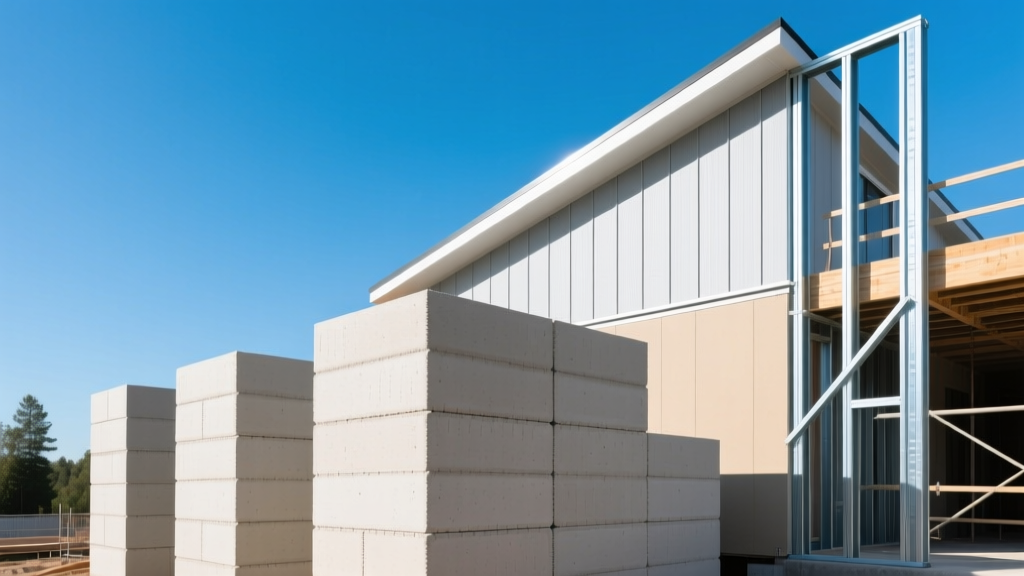
Insulated Concrete Forms (ICF), such as Nudura or Fox Blocks, have emerged as the most cost-effective structural choice for the Midwest and Northeast. While the raw material cost for ICF blocks sits between $24 and $28 per square foot of wall area, the installed cost equalizes with advanced wood framing when factoring in labor and secondary envelope requirements.
Furthermore, ICF eliminates the risk of frost heave damage to above-grade walls and drastically reduces the HVAC tonnage required for the home, allowing builders to downsize mechanical systems by 20% to 30%—a direct capital savings that improves the overall project ROI.
The South: Humidity, Hurricanes, and Cooling Loads
Building in the South means battling high humidity, intense UV degradation, and the constant threat of high-velocity winds. Here, cost-effective materials are those that eliminate the need for premature replacement and expensive insurance premiums.
Fiber Cement and Standing Seam Metal
Vinyl siding remains the cheapest upfront cladding at roughly $4 to $6 per square foot installed. However, in the deep South, UV exposure makes vinyl brittle within a decade, and it offers zero protection against windborne debris. James Hardie fiber cement siding (specifically the HardiePlank line) is the superior cost-effective alternative. Priced at $9 to $12 per square foot installed, it is impervious to rot, termites, and UV warping. More importantly, it qualifies for windborne debris ratings in coastal counties, which can reduce annual homeowners insurance premiums by 10% to 15%.
When building in High-Velocity Hurricane Zones (HVHZ), the Insurance Institute for Business & Home Safety (IBHS) FORTIFIED standard mandates specific roof tie-downs and impact-resistant cladding. Spending 8% more on a 26-gauge Galvalume standing seam metal roof over architectural asphalt shingles prevents the catastrophic failure of the roof deck during Category 3+ storms.
For the structural shell, 2x4 southern yellow pine remains the most cost-effective framing lumber due to local mill proximity. However, builders must budget an additional $1.50 to $2.50 per square foot for Simpson Strong-Tie hurricane straps and continuous load-path hardware, which are strictly enforced by local inspectors from Florida to the Carolina coast.
The West: Wildfire Zones and Seismic Shifts
The Western US presents the most hostile environment for traditional wood construction. The expansion of the Wildland-Urban Interface (WUI) means that vast tracts of land in California, Oregon, and Colorado now mandate non-combustible exterior materials. Additionally, seismic activity requires structural flexibility that rigid masonry cannot provide without exorbitant engineering costs.
Light-Gauge Steel and 3-Coat Stucco
Light-gauge steel framing (using brands like ClarkDietrich) is the most cost-effective structural solution for the West. While steel studs cost roughly 15% more upfront than Douglas Fir lumber, they are entirely immune to dry rot and termites—two pervasive issues in Western microclimates. More critically, steel framing is non-combustible, allowing homes to pass strict WUI fire codes without requiring expensive fire-retardant wood treatments.
| Material Assembly | Upfront Cost/SqFt | Fire Rating | Seismic Flexibility | Long-Term Maintenance |
|---|---|---|---|---|
| Wood Framing + Wood Siding | $45 - $55 | Low (Fails WUI) | High | High (Termites, Rot, Fire Risk) |
| Steel Framing + 3-Coat Stucco | $62 - $78 | 1-Hour+ (Passes WUI) | High | Minimal |
For cladding, traditional 3-coat Portland cement stucco over wire lath is the undisputed cost-effective champion in the West. At $11 to $15 per square foot installed, it provides an inherent one-hour fire rating and excellent thermal mass, which helps moderate the extreme diurnal temperature swings of high-desert environments. Synthetic stucco (EIFS) is cheaper but frequently rejected by local fire marshals in high-risk fire zones due to the combustible nature of its foam insulation core.
Hidden Regional Cost Multipliers
When calculating the true cost of materials, estimators must factor in hidden regional multipliers that rarely appear on a standard supplier price sheet:
- Freight and Logistics: Shipping heavy materials like ICF blocks or concrete masonry units (CMUs) to remote Western or Northeastern sites can add 18% to 25% to the material invoice. Sourcing within a 250-mile radius is critical for maintaining budget integrity.
- Local Code Mandates: California Title 24 energy codes require windows with U-factors of 0.28 or lower. Upgrading from standard dual-pane to low-E argon-filled glass adds $12 to $18 per square foot of window area, a cost that must be baked into the envelope budget early.
- Specialized Labor Shortages: While ICF and steel framing are cost-effective in material terms, if the local labor pool lacks experience with these systems, contractors will add a 10% to 15% 'learning curve' premium to their bids. Always verify local trade availability before specifying non-standard materials.
Strategic Sourcing Framework
To lock in the most cost-effective materials for your specific region in 2026, follow this procurement sequence:
- Audit the Micro-Climate Code: Pull the specific WUI, HVHZ, or frost-line requirements for the exact parcel of land. Do not rely on county-wide generalizations.
- Run the Envelope Lifecycle Model: Compare the 30-year cost of the structural shell, factoring in HVAC downsizing, insurance premium reductions, and maintenance cycles, rather than just the day-one builder invoice.
- Secure Mill and Factory Directs: For regional staples like Southern Yellow Pine or Midwest-manufactured ICF blocks, bypass big-box retailers and establish direct accounts with regional distributors to avoid retail markup and secure volume freight rates.
Ultimately, the most cost-effective materials for building a house are those that align with the specific environmental and regulatory realities of the build site. By respecting regional physics and local codes, builders can deliver highly resilient, energy-efficient homes that protect both the initial capital outlay and the long-term asset value.
Written by
James ThorntonJames Thornton is a construction industry veteran with 25 years of hands-on experience in wood framing, lumber grading, and residential building codes. He started as a framing carpenter in rural Oregon, earned his ICC Residential Building Inspector certification, and eventually became a senior plan reviewer for the City of Portland Bureau of Development Services. James holds a B.S. in Wood Science & Technology from Oregon State University and is a certified lumber grader through the West Coast Lumber Inspection Bureau (WCLIB). He has inspected over 3,000 residential construction sites and authored the city's internal guide on advanced framing techniques (2x6 at 24" O.C.). James lives in Bend, OR, where he builds custom timber-frame cabins and competes in lumberjack sports.
More from James Thornton
View all
Insulation
Best Home Insulation Materials: Complete 2026 Guide
Compare top home insulation materials for 2026. Find R-values, installed costs per square foot, and best uses for fiberglass, spray foam, and mineral wool.
Aug 4, 2026

Sustainable Building
Certify Your Green Building Material for LEED and WELL
Step-by-step guide to certifying a green building material for LEED v5 and WELL v2. Master EPDs, HPDs, and VOC limits for 2026 project specifications.
Aug 4, 2026

Stone & Masonry
Veneer Stacked Stone Panels: Interior Design & Style Showcase
Discover how veneer stacked stone panels transform interiors. Explore modern design profiles, material pairings, and technical installation specs.
Aug 4, 2026