Proven Strategies to Reduce the Cost to Build a Cell Tower
Discover proven strategies to lower the cost to build a cell tower, from collocation and guyed masts to modular foundations and secondary market gear.

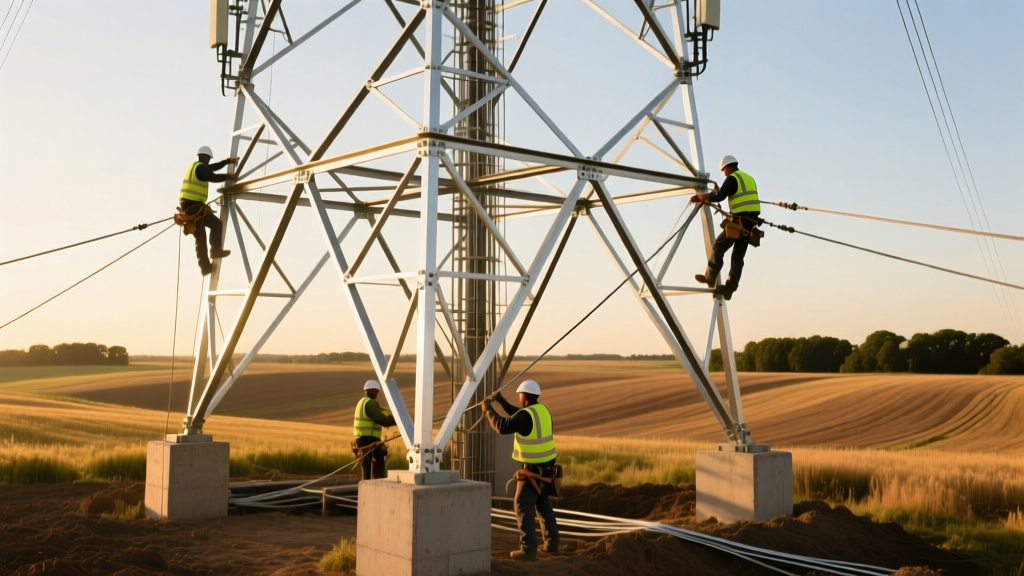
Constructing a greenfield macro cell site is a capital-intensive endeavor. Depending on the region, zoning complexity, and structural requirements, the baseline cost to build a cell tower routinely ranges from $250,000 to over $500,000. For telecommunications investors, Wireless Internet Service Providers (WISPs), and private enterprise network builders, mitigating these expenses without compromising structural integrity or RF performance is critical. Reducing capital expenditure (CAPEX) requires moving away from default monopole designs and standard concrete pours, opting instead for site-specific engineering and strategic procurement.
Structural Topology: Right-Sizing the Mast
The most common mistake in tower development is defaulting to a monopole structure for every site. While monopoles offer a small footprint and aesthetic appeal for suburban zones, they are heavily over-engineered and overpriced for rural or industrial deployments. Selecting the correct topology based on TIA-222-H wind load standards and site constraints is the first major lever for cost reduction.
| Tower Type | Avg. Structural Cost | Footprint | Best Application |
|---|---|---|---|
| Monopole | $150,000 - $250,000 | 10x10 ft | Suburban, high-zoning scrutiny, limited land |
| Self-Supporting Lattice | $110,000 - $180,000 | 20x20 ft | Heavy loading, multi-tenant collocation, rural |
| Guyed Mast | $45,000 - $90,000 | 150x150 ft | Rural, agricultural, WISP, off-grid deployments |
| Stealth / Concealed | $250,000 - $400,000+ | Varies | Strict municipal zoning, historic districts |
For rural broadband expansion or agricultural IoT networks, a guyed mast reduces the structural steel and erection costs by up to 65% compared to a monopole. The trade-off is land usage; guyed towers require a large radius for anchor foundations. If land lease costs are minimal, the guyed mast is the undisputed champion of CAPEX reduction.
Civil Works: Modular vs. Poured Foundations
Traditional reinforced concrete caissons or drilled shaft foundations require extensive excavation, rebar tying, concrete pouring, and a 28-day curing period before steel erection can begin. This process alone can consume $40,000 to $75,000 of the budget and add weeks to the project timeline.
The Helical Pile Alternative
Helical pile foundations (utilizing products from manufacturers like Hubbell Power Systems or Chance) are engineered steel shafts with helical bearing plates that are mechanically torqued into the ground.
- Cost Savings: Typically 30% to 50% cheaper than poured concrete, ranging from $15,000 to $30,000 for a complete monopole foundation.
- Speed: Installation takes 1 to 3 days. Steel erection can begin immediately, as there is no curing time.
- Environmental: Minimal soil displacement and no concrete truck access required, which is ideal for remote or ecologically sensitive sites.
Geotechnical borings are mandatory to design the helical pile depth and torque requirements, but the elimination of mobilized concrete pumps and curing delays drastically compresses the project schedule and soft costs.
Active Equipment: Navigating the Secondary Market
Baseband Units (BBUs) and Remote Radio Units (RRUs) from primary OEMs like Ericsson, Nokia, and Huawei represent a massive portion of the budget. A fully loaded 5G NR sector can easily exceed $60,000 in new OEM hardware.
Additionally, utilize Open RAN (O-RAN) architectures where feasible. Decoupling the hardware from the software allows operators to deploy Commercial Off-The-Shelf (COTS) servers for baseband processing, avoiding vendor lock-in and reducing long-term licensing fees.
Power and Backhaul: Bypassing the Grid and Trenching
Extending commercial AC power and trenching fiber optic backhaul are notorious budget-killers. Utility companies frequently quote $50,000 to $120,000 per mile for grid extension, while fiber trenching in rocky or urban terrain can exceed $100,000 per mile.
Off-Grid Hybrid Power Systems
For sites drawing under 3kW of continuous load, a solar-hybrid system utilizing LiFePO4 (Lithium Iron Phosphate) battery banks and a backup propane generator is highly cost-effective. While the upfront CAPEX for a robust solar array and battery shelter might be $45,000, it entirely eliminates utility extension fees and drastically reduces monthly OPEX.
Microwave Backhaul
If fiber is unavailable, modern millimeter-wave (E-band/V-band) or traditional microwave links (using hardware from Aviat Networks or Ceragon) provide multi-gigabit throughput. A point-to-point microwave link costs between $15,000 and $25,000 per hop, completely bypassing the need for civil trenching.
Regulatory Hacks: Collocation and Section 6409(a)
The single most effective way to reduce the cost to build a cell tower is to avoid building a new tower entirely. Collocating on an existing structure shifts the financial burden from civil engineering to structural reinforcement and lease negotiations.
Under FCC regulations, specifically Section 6409(a) of the Spectrum Act, state and local governments are restricted from denying applications for 'eligible facilities requests.' If you are modifying an existing tower (e.g., adding antennas, increasing height by up to 20 feet, or adding a new equipment shelter) without substantially changing the tower's physical dimensions, the zoning approval process is heavily streamlined. This bypasses months of public hearings, environmental reviews, and expensive legal fees, saving tens of thousands of dollars in soft costs.
When evaluating existing structures for collocation, consult the Telecommunications Industry Association (TIA) standards to ensure the host tower has the residual wind-load capacity to support your additional RRUs and microwave dishes without requiring a $50,000 structural reinforcement.
Actionable Cost Reduction Matrix
Implementing the following framework during the site acquisition and design phase will systematically compress your CAPEX.
| Project Phase | Traditional Approach | Cost-Optimized Strategy | Estimated Savings |
|---|---|---|---|
| Site Selection | Greenfield raw land | Collocation on existing vertical assets | $100,000 - $200,000 |
| Structural Design | Default Monopole | Guyed Mast (rural) or Lattice (heavy load) | $50,000 - $120,000 |
| Foundation | Poured concrete caisson | Engineered helical pile system | $15,000 - $35,000 |
| RF Equipment | Direct OEM new purchase | Certified secondary market / Open RAN COTS | 30% - 50% on hardware |
| Backhaul | Trenched fiber optic | E-band / Millimeter-wave microwave link | $40,000+ per mile |
By treating tower construction as a modular engineering challenge rather than a rigid real estate development, operators can deploy robust, high-capacity wireless infrastructure while preserving vital capital for network expansion.
Written by
David NakamuraDavid Nakamura is a licensed architect (AIA) and construction technology writer focused on sustainable building methods, mass timber engineering, and high-performance building envelopes. He holds a Master of Architecture from the University of Washington and is a certified Passive House Consultant (CPHC). David spent eight years at the Seattle firm Mithun, where he led the design of three LEED Platinum projects, before founding his own practice specializing in net-zero residential design. He serves on the editorial advisory board of GreenBuilder Magazine and has authored peer-reviewed papers on cross-laminated timber (CLT) connections for the Journal of Structural Engineering. In his spare time, David teaches woodworking at Pratt Fine Arts Center and kayaks the Puget Sound.
More from David Nakamura
View all
Construction Cost
Labor Cost to Build a Deck Per Sq Ft: 2026 Installation Guide
Discover the exact labor cost to build a deck per sq ft in 2026. This installation guide breaks down contractor rates, complexity factors, and hidden fees.
Aug 4, 2026

Construction Cost
How Much Does It Cost to Build a 3 Bedroom House? Financing Guide
Learn exactly how much it costs to build a 3 bedroom house and explore 2026 financing options, construction loan types, and budget frameworks for your build.
Aug 4, 2026

Construction Cost
Cost to Build a Tennis Court: 2026 Guide
How much does it cost to build a tennis court in 2026? Breakdowns for asphalt, concrete, and synthetic surfaces plus fencing and lighting.
Jul 30, 2026