Average Material Cost to Build a Home: 2026 Breakdown
Discover the true material cost to build a home in 2026. Get detailed pricing breakdowns for lumber, concrete, roofing, and finishes per square foot.
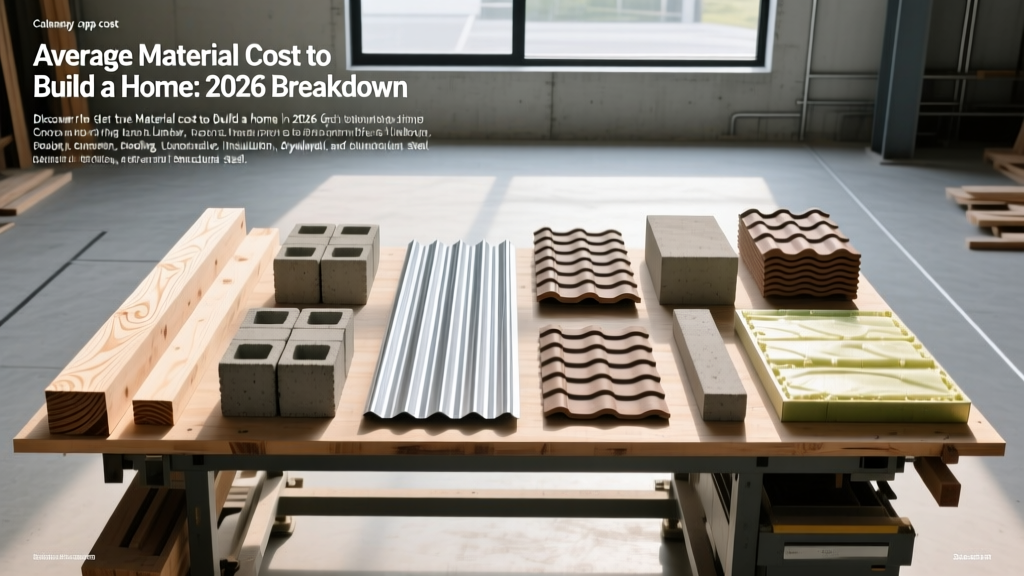
The 2026 Material Cost Baseline
Calculating the exact material cost to build a home requires separating raw supplies from labor, land acquisition, and soft costs like permits and architectural fees. According to recent data from the National Association of Home Builders (NAHB), materials typically account for 41% to 45% of the total construction cost of a single-family home. With the median new home construction cost hovering around $320,000 to $380,000 in 2026, the pure material expenditure ranges from $131,000 to $171,000 for a standard 2,000-square-foot build.
This translates to a baseline material cost of $65 to $85 per square foot. However, this average masks massive variances based on structural choices, envelope performance requirements, and finish grades. Below is a comprehensive, component-by-component breakdown of what you will actually spend on physical materials.
Quick Cost Snapshot: 2,000 Sq. Ft. Home
- Foundation & Concrete: $12,000 - $16,500
- Framing & Structural Shell: $28,000 - $42,000
- Exterior Envelope (Roof, Siding, Windows): $24,000 - $38,000
- Mechanicals (HVAC, Plumbing, Electrical): $18,000 - $26,000
- Interior Finishes & Drywall: $35,000 - $65,000+
- Fasteners, Adhesives & Wraps: $4,500 - $7,000
Shell & Structure: Foundation, Framing, and Roofing
The structural shell is the most capital-intensive material phase. In 2026, supply chain stabilization has normalized softwood lumber prices, but engineered wood products and concrete remain subject to regional freight surcharges and cement kiln capacity constraints.
Foundation Materials
A standard poured concrete foundation for a 2,000-square-foot footprint requires approximately 110 to 130 cubic yards of ready-mix concrete. In 2026, 3,000 PSI to 4,000 PSI ready-mix averages $135 to $165 per cubic yard delivered. When you factor in #4 and #5 epoxy-coated rebar ($0.90 to $1.20 per linear foot), vapor barriers (10-mil polyethylene at $0.15 per square foot), and rigid foam insulation for frost walls, the raw material cost for a full basement foundation sits between $14,000 and $18,000. Slab-on-grade foundations reduce this material cost by roughly 40%, dropping to $8,000 to $11,000.
Framing: Dimensional Lumber vs. Engineered Systems
While traditional SPF (Spruce-Pine-Fir) #2 grade 2x4 and 2x6 studs remain the baseline for exterior walls (averaging $4.50 to $5.80 per stud), modern building codes and energy standards are driving a shift toward advanced framing and engineered components.
| Material Type | Application | 2026 Unit Cost | Cost Impact vs. Baseline |
|---|---|---|---|
| SPF #2 Dimensional Lumber | Standard 16" O.C. Walls | $4.50 - $5.80 / stud | Baseline |
| Engineered I-Joists (e.g., TJI) | Floor & Roof Systems | $14.00 - $19.00 / LF | +15% over solid joists |
| LVL Beams (e.g., Boise Cascade) | Ridge beams, headers | $18.00 - $28.00 / LF | Required for open spans |
| Cold-Formed Steel Studs | Interior non-load walls | $3.80 - $4.50 / stud | -5% vs wood, straighter |
Roofing Materials
The roof is your primary weather barrier. Standard architectural asphalt shingles (like GAF Timberline HDZ or Owens Corning Duration) cost between $1.20 and $1.60 per square foot for the materials, including synthetic underlayment and ice-and-water shield. For a 2,500-square-foot roof area (accounting for pitch and overhangs), expect to spend $3,000 to $4,000 on shingle materials. Upgrading to a 24-gauge Galvalume standing seam metal roof increases the material cost to $9.00 to $13.00 per square foot, pushing the material budget to $22,500 to $32,500, though it offers a 50-year lifespan.
Exterior Envelope: Siding, Windows, and Insulation
The building envelope dictates long-term energy performance and structural durability. The U.S. Department of Energy emphasizes that continuous insulation and high-performance fenestration are no longer optional upgrades but baseline requirements in most climate zones.
Siding and Cladding
- Vinyl Siding: The most economical option at $2.50 to $4.00 per square foot (material only). Insulated vinyl panels push this to $5.50 per square foot.
- Fiber Cement (e.g., James Hardie HardiePlank): A premium, fire-resistant, and rot-proof standard. Material costs range from $4.50 to $7.00 per square foot. Requires specialized blind-nailing and color-matched acrylic caulking.
- Manufactured Stone Veneer: Used primarily as an accent (e.g., wainscoting or gable ends). Material costs run $9.00 to $14.00 per square foot, plus mortar, lath, and weep screeds.
Windows and Doors
Window material costs vary wildly based on frame composition and glazing. Standard double-pane vinyl windows with Low-E argon fill cost $250 to $450 per unit. Upgrading to fiberglass frames (like Pella Impervia or Andersen 100 series) with triple-pane glazing increases the material cost to $600 to $950 per unit. For a home with 25 window openings and 2 sliding patio doors, the fenestration material budget will range from $8,500 for basic vinyl to over $22,000 for high-performance fiberglass.
Insulation Systems
Insulation material choices directly impact HVAC sizing and monthly utility loads.
- Fiberglass Batts (R-13 to R-21): $0.60 to $0.90 per square foot. Cheap, but highly susceptible to installation gaps and thermal bridging.
- Mineral Wool (e.g., Rockwool Safe'n'Sound): $1.30 to $1.80 per square foot. Offers superior fire resistance and acoustic dampening for interior partition walls.
- Closed-Cell Spray Foam (R-7 per inch): $1.60 to $2.50 per board foot. Expensive, but acts as a structural racking agent and a complete vapor barrier, eliminating the need for separate housewrap in some assemblies.
Interior Finishes: Where Budgets Expand or Contract
Interior finishes represent the highest variance in the material cost to build a home. A builder-grade finish package and a custom-grade package can use the exact same structural shell but differ by $60,000 or more in interior materials alone.
Warning: The Cabinetry Multiplier
Kitchen and bathroom cabinetry is consistently the single most expensive interior material line item. Stock particleboard cabinets from big-box retailers average $120 to $180 per linear foot. Semi-custom plywood-box cabinets with soft-close hardware range from $250 to $450 per linear foot. In a standard kitchen requiring 30 linear feet of cabinetry, the material swing is between $3,600 and $13,500 before counting islands or specialty pull-outs.
Flooring Materials: Luxury Vinyl Plank (LVP) with a 20-mil wear layer dominates the 2026 market for its waterproof properties and realistic embossing, costing $2.50 to $4.50 per square foot. Engineered hardwood with a 4mm veneer wear layer costs $5.50 to $9.00 per square foot. Wide-format porcelain tile (24x48 inches) costs $3.00 to $6.00 per square foot, but requires premium polymer-modified thinset and large-format trowels, adding $1.50 per square foot in setting materials.
Drywall and Paint: Standard 1/2-inch gypsum board costs about $12 to $15 per 4x8 sheet. However, building codes require 5/8-inch Type X fire-rated drywall in garages and utility rooms ($18 to $22 per sheet), and mold-resistant paperless drywall in bathrooms ($16 to $20 per sheet). High-quality acrylic interior paint (e.g., Benjamin Moore Regal Select or Sherwin-Williams Emerald) costs $75 to $95 per gallon, covering roughly 350 square feet per coat.
Mechanicals: Plumbing, Electrical, and HVAC
Mechanical materials are highly regulated and require specific certifications.
HVAC Systems
With updated DOE efficiency mandates, the baseline for central air is now 15.2 SEER2. A standard 3-ton split system (condenser and air handler) costs $2,800 to $4,200 in equipment. However, the 2026 market is seeing a massive shift toward cold-climate air-source heat pumps (ccASHP). Systems like the Mitsubishi Hyper-Heat or Bosch IDS 2.0 cost $4,500 to $7,500 for the equipment alone, but they eliminate the need for a separate gas furnace and provide highly efficient heating down to -15°F.
Plumbing and Electrical
PEX-A tubing (Uponor) has largely replaced copper for water supply lines, reducing material costs from $3.50 per linear foot (copper) to $0.80 per linear foot (PEX). For drain-waste-vent (DWV), Schedule 40 PVC remains the standard at $1.50 to $3.00 per linear foot depending on diameter. Electrical material costs are driven by copper wire prices. A standard 200-amp service panel (e.g., Square D Homeline or Siemens) costs $250 to $400. Romex 12/2 NM-B wire averages $0.45 to $0.60 per foot. Budget $4,500 to $6,500 for the raw electrical materials (wire, boxes, switches, and standard receptacles) for a 2,000-square-foot home, excluding smart-home automation or EV charger hardwiring.
Hidden Material Costs Often Missed in Estimates
Amateur estimators frequently calculate the primary materials and forget the 'connective tissue' of the house. These hidden costs typically add 8% to 12% to your total material budget:
- Structural Connectors: Simpson Strong-Tie hurricane ties, joist hangers, and hold-downs. Budget $1,500 to $2,500 for a complete hardware package.
- Weatherization: Tyvek HomeWrap, flashing tapes (like Zip System), and acoustical sealant for bottom plates. Budget $1,200 to $1,800.
- Fasteners and Adhesives: Framing nails, structural screws (e.g., GRK RSS), subfloor adhesive (PL Premium), and drywall screws. Budget $1,500 to $2,000.
- The Waste Factor: Lumber yields a 10% to 15% waste factor due to cuts, defects, and warping. Roofing and siding require a 10% overage for pattern matching and starter courses. Never order exact square footage.
Actionable Framework: Value-Engineering Your Material List
Value engineering is not about buying the cheapest materials; it is about reallocating budget to where it yields structural or energy returns. According to analyses by the Harvard Joint Center for Housing Studies, homes with superior envelopes and durable exteriors command higher appraisal values and experience lower warranty callbacks.
Where to Spend: Invest heavily in the building envelope. Upgrade from fiberglass batts to mineral wool or spray foam. Buy high-quality flashing tapes and synthetic roofing underlayment. Choose fiber cement or brick over vinyl siding. These materials are nearly impossible to retrofit once the house is built. Where to Save: Downgrade interior finishes that are easily swapped later. Install builder-grade carpet in secondary bedrooms instead of hardwood. Use standard laminate countertops instead of quartz, and upgrade to stone later. Use hollow-core MDF doors for bedrooms and closets instead of solid wood. By strategically compressing the interior finish budget, you can fund a premium structural shell without exceeding your total material cost baseline.
Written by
Marcus ChenMarcus Chen is a licensed structural engineer (PE) and building materials analyst with over 12 years of experience across residential, commercial, and industrial construction. He holds a Master of Science in Civil Engineering from UC Berkeley and spent six years at Thornton Tomasetti before transitioning to independent consulting and technical writing. Marcus specializes in material selection for seismic-prone regions, concrete reinforcement strategies, and lifecycle cost analysis. His work has been cited by the American Concrete Institute (ACI) and the Structural Engineers Association of California (SEAOC). When he is not on a job site or at his desk, you will find him hiking the Sierra Nevada or restoring a 1920s craftsman bungalow in Oakland, CA.
More from Marcus Chen
View all
Construction Cost
How Much Did the Eiffel Tower Cost to Build?
How much did the Eiffel Tower cost to build in 1889? We adjust for inflation and compare its budget to modern skyscraper construction.
Aug 4, 2026

Fire Resistance
What Is a Fire Resistant Material? Testing & Certification Guide
Discover what is a fire resistant material through ASTM and UL testing. Learn how fire ratings, certifications, and assemblies work in construction.
Aug 4, 2026

Construction Cost
How Much Did the Burj Khalifa Cost to Build?
How much did the Burj Khalifa cost to build? We break down the $1.5B project and extract 5 money-saving strategies for your next build.
Jul 30, 2026